
Supposedly, the Golden Rule is something most faith traditions agree on. Supposedly, people without a faith tradition can agree on it as well. Does “the Golden Rule make a good one-sentence summary of what morality is about” for you?
“The golden rule captures the spirit behind morality. It helps us to see the point behind moral rules. It engages our reasoning, instead of imposing an answer. It counteracts self-centeredness. And it concretely applies ideas like fairness and concern. So, the Golden Rule makes a good one-sentence summary of what morality is about.” Harry Gensler, philosopher. philosophynow.org/issues/125/The_Not_So_Golden_Rule
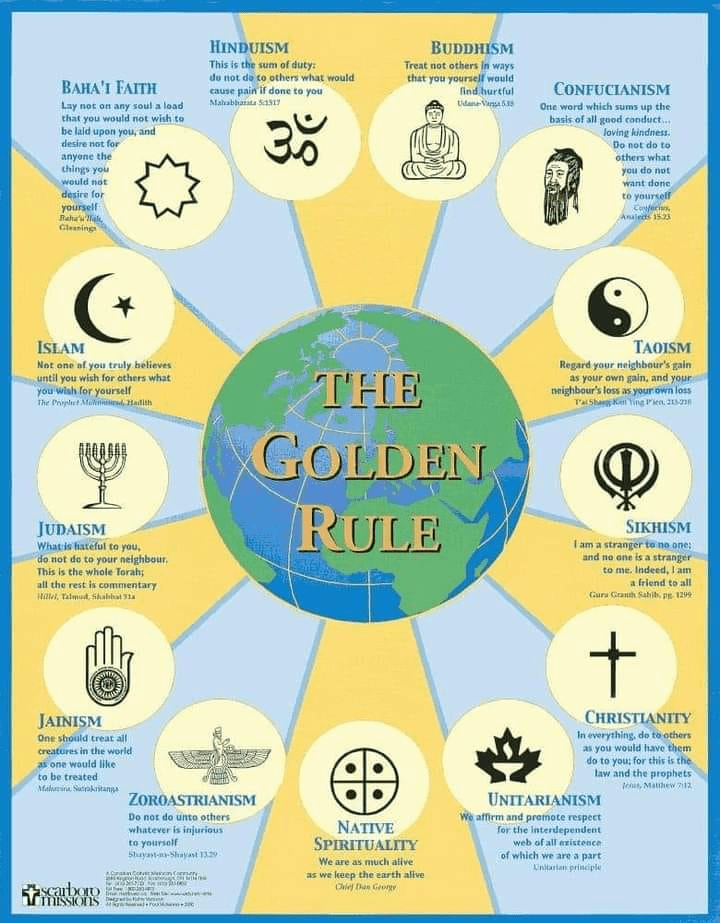


So I learned the “Golden Rule” as “Do unto others as you would have others do unto you.” This in my opinion seems not to “counteract” self-centeredness so much as to acknowledge it as a fact of existence. It’s saying “consider yourself, how you wish to be treated. Now recognize that every other being is also self.” Perspective of self is all we have. Even the most transcendent experience, it’s Self that we perceive. Connectedness with the One Consciousness we are all eternally informing and becoming. That, to me, is the meaning of the “Golden Rule.” Everything we do, we do to Self. ❤️
LikeLiked by 1 person
Thank you for expanding the topic, Camilla. I love your larger perspective and your comment speaks to both relative and absolute truth AND the small and large Self connection.
Richard Rohr speaks to this in his post on Relative Truth and Absolute Truth here (cac.org/daily-meditations/relative-truth-absolute-truth-2015-09-02).
Carl Jung also speaks to Self. For example, “Jung considered that from birth every individual has an original sense of wholeness—of the Self—but that with development a separate ego-consciousness crystallizes out of the original feeling of unity.” See en.wikipedia.org/wiki/Self_in_Jungian_psychology).
_/_
LikeLike