Category Archives: love

Forgiveness and Mercy Recap

The Gottman Method speaks to looking at criticism as requests. One of their Four Horsemen of the Apocalypse, their method helps couples recover from relationship challenges. See this link for more information: https://www.regain.us/advice/general/what-are-the-four-horsemen-of-the-apocalypse-gottman-and-the-signs-of-relationship-strain/

For another variation on the theme for improving relationships, the Center for Action and Contemplation offers a series of meditations on Forgiveness and Mercy. Below is an excerpt from this week’s summary. For the full recap see: cac.org/daily-meditations/forgiveness-and-mercy-weekly-summary/

Praying to Forgive 

Brian McLaren identifies how prayers of petition help us to experience forgiveness:   

Since being wounded or sinned against is a terribly common experience, I suspect we need to pay more attention to it. In fact, being wronged is directly linked in the Lord’s Prayer to the reality of doing wrong; we pray, “forgive us our sins as we forgive those who sin against us.”  

Father Richard Rohr says it well: Pain that isn’t processed is passed on. Pain that isn’t transformed is transmitted. So we need to process our woundedness with God, and that processing begins by naming the pain and holding it … in God’s presence: 

Betrayed. Insulted. Taken advantage of. Lied to. Forgotten. Used. Abused. Belittled. Passed over. Cheated. Mocked. Snubbed. Robbed. Vandalized. Misunderstood. Misinterpreted. Excluded. Disrespected. Ripped off. Confused. Misled.  

It’s important not to rush this process. We need to feel our feelings, to let the pain actually catch up with us…. I’ve found that it takes less energy to feel and process my pain than it does to suppress it or run away from it. So, just as through confession we name our own wrongs and feel regret, through petition we name and feel the pain that results from the wrongs of others…. We translate our pain into requests:  

Comfort. Encouragement. Reassurance. Companionship. Vindication. Appreciation. Boundaries. Acknowledgement.  

It’s important to note that we are not naming what we need the person who wronged us to do for us. If we focus on what we wish the antagonist would do to make us feel better, we unintentionally arm the antagonist with still more power to hurt us. Instead, in this naming, we are turning from the antagonist to God, focusing on what we need God to do for us. We’re opening our soul to receive healing from God’s ever present, ever generous Spirit. 

Reference: 
Brian D. McLaren, Naked Spirituality: A Life with God in 12 Simple Words (San Francisco, CA: HarperOne, 2011), 118–119. 

THREE GOODNESSES – Richard Rohr

“the great thawing of all logic, reason, and worthiness”

Below is today’s reminder of the power of forgiveness from Richard Rohr and the Center for Action and Contemplation.


Three Goodnesses 

Among the most powerful of human experiences is to give or to receive forgiveness. When we forgive, we choose the goodness of others over their faults, we experience God’s goodness flowing through ourselves, and we also experience our own goodness in a way that surprises us.

We are still living in a world of meritocracy, of quid-pro-quo thinking, of performance and behavior that earns an award. Forgiveness is the great thawing of all logic, reason, and worthiness. It is a melting into the mystery of God as unearned love, unmerited grace, the humility and powerlessness of a Divine Lover.  

Without forgiveness, there will be no future.

People formed by such love are indestructible. Forgiveness might just be the very best description of what God’s goodness engenders in humanity. [2]   

Read this meditation on cac.org.
 
[1] Adapted from Richard Rohr, The Wisdom Pattern: Order, Disorder, Reorder (Cincinnati, OH: Franciscan Media, 2001, 2020), 155, 158–159, 162. 

[2] Adapted from Richard Rohr, The Universal Christ: How a Forgotten Reality Can Change Everything We See, Hope for, and Believe (New York: Convergent, 2019, 2021), 72. 

Focus on Love, Not Sin REPOST

We can learn a lot from cat ladies. Take Julian of Norwich, for example.

Today’s repost comes from the Center for Action and Contemplation and offers us five provocative statements. Do any of these resonate for you and how might we respond?

  • Radical optimism
  • Sin is not real, only love is real
  • All is well
  • Waste no energy on regret
  • Get on with our holy task of loving

A Focus on Love, Not Sin 

Wednesday, August 14, 2024

Julian’s revelations offer a loving alternative to the focus on sin which characterized the theology of her time. Mirabai Starr writes:  

Julian of Norwich is known for her radically optimistic theology. Nowhere is this better illumined than in her reflections on sin. When Julian asked God to teach her about this troubling issue, he opened his Divine Being, and all she could see there was love. Every lesser truth dissolved in that boundless ocean…. 

Julian confesses, 

The truth is, I did not see any sin. I believe that sin has no substance, not a particle of being, and cannot be detected at all except by the pain it causes. It is only the pain that has substance, for a while, and it serves to purify us, and make us know ourselves and ask for mercy. [1]  

Starr clarifies where Julian located the impact of sin:  

Julian informs us that the suffering we cause ourselves through our acts of greed and unconsciousness is the only punishment we endure. God, who is All-Love, is “incapable of wrath.” And so it is a complete waste of time, Julian realized, to wallow in guilt. The truly humble thing to do when we have stumbled is to hoist ourselves to our feet as swiftly as we can and rush into the arms of God where we will remember who we really are.  

For Julian, sin has no substance because it is the absence of all that is good and kind, loving and caring—all that is of God. Sin is nothing but separation from our divine source. And separation from the Holy One is nothing but illusion. We are always and forever “oned” in love with our Beloved. Therefore, sin is not real; only love is real. Julian did not require a Divinity degree to arrive at this conclusion. She simply needed to travel to the boundary-land of death where she was enfolded in the loving embrace of the Holy One, who assured her that he had loved her since before he made her and would love her till the end of time. And it is with this great love, he revealed, that he loves all beings. Our only task is to remember this and rejoice.  

In the end, Julian says, it will all be clear.  

Then none of us will be moved in any way to say, Lord, if only things had been different, all would have been well. Instead, we shall all proclaim in one voice, Beloved One, may you be blessed, because it is so: all is well. [2]  

The fact that Julian “saw no wrath in God” does not tempt her to engage in harmful behaviors with impunity. On the contrary, the freedom she finds in God’s unconditional love makes her strive even more to be worthy of his mercy and grace. Yet she does not waste energy on regret. She suggests that we, too … get on with the holy task of loving God with all our hearts and all our minds and all our strength.  

References:  
[1] Julian of Norwich, The Showings: Uncovering the Face of the Feminine in Revelations of Divine Love, trans. Mirabai Starr (Charlottesville, VA: Hampton Roads, 2013, 2022), 68. Selection from chap. 27.  

[2] Showings, 223. Selection from chap. 85. 

Mirabai Starr, introduction to The Showings, xviii–xix. 

cac.org/daily-meditations/a-focus-on-love-not-sin/

Facing the Hurt

Facing the hurt and rediscovering mercy. Today’s post from the Center for Action and Contemplation quotes Anne Lamott and Richard Rohr as they speak to Step 8 of the Twelve Steps:

“Made a list of all persons we had harmed and became willing to make amends to them all.”

Facing the Hurt 

If you are bringing your gift to the altar, and there remember that your brother or sister has anything against you, go first and be reconciled to him or her, and then come back and present your gift. Matthew 5:23–24 

Made a list of all persons we had harmed, and became willing to make amends to them all.   
—Step 8 of the Twelve Steps 

Father Richard names the importance of acknowledging wrong and harm, while trusting in the gift of grace: 

Despite the higher economy of grace and mercy lived and taught by Jesus, he didn’t entirely throw out the lower economy of merit or “satisfaction.” They build on one another, and the lower by itself is inadequate to life’s truly great tasks—love, forgiveness, endurance of unjust suffering, and death itself. When we move to more mature stages of love and transformation, we don’t jump over earlier stages. We must go back and rectify earlier wrongs. Otherwise, there may be no healing or open future for us—or for those we have hurt.  

God fully forgives us, but the impact or “karma” of our mistakes remains, and we must still go back and repair the bonds we’ve broken. Otherwise, others may not be able to forgive us, nor will we likely forgive ourselves. “Amazing grace” is not a way to avoid honest human relationships. Rather, it’s a way to redo them—but now, gracefully—for the liberation of both sides. Nothing just goes away in the spiritual world; all must be reconciled and accounted for. [1]  

Anne Lamott recounts how her son held her accountable after she posted insensitive comments online, and reflects on experiencing mercy

[My son] asked me to apologize publicly. I didn’t want to, because the hundreds of people who attacked me were so vicious…. My son said that this was not the point. The point was that I had done something beneath me that had hurt a lot of people, and that I needed to make things right.  

We talked on the phone about this and he said: “I love you, but you were wrong. You did an awful thing. Please apologize. I’m not going to let this go. And I won’t let you go, either.” He was in tears. I was sick to my stomach.  

Later he sent an e-mail: “You need to do the right thing, Mom. I love you.”   

I wrote to the public that I was deeply, unambiguously sorry, even though I secretly still felt misunderstood…. I did this imperfectly, the best I could, admitting I was wrong. I expressed contrition. It was awful.  

My son was grateful, but distant for a time…. Extending mercy had cost him, and extending mercy to myself cost me even more deeply, and it grew us both, my having screwed up on such a big stage. It taught me that mercy is a cloak that will wrap around you and protect you…. It can help you rest and breathe again for the time being, which is all we ever have. [2]  

References:  
[1] Selected from Richard RohrBreathing under Water: Spirituality and the Twelve Steps, 10th anniv. ed.(Cincinnati, OH: Franciscan Media, 2011,2021), 65. 

[2] Anne LamottHallelujah Anyway: Rediscovering Mercy (New York: Riverhead Books, 2017), 41–42. 

cac.org/daily-meditations/facing-the-hurt/

Writing Love Letters to Monsters

Holding two truths is not just about holding someone else’s truth that you don’t like; it’s about knowing we also have a truth, and we get to hold that, too. It takes discipline and practice to be able to hold both truths without needing an answer—and without losing ourselves along the way.Kai Cheng Thom

Below is an excerpt from Writing Love Letters to Monsters, an archived Tricycle interview with Kai Cheng Thom. For the full article, see tricycle.org/article/kai-cheng-thom-interview

Writing Love Letters to Monsters

What does it mean to love the people—and the parts of ourselves—that we do not believe are worthy of love?

Interview excerpts with Kai Cheng Thom by Sarah Fleming  AUG 09, 2023

When writer Kai Cheng Thom felt like the world was collapsing, she posed a question to herself: What happens when we imagine loving the people—and the parts of ourselves—that we do not believe are worthy of love?

Over the course of her career, Thom has worked as an activist, sex worker, psychotherapist, conflict mediator, and community healer. In each of these roles, she has witnessed both our essential goodness and the violence that we are capable of.

As a way of reckoning with our sacredness and our potential to cause harm, she began writing love letters—to ancestors and exes, to her past and future selves, to those who have harmed her and those she has harmed, and to everyone she believed was beyond saving. “I needed to know that I could love them,” she writes, “because that meant I could still love myself—as hopeless and lost as I had become.”

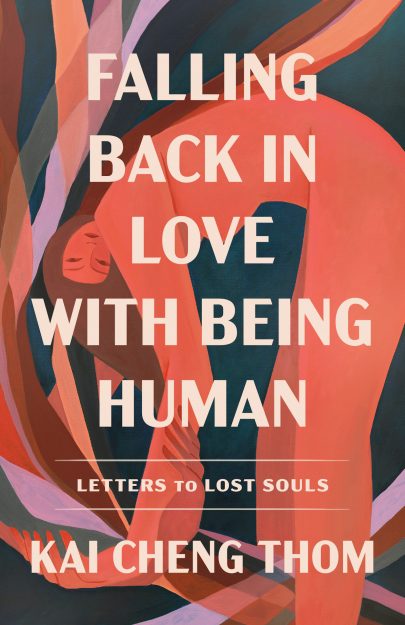
The result, Falling Back in Love with Being Human: Letters to Lost Souls, is Thom’s “act of prayer in a collapsing world”—a spell to summon the language to help her fall back in love with herself and the people around her. Tricycle sat down with Thom to discuss the Buddhist rituals that inform her work, how writing helps her to hold seemingly contradictory truths, and what it means to choose love as a daily practice.

Throughout the book, you explore what it means to love others and the parts of ourselves that we might consider monstrous, and you define a monster as a creature made of the truth that no one else dares to speak. How did you come to this notion of what it means to be a monster, and how have you reclaimed the monstrous? In the Western psychological tradition, Carl Jung wrote about the monsters within us, and he took a lot of inspiration from Buddhism and Hinduism. In thinking about the monstrous, I draw from Jung’s work, as well as different understandings of demons in Buddhist spirituality, especially practices of looking for the demons inside ourselves and learning to sit with them.

On a more personal level, I was raised evangelical Christian, and like many queer and trans people, I grew up being told that I was full of sin and that queer people were sinful monsters. Homophobia and transphobia were really present in my day-to-day. I was trying to repress the sin inside of me, and at the same time, I loved and longed for the sin outside me. I think this happens to us often: we desire the monstrous even as we fear it.

This can be complicated. Queerness is something beautiful that has been labeled as monstrous, but some things classified as monstrous are truly dangerous, like anger and rage. Our monsters need space to live and breathe, and if we’re not careful with them, they can result in harm and abuse.

You’ve mentioned your evangelical upbringing, and many of the letters in the book have a liturgical rhythm to them. How have you reclaimed liturgies and practices from a tradition that harmed you? There’s beauty in every monster and wisdom in every beast. The beast of evangelical Christianity is full of beauty, and its liturgy is something that I love, and Jesus is actually someone that I love. The part of Christianity that has stuck with me, beyond all of the pageantry, is the concept of grace. In Christianity, grace is the idea that we are all full of sin, but we can receive divine love anyway. I just love that. I don’t know if there is a God out there, but I think that human beings can offer one another divine love even in light of all that we’ve done wrong. I want to keep that idea around forever.

Are there any Buddhist rituals or practices that have particularly influenced you? There is a Tibetan Buddhist meditation about sitting and visualizing our demons and just being there and saying hello. That’s a practice that I will always love. But the Buddhist worldview that informs my life the most is the idea that paradox is where enlightenment is born—it’s not about resolving or conquering paradox by choosing one side; rather, it’s in the tension of more than one truth being true that a new wisdom arises. I think it’s so important to allow more than one thing to be true, especially when we’re talking about the nature of good and evil and people who may have harmed us.

Does writing help you to hold multiple truths? Definitely. In writing, I get to put both truths onto the page and then see if there is any new wisdom that arises, and then that wisdom becomes the basis of the poem. Language allows me to be in the chaos of competing truths and to give that chaos form, which is another paradox. Language gives form to the chaos of our internal experience and then somehow makes it more beautiful and bearable.

In the final letter, you write about your practice of choosing love. So what does it look like to choose love on a daily basis? There are many spiritual practices centered on choosing love, like lovingkindness meditation. But I think on the day-to-day level, choosing love is about resisting the spirit of panic and fear. One thing I’ve learned from my work in mediation and dialogue facilitation is that we need to be very careful about our tendency toward othering and monster-making. When we’re in groups, it can be so easy to get caught up in the spirit of panic. At the heart of panic is deep fear, and this fear can lead to toxic and possibly dangerous situations.

It can be so scary to live in the world. Choosing love is about choosing courage: the courage to take a relational risk that is meaningful. Maybe there’s someone in your community that you’re irritated by or that you disagree with. Actually choosing love might mean starting a conversation with them. I often think about the tragedies that occur when we say that our fear and our right to feel comfortable legitimizes or strengthens the call for the restriction on others’ freedom of others. Choosing love is about saying that it’s OK for me to be a little bit scared or uncomfortable so that we can all be free.

What are you hoping readers will take away from the book? I hope that people who read the book might feel inspired to put it into practice. One important lesson from Buddhist practice is that falling back in love doesn’t really work if we are trying to fall back in love with other people first. Generally, it’s more sustainable if we start with ourselves. If we just try to love the oppressor without loving ourselves first, then we run the risk of internalizing our own oppression or gaslighting ourselves. It must begin with self-love, falling back in love with ourselves, and then we can fall back in love with others. Of course, it’s not linear—it’s a cycle we go through over and over again.

A lot of people react to my work with fear, and I get that. But holding two truths is not just about holding someone else’s truth that you don’t like; it’s about knowing we also have a truth, and we get to hold that, too. It takes discipline and practice to be able to hold both truths without needing an answer—and without losing ourselves along the way.

kai cheng thom interview

Sarah Fleming is Tricycle‘s audio editor.
Kai Cheng Thom is a writer, performance artist, and community healer based in Toronto. Her most recent book is Falling Back in Love with Being Human: Love Letters to Lost Souls

We Will Not Cancel Us

Today’s post from the Center for Action and Contemplation includes an excerpt from adrienne maree brown’s book We Will Not Cancel Us: And Other Dreams of Transformative Justice (Chico, CA: AK Press, 2020), 76–77.

There’s great compassion and wisdom in her words below. May we not cancel ourselves and one another. …

Writer and activist adrienne maree brown normalizes making mistakes and working towards accountability instead of “canceling” others:  

“We will tell each other we hurt people, and who. We will tell each other why, and who hurt us and how. We will tell each other what we will do to heal ourselves and heal the wounds in our wake. We will be accountable, rigorous in our accountability, all of us unlearning, all of us crawling towards dignity. We will learn to set and hold boundaries, communicate without manipulation, give and receive consent, ask for help, love our shadows without letting them rule our relationships, and remember we are of earth, of miracle, of a whole, of a massive river—love, life, life, love.  

We all have work to do. Our work is in the light. We have no perfect moral ground to stand on, shaped as we are by this toxic complex time. We may not have time, or emotional capacity, to walk each path together. We are all flailing in the unknown at the moment, terrified, stretched beyond ourselves, ashamed, realizing the future is in our hands. We must all do our work. Be accountable and go heal, simultaneously, continuously. It’s never too late. 

We will not cancel us. If we give up this strategy [of canceling], we will learn together the other strategies that will ultimately help us break these cycles, liberate future generations from the burden of our shared and private pain, leaving nothing unspeakable in our bones, no shame in our dirt.  

Each of us is precious. We, together, must break every cycle that makes us forget this.”

For the full post see: cac.org/daily-meditations/confession-not-cancellation/

Nouwen/Reeves Mash Up

We are a composite of all the influences we accept. Through nature and nurture, we look at life through the filters we’ve inherited and acquired.

The work of two artists converges into a message and an earworm guiding me this morning.

The first is today’s meditation from Henri Nouwen on seeing truth, love and beauty in our everyday lives. The second is a Del Reeves song reminding us to appreciate what we have because we will lose it if we don’t take care of it. Together they remind me how fortunate I am.

Here’s hoping one or both offer something to you.


henrinouwen.org/meditation/

What We’re Looking for is Already Here

We discover that cleaning and cooking, writing letters and doing professional work, visiting people and caring for others, are not a series of random events that prevent us from realizing our deepest self. It is the right time, the real moment, the chance of our lives.


genius.com/Del-reeves-be-glad-lyrics

Be glad you’ve got what you’ve got when you’ve got it
Or you’re gonna find out what you’ve got is gone

Take care what you do when you do if you do it
If you don’t you won’t have your baby long

Everybody envies you, you lucky so and so
You should thank your lucky stars above

You’d better treat her better you’d better start right now
She deserves the best that you can do
She does everything for you the best that she knows how
That’s the least she can expect from you

Emily Bronte’s Faith Poem

“A deity synonymous with Nature … (Emily Bronte’s) poem of faith … finds its affirmation not through anthropomorphic rendering but in a pantheistic (and multiverse?) vision of Deity’s universal immanence.”

RJ’s analysis of Emily Bronte’s poem is both instructive and inspiring. Check it out at the link below.

A Heart-Centered Revolution

Are you lovable? Do you have a perspective worth sharing? Is the world better off for you being here?

Today’s meditation from the Center for Action and Contemplation includes a challenge from Jacqui Lewis to “really see.” See an excerpt below and read the full meditation on cac.org.

jacquilewis.com

A Heart-Centered Revolution Excerpt

Rev. Dr. Jacqui Lewis writes of the solidarity necessary to transform our culture and our world: 

In order to live a moral life, a good life, an ubuntu life, we must commit to a life of love that means seeing all the things ..… 

Friend, you are the only one standing where you stand, seeing what you see, with your vantage point, your story. You are right there for a reason: to have, as my dear friend Ruby Sales says, “hindsight, insight, and foresight.” I want us to learn to see, with our eyes wide open, how best to be healers and transformers. I want us to really see, to fully awaken to the hot-mess times we are in and to the incredible power we have to love ourselves into wellness…. 

I want us open to revelation, not afraid of it, and open to the ways that it will provoke us to believe assiduously in how lovable we each are, and in the love between us and among us because, actually, believing is seeing. [2]  

[2] Jacqui Lewis, “Apocalypse Now: Love, Believing, and Seeing,” Oneing 10, no. 1, Unveiled (Spring 2022): 44–45. Available in print and PDF download. 

Finding Home in Ourselves

“Don’t forget … to call yourself Home.” Kaitlin Curtice

This is a beautiful excerpt from the Center for Action and Contemplation about Kaitlin Curtice’s writing on the sacred legacy of home.

Check out both links identified below. You will be comforted and edified.


http://www.kaitlincurtice.com

Finding Home in Ourselves
 
Author Kaitlin Curtice writes about the sacred legacy of home:  

May we always return to the places where the stories begin, to challenge them, to accept and honor them, and to whisper to ourselves and one another that we are always, always arriving. 

Don’t forget, 
my love, 
to live. 


Don’t forget 
to love yourself, 
all of you, 
from every season 
and every place, 
because you never know 
when they will 
come knocking for 
a cup of coffee 
and an overdue hug. 


call yourself Home