Generosity as Foundation
Leave a reply


tricycle.org/article/kai-cheng-thom-interview/
Tricycle magazine offers an insightful and provocative article on Kai Cheng Thom and her book Falling Back In Love With Being Human (c) 2023.
http://www.amazon.com/Falling-Back-Love-Being-Human
Highlights from the article/interview by Sarah Fleming include:
“I needed to know that I could love them,” she writes, “because that meant I could still love myself—as hopeless and lost as I had become.”
We’re less inclined to love one another because we’re so full of anger and hatred.
I don’t know if there is a God out there, but I think that human beings can offer one another divine love even in light of all that we’ve done wrong. I want to keep that idea around forever.
enlightenment is born—it’s not about resolving or conquering paradox by choosing one side; rather, it’s in the tension of more than one truth being true that a new wisdom arises. I think it’s so important to allow more than one thing to be true, especially when we’re talking about the nature of good and evil and people who may have harmed us
on the day-to-day level, choosing love is about resisting the spirit of panic and fear
Choosing love is about choosing courage: the courage to take a relational risk that is meaningful.
One important lesson from Buddhist practice is that falling back in love doesn’t really work if we are trying to fall back in love with other people first. Generally, it’s more sustainable if we start with ourselves. If we just try to love the oppressor without loving ourselves first, then we run the risk of internalizing our own oppression or gaslighting ourselves. It must begin with self-love, falling back in love with ourselves, and then we can fall back in love with others. Of course, it’s not linear—it’s a cycle we go through over and over again.”
Check out the full interview and the book at the links offered above.
life is a series of flights
we think we choose when to leave, when to arrive and where to go
but the variables are innumerable
plans, if made at all, are often challenged
and sometimes thwarted
dearly departed, dearly encountered,
traveling companions have plans too
and preferences and dreams
god, a good night’s sleep would be so helpful, i think
get me to the airport on time
Today’s free verse soliloquy is the result of dreams, texts, and holiday travel challenges. May we all be safe, healthy, and patient during this holiday season.
trust and forgiveness
marriage is a tough, tough gig
life’s a stormy sea
Four quotes inform today’s senryu:
Kevin Costner once said, “I try to conduct my life with a certain amount of dignity and discretion — but marriage is a hard, hard gig,” Read More: https://www.thelist.com/1331805/signs-kevin-costner-christine-baumgartner-never-going-to-last/
“Marriage has become a lonely life raft in a storm-tossed sea.” Stephen Mintz, PhD. http://www.psychologytoday.com/us/blog/the-prime-life/201606/why-marriages-are-so-difficult-sustain
If trust has been broken in a marriage, there can be severe consequences beyond the end of the marriage. But let’s back up and see if the situation can be helped or modified towards a different conclusion.
First, if something has happened and there is mistrust in a marriage, both partners have to want to mend what is broken. Frank conversations are needed to tackle a lack of trust in a relationship.
Both people must speak openly about what has happened to break the trust in the marriage. It simply does not work unless both are engaged in rectifying what has occurred.
It will take effort and some compromise from both people. Regardless of the cause, forgiveness must be part of the equation if the marriage continues.
If forgiveness cannot be achieved and the lack of trust in a relationship persists, it is better to seriously consider ending the relationship and moving on. …
There are several potential reasons for the lack of trust in your relationship. Mainly, these come from unresolved childhood pain, unmet needs, and unrealistic expectations. The key is to partner up with someone who has similar values so that you can create a unified future.
Resolving a lack of trust will take time, but it is possible if both are willing to change. Sometimes that means getting some external support and guidance through individual or couples’ therapy.
Clearly, at some point, you have to decide what’s right for you and whether the relationship is worth the fight. Either way, the decision is yours, so don’t let distrust ruin your life. Learn from it, make whatever changes you need, and keep looking forward.” Rachael Pace at http://www.marriage.com/advice/relationship/lack-of-trust-in-a-relationship/
My quest to better understand and practice trust continues with today’s senryu.
It’s true, I need help.
Being vulnerable
is so hard for me.
brenebrown.com/videos/anatomy-trust-video/
Brene’ Brown employs the BRAVING acronym to explain how she understands trust. The twenty-three-minute video (found at the URL shown above) is well worth the time. In short, the acronym stands for boundaries, reliability, accountability, vault, integrity, nonjudgment, and generosity. Have a pen and paper handy because you will want to take some notes. That said the two most important things for me were:
In other words, we have to trust ourselves first before we can trust others and be trustworthy to others. Self-love, self-love, self-respect are all critical components of building and maintaining trust.”
Three popular Brene’ Brown quotes:
“We need to trust to be vulnerable, and we need to be vulnerable in order to build trust.”
“Trust is earned in the smallest of moments. It is earned not through heroic deeds, or even highly visible actions, but through paying attention, listening, and gestures of genuine care and connection.”
“Vulnerability is the core of shame and fear and our struggle for worthiness, but it appears that it’s also the birthplace of joy, of creativity, of belonging, of love.”
http://www.thedailyshifts.com/blog/25-popular-brene-brown-quotes-on-empathy-shame-and-trust
I have been encouraged to study and practice the definitions of trust.
One definition is “Consistency over time is trust” credited to Microsoft CEO, Satya Nadella in his book, Hit Refresh: The Quest to Rediscover Microsoft’s Soul and Imagine a Better Future for Everyone. Clearly, doing the same thing over and over again will build a reputation of reliability. Repetitive behavior can be counted on to not surprise others; this definition of trust might be synonymized as being “solid and dependable.”
Another definition of trust offered in an internet search is perhaps a more metaphysical one. “We need people in our lives with whom we can be as open as possible. To have real conversations with people may seem like such a simple, obvious suggestion, but it involves courage and risk.” –Thomas Moore, Care of the Soul: A Guide for Cultivating Depth and Sacredness in Everyday Life
So, today’s senryu is:
to build trust, let’s be
open and reliable
no surprises, please
Some things don’t make sense until they’re over. In the meantime, friends, human and more-than-human, make life tolerable.

Shiba – photo by author
what will be, will be
years have flown so why pretend
it doesn’t matter
Three muses informed today’s senryu.
In the last moments of the film, as the newfound family walks out together, Jiminy Cricket comes to the end of his narration. He says that many stories were told about Pinocchio, with some claiming he becomes a real flesh-and-bone boy. However, Jiminy doesn’t know if that ever happened. But he says it doesn’t matter. What matters is that Pinocchio was brave, truthful and unselfish and that made him as real a boy as any!“ http://www.thereviewgeek.com/pinocchio2022-endingexplained/
It’s a Long Road to Freedom by Miriam Therese Winter
It’s a long road to freedom, a winding steep and high
But when you walk in love with the wind on your wing
And cover the earth with the songs you sing
The miles fly by
I walked one morning by the sea
And all the waves reached out to me
I took their tears, then let them be
I walked one morning at the dawn
When bits of night still lingered on
I sought my star, but it was gone
I walked one morning with a friend
And prayed the day would never end
The years have flown so why pretend
genius.com/Medical-mission-sisters-its-a-long-road-to-freedom-lyrics
irisharoundtheworld.com/irish-proverbs/
Giorraíonn beirt bother. A companion shortens a road.
When a friend helps time pass on a journey.
her blindness and his ignorance
her deafness and his magical thinking
her dementia and his futility
our connection and our rescue
Here are two different topics that totally connect for me.
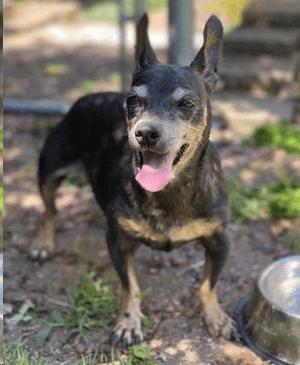
First, Etta Pearl was the first rescue dog I adopted. Found near a dumpster, lost or abandoned, she needed and received help. Unfortunately, she was blind and deaf and very agitated. For some convoluted reason, I thought I was ready to take on this challenge.
I’ve since learned that there’s a term for when a rescue shelter wants to help an animal but knows they are extremely medically challenged AND they don’t want to hurt their statistics for being a “no-kill facility.” The term is outsourced euthanasia.
If a private individual adopts an animal and then proceeds with a vet-recommended end-of-life procedure, then the animal is “liberated” from their suffering AND the rescue shelter does not record the death on their records.
In Etta Pearl’s case, her extreme agitation led to obsessively walking in tight circles and biting anyone who tried to comfort or feed her. The vet said it was a clear case of canine cognitive dysfunction aka “doggie dementia.” My first rescue adoption lasted less than three weeks.
Second, is …
Richard Rohr‘s Daily Meditation
From the Center for Action and Contemplation
Week Forty-Eight: The Prophetic Path: Motivated by Love
It All Begins with Union
For I am convinced that neither death, nor life, nor angels, nor principalities, nor things present, nor things to come, nor powers, nor height, nor depth, nor any other created thing, will be able to separate us from the love of God, which is in Christ Jesus our Lord.
—Romans 8:38–39
This week we focus on people who call us to act out of loving union with God for the sake of others. Father Richard considers union with God as something that has already taken place, whether we experience it or not:
We are already in union with God! There is an absolute, eternal union between God and the soul of everything. At the deepest level, we are “hidden with Christ in God” (Colossians 3:3) and “the whole creation … is being brought into the same glorious freedom as the children of God” (Romans 8:21). The problem is Western religion has not taught us this. For most Christians that I’ve worked with as a priest, God is still separate and “out there.” Most people are still trying to secure God’s approval. Our ego over-emphasizes our individuality and separateness from God and others. We limited God’s redemption to the human species—and not very many individuals within that species! [1]
Daily contemplative prayer helps us rediscover our inherent union and learn how to abide in Presence, trusting that we are already good and safe in God. We don’t have to worry about our little private, separate, insecure self. Jesus taught, I am one with you and you are one with your neighbor and we are all one with God. That’s the gospel! That’s the whole point of Communion or Eucharist; we partake of the bread and wine until they convince us that we are in communion. It seems easier for God to convince bread and wine of their identity than to convince us.
Believe it or not, we’re not here to save our souls. That’s already been done once and for all—in Christ, through Christ, with Christ, and as Christ (see Ephesians 1:3–14). By God’s love, mercy, and grace, we are already the Body of Christ: the one universal body that has existed since the beginning of time. You and I are here for just a few decades, dancing on the stage of life, perhaps taking our autonomous selves far too seriously. That little and clearly imperfect self just cannot believe it could be a child of God. I hope the gospel frees us to live inside of a life that is larger than the one our small selves have imagined. The larger life of the Body of Christ cannot be taken from us. It is the very life of God which cannot be destroyed. [2]
As Thomas Merton wrote in his journal, “We are already one. But we imagine that we are not. And what we have to recover is our original unity. What we have to be is what we are.” [3]
[1] Adapted from Richard Rohr, Emotional Sobriety: Rewiring Our Programs for “Happiness” (Albuquerque, NM: Center for Action and Contemplation, 2011), webcast. Available as MP3 audio download.
[2] Adapted from Richard Rohr, “There Is Only One Suffering; There Is Only One Happiness,” homily, September 13, 2015.
[3] Thomas Merton, The Asian Journal of Thomas Merton, ed. Naomi Burton, Patrick Hart, James Laughlin (New York: New Directions, 1973), 308. Rohr’s emphasis.
Today, I am especially mindful of the lost loved animal companions that have passed since this time last year. For me, that includes two cats and two dogs: Leezy, Lexie, Tilly and Zorro.
I’m also remembering the cats and dogs that have been honored by sister and brother grief companions in the St. Louis region. They are Duke, Ellie, Journi Ray, Kitty, Lovey-Dovey, Maggie, Moses, Sangria, Stella, Stewie, Sunny Marie, Tully, and Whitey.
Below is a repost of a beautiful reminder of the many reasons we love our animal companions. Thank you, Katya Lidsky-Friedman, for all you do to recognize both human and more-than-human animals today.
Pets are always finding new ways to make us laugh. Whether they be old pets, new pets, or foster dogs and cats — we find ourselves in stitches over their hilarious antics. All pets have their own personalities, their own jokes, and their own way of being funny. Thank you to our four-legged friends for keeping us cracking up.
Pets don’t live in the past or in the future. They’re living in the present like a furry little Buddha. They remind us to be mindful, to take deep breaths, to let go of past or future moments, and to be in the now. We thank pets for reminding us that the present is a gift.
Who doesn’t love a good snuggle buddy to enjoy a good movie with? Pets make fantastic friends because they are simply masters of loyalty and companionship. It’s hard to be lonely when you have a devoted pal to spend your time with. We appreciate our furry friends for their incredible friendship.
Helping homeless pets feels good. It feels right. It feels worthy and meaningful because it is, in fact, worthy and meaningful. Because regardless of how you do it or how much time you have to share, giving back to animals is a wonderful way to volunteer and be of service. We’re thankful to help animals and, in turn, be given a mission we can believe in.
They’re non-judgemental. We can make mistakes in front of them and they don’t mind. They’re always there to lick away a tear or cuddle next to us when we need support. Pets allow us to learn as we go, to fail, and to be imperfect – and they love us anyway. We are indebted to animals for accepting us just as we are.
Pets keep us active because they need regular walks, playtime, and socialization to keep both mentally and physically stimulated. Dogs make terrific running, walking, or hiking buddies. Cats love to play. By providing bunnies with a safe and enclosed area to frolic outside, rabbits can encourage us to soak up some sunshine. Horses pull us towards nature. High fives or high paws to all our pets for keeping us full of life and energy.
Some pets are easier than others. Some are a more natural fit for your lifestyle. But we believe all animals deserve a chance at a happy life. Time and time again, we see that even pets who challenge us offer tremendous value and always reward us with as much as we put in. Whether it’s a more difficult pet with behavioral or health issues, a dog who takes extra time to smell the grass on a walk, or a kitty who just can’t get where the litterbox is, all animals require consistency, patience, and love from us in order to succeed. We get to become a team with our pets as we work with them.
Let’s be real — we all love how excited our pets get each and every time we come home. Even when you just step out of the shower, the display of adoration and dedication is good for the ego. Animals aren’t afraid or embarrassed to shower us with love and to show us how much we mean to them. We are so grateful to our dogs for making us feel as awesome and interesting as rock stars.
Our pets improve us in so many ways. Studies show that petting an animal can reduce a person’s heart rate as well as their blood pressure, and animals keep us physically healthier overall because they keep us moving. And the endless joy they bring increases our mental health. By focusing on positive reinforcement with our pets, we learn to pay attention to what we love about others, and it keeps us focusing on the good. Thanks to our pets for all the physical, mental, emotional, and spiritual benefits they grant us.
Look at the list above. We thank our own pets and all pets for keeping us thankful. With their help, every day can be Thanksgiving.
Katya Lidsky is a published writer, host of “The Animal That Changed You” podcast, and a life coach for Dog People.
As I prepare for Thanksgiving Day in America, it’s helpful to remind myself that everything in life matters. I hope you enjoy the holidays ahead. I hope you enjoy the poem below.

photo by author
SEAGULL ON A DOCK by Patrick J Cole
You may see the bird,
or the many posts beyond it.
You may even see the harbor shoreline not that far ahead
or the ripples on the water below
or heavily clouded sky above.
But, if you don’t know me by now,
I see the birdshit splotches.
White artwork on the dock
that tells me this is real.
No lotus without the mud.
No seagull without the birdshit.
No love without grief.
No joy without suffering.
 Life Matters