Category Archives: Writing Tips

Memoir Analysis #5: Harrison Scott Key

http://www.amazon.com/How-Stay-Married-Insane-Story/

Harrison Scott Key, winner of the Thurber Prize for American Humor, tells the shocking, “shot through with sharp humor” (The Washington Post), spiritually profound story of his journey through hell and back when infidelity threatens his marriage.Amazon.com summary.

Harrison Scott Key delivers another comic-tragedy and this is the most revealing of all. Another heart-wrenching memoir that addresses all the pain of betrayal and the struggle to survive.

Here are a few quick observations:

  • “Do I really care about three hundred pages on some stranger’s marriage? It turns out I did … There is an energy to HOW TO STAY MARRIED that I haven’t previously experienced in a memoir … Shot through with sharp humor” Jane Smiley, The Washington Post
  • Approximately 90k words spread over 38 chapters … just when you think it’s over, the pain and love and pain and forgiveness start all over again
  • “I read Harrison Scott Key’s hilarious, raw, bracing, profound memoir and have been recommending it to everyone I know. Read it! I’ve never read anything else quite like it.” Eleanor Barkhorn, The Atlantic

Key’s memoir of infidelity and forgiveness are presented in a realistic, painful yet hopeful way … and I speak with some experience on this topic. Yes, there’s some “god talk” included but not as much as you might think. Or, in other words, you’re likely to enjoy this book regardless of your faith or no faith perspective.

This book is definitely worth reading at least once. I’ve read it three times so far and find more humor and wisdom with each read.

One more memoir analysis to come within the next week. Please let me know if you have any questions on this or previous analyses offered.

To healing,

Patrick Cole

Memoir Analysis #4: Sloane Crosley

http://www.amazon.com/Grief-People-Sloane-Crosley

A best book of 2024 “, GRIEF IS FOR PEOPLE by Sloane Crosley is the fourth book and author selected for memoir analysis. It’s a heart-wrenching memoir that addresses the theft of family jewelry AND even more devastating, loss of a best friend to suicide.

Here are a few quick observations:

  • Is it wrong to say that a memoir about loss and grieving is fun to read? If so, I’m in trouble, because I enjoyed every word of this book. I also ached and suffered along with Sloane Crosley: Her portrait of mourning after the suicide of her best friend is gutting and deeply engaging.” Susan Orlean, author of The Orchard Thief,
  • It has approximately 57k words spread over 8 chapters.
  •  “Like Joan Didion’s The Year of Magical Thinking or Daniel Defoe’s A Journal of the Plague Year, Grief Is for People takes us through the ordinary, awful, and never-quite-ending experience of loss. It also made me laugh very hard, many times. I can’t stop thinking about it.” — John Mulaney

Unlike the three books previously reviewed, Crosley’s book offers a poignant, gallows humor, tale of two emotional losses in 2019 which were further exacerbated by the pandemic that hit the world and her NYC lifestyle.

While all our worlds were severely disrupted by Covid 19, Crosley’s, foggy upside-down, world began some six months earlier and still defines her life five years later. Perhaps time does heal but not nearly as fast as we would hope. This book is definitely worth reading now and in the future.

More successful memoirs will be reviewed in the weeks to come.

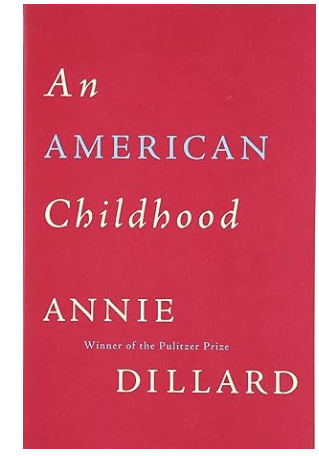
Memoir Analysis #3: An American Childhood by Annie Dillard

http://www.amazon.com/American-Childhood-Annie-Dillard

The third author and book selected for memoir analysis is the 1987 classic, An American Childhood by Annie Dillard. A literary gem, her memoir is very different from the first two I presented earlier this month. Here are a few quick observations:

  • A book that instantly captured the hearts of readers across the country, An American Childhood is Pulitzer Prize-winning author Annie Dillard’s poignant, vivid memoir of growing up in Pittsburgh in the 1950s and 60s.” Amazon summary,
  • It has approximately 70k words spread over 41 untitled chapters.
    • Note: at first, I was annoyed by the untitled chapters and then I realized that while each chapter was different, it also naturally flows from the previous one.
  •  And finally, “[An American Childhood] combines the child’s sense of wonder with the adult’s intelligence and is written in some of the finest prose that exists in contemporary America. It is a special sort of memoir that is entirely successful…This new book is [Annie Dillard’s] best, a joyous ode to her own happy childhood.” — Chicago Tribune

Unlike the first two books analyzed, Dillard’s book offers more nostalgia for bygone American culture and less humor than Bryson or Sedaris. That said, it is a wonderful read about a girl who loves to read and attempts to relive those written words in her own life.

Five more successful memoirs will be reviewed in the weeks to come. Please let me know what some of your favorite memoirs are.

Patrick Cole

Memoir Analysis #2: Bill Bryson

http://www.amazon.com/Life-Times-Thunderbolt-Kid-Memoir

One way to determine if a memoir is ready for publication is to compare it to others that have already been proven successful. Continuing to aim very high, the second author and book selected for analysis is the 2006 book The Life and Times of the Thunderbolt Kid by Bill Bryson. Here are a few quick observations:

  • this New York Times Bestseller is a “mix of exquisite detail and inspired exaggeration (which) all add up to the Truth with a capital T that rhymes with G that stands for out-loud guffaws” as reported by Scott Simon for NPR’s Weekend Edition Saturday,
  • it has approximately 81k words spread over 15 chapters, and
  • “The Life and Times of the Thunderbolt Kid is steeped in … the sweet, simple pleasures of an all-American boyhood. Even the world-weariest of souls will be charmed.” Parade

While Bryson and Sedaris may be contemporaries in time and country, their memoirs are worlds apart and inspired by worlds that no longer exist.

Six more successful memoirs will be reviewed in the weeks to come. Please let me know what your thoughts are on memoirs in general and what makes them worth reading for you.

Slow but sure, Patrick Cole

Memoir Analysis #1 – David Sedaris

http://www.amazon.com/David-Sedaris-Book-Set-Corduroy

My goal is to publish a memoir by this time next year: December 29, 2025. I wrote and edited a first draft this year so I’m publicly acknowledging that I need at least a year to complete this publishing goal. More drafts, more editing, more polishing are necessary before it will ever see a bookshelf.

One way to determine if my memoir is ready for publication is to compare it to others that have already been proven successful. Clearly, I’m aiming very high by selecting David Sedaris as one standard for comparison. Based on a recommendation, I chose his 2004 book Dress Your Family in Corduroy and Denim for review. Here are a few observations for starters:

  • this #1 National Bestseller is “hilarious, elegant and …. Sedaris is a complete master of the form” as Chris Lehmann reported for Washington Post Book World,
  • it has approximately 77k words spread over 22 chapters, and
  • “Sedaris’s perennial themes are not simply played for self-deprecating laughs in this volume, but are made to yield a more Chekhovian brand of comedy” as reported by Michiko Kakutani for the New York Times.

I know, it’s audacious of me to compare my memoir to one of Sedaris’s many successes. But why not aim high?

I will be reviewing seven other successful memoirs in the weeks to come. In the meantime, please let me know what recommendations you have for writing a successful memoir.

Slow but sure, Patrick Cole

Confessions of a Zen Novelist

Successful novelists must develop their “voice” and their “backbone.” Ruth Ozeki, in an archived Lion’s Roar article, tells us her story about learning to tell “her truth.”

See an excerpt from her article below. For the full article, see http://www.lionsroar.com/confessions-of-a-zen-novelist/

………………………………………………….

When bestselling author Ruth Ozeki becomes a Zen priest, she finds out Zen and novel writing do not easily go hand in hand.

Ruth Ozeki

“In 2003 … I found myself unable to write.

No, that’s not quite right. Let me clarify. I was writing, or trying to write. …

(Poet and Zen writer, Norman Fischer said), “You were such a nice writer, I was afraid Zen would wreck it for you. I’ve watched you getting so serious about your prac­tice, and I wanted to warn you. Practice will ruin everything! It will change you so you won’t be able to write in the same way anymore. Maybe you shouldn’t practice Zen so much.” He was smiling when he said this, so I knew he was joking—sort of. He shrugged and continued, “But I knew it was hopeless; it was already too late. You were in too deep already, and besides, I knew you wouldn’t listen.”

It wasn’t a matter of wanting to be a writer. I simply was one. I was a writer because I wrote.

There is something inhuman—or perhaps relentlessly human—in what writers do, in their naked attempt at truth telling. I’ve long been aware that I write from remorse, usually over something I’ve done or not done. My regret acts as an irritant, like a lump in a mattress that trig­gers a dream, and I then write in an attempt to understand my behavior, to test alternative pos­sibilities and outcomes, and to discover some­thing true. But every book I write misrepresents something else, generating more remorse, which I then must try to address in the only way I know, by writing another book. In trying to get at one truth, I distort others. It’s a process fraught with contrition, and I used to think this was good news, in that I would never run out of things to write about. But the bad news was that as my work got published, my sense of remorse intensi­fied, and I stopped being able to write.

Publication is a kind of exposure. … How could I write with honesty and candor about the core questions of my life without implicating my family and friends? How could I write humor­ously without hurting others? How could I write dramatically without distorting the truth? How could I write fiction without lying or stealing other people’s stories? How could I take on the responsibility and consequences of representing the world with what I knew was my flawed and limited vision?

I knew that were I to continue writing, I would need a backbone, too.

Thomas King, a Canadian aboriginal writer, wrote, “The truth about stories is that that’s all we are.” My old story is that I am a novelist. My new story is that I am a priest. Ordination didn’t eliminate one story; it just added another plotline, and the two often feel irreconcilable.

Have you heard the one about the two monks crossing the river? An old monk and a young monk happen across a beautiful woman on the bank of a fast-flowing river. She needs to get across, and the older monk offers to carry her. The woman clambers onto his back, and he wades into the water. The young monk fol­lows silently, quivering with umbrage. When they reach the other side, the old monk lets the lady off, she thanks him, and the two monks go on their way. But of course, the young guy can’t let it go. He keeps thinking of the woman’s legs wrapped around his master’s waist, and the old man’s grizzled fingers clutching the white flesh of her thighs. Finally, he can’t contain himself anymore. “How could you do that?” he cries. “Touching that woman! Breaking your vows!” The old man looks at his student and shrugs. “I left her back on the riverbank. Are you still car­rying her around?”

I’ve always liked that young monk. He’s a novelist like me.

We are all the stories we tell ourselves. As the heroes of our own I-novels, we never stop conceiving and reconceiving ourselves and those around us.

Birds live in air, fish live in water, and human beings live in language. That’s what Norman (Fischer) says, and I agree. We can no more remove our­selves from language than we can stop breathing. Dogen Zenji, the founder of Soto Zen, was an incorrigible writer. He agreed that language was a prison of delusion, but he had a more expan­sive view of the matter, maintaining that we can escape the thrall of language only through lan­guage itself. His all-inclusive approach has become my backbone, one that keeps me upright and enables me to write, or not write, as the case may be, and, either way, to hold my stories just a little bit more lightly.

Ruth Ozeki

Ruth Ozeki is a Soto Zen priest and an award-winning writer. Her novels include All Over CreationMy Year of Meats, and A Tale for the Time Being. She lives in New York and British Columbia.

Ugly Middles & Perseverance

Writing, like life, is not a cake walk and sometimes it’s just plain ugly.

I’m enjoying the 100 Day Book Writing Program offered by The Write Practice. Below is one of the helpful reminders from the program creator, Joe Bunting.

See thewritepractice.com for more information.


Middles are always the hardest. In A Million Miles in a Thousand Years, Donald Miller said every story is like paddling a rowboat to an island. When you first start, you feel like you’re making a lot of progress. The shore recedes quickly and the island feels so close you could touch it.

But once you get out into open water, it’s easy to think you’re not even moving. The shore you left seems far away and the island you’re going to isn’t getting closer. You’re not making any progress, and you wonder if you should just quit.

This is where most people, including myself, get stuck in their writing.

We have no problem starting stories. We don’t even have a hard time finishing them. But the middle is a story graveyard, littered with corpses of books, blog posts, and articles.

If you keep going though, almost miraculously, the opposite shore appears. You’re almost there. You can tell you’re just a few paddle strokes from land.

Don’t give up in the Ugly Middle. The breakthrough will always come just after the hardest part.

Even when it’s messy, keep writing. Even when you’re stuck, keep writing. Even when you feel like you’ve made no progress and the end is as far away as ever, keep writing.

And when you can see the shore, when you realize you finally, at last, know what your book is about, remember the feeling. You’ll need that memory for the next time you find yourself in the Ugly Middle.” Joe Bunting

Apr 21 – Good One, Mark Twain

https://www.onthisday.com/people/mark-twain

Samuel Clemens (aka Mark Twain) born November 30, 1835, in Missouri and died April 21, 1910, in CT, at the age of 74 from a heart attack. An American author most known for his classic, The Adventures of Huckleberry Finn, published in 1885.

Known for his humorous and insightful quips, here are a few of my favorites:

“Age is an issue of mind over matter. If you don’t mind, it doesn’t matter.”

“When your friends begin to flatter you on how young you look, it’s a sure sign you’re getting old.”

“Writing is easy. All you have to do is cross out the wrong words.”

http://www.azquotes.com/author/Mark_Twain

Today’s senryu: Good One, Mark Twain

enjoy life today

tomorrow too, if it comes

humor helps a lot

The Power of Storytelling

Love this author and her latest post from her blog SaaniaSparkle. Find this and more wisdom at her site https://saania2806.wordpress.com

The Power of Storytelling

There is an ancient parable very close to my heart, which goes as follows: a Jewish man was going down from Jerusalem to Jericho when he was attacked by robbers, leaving him half dead. A priest and a Levite saw him yet passed by. But a Samaritan came to where the man was and bandaged his wounds. Then, put the man on his own donkey, brought him to an inn, and cared for him until he healed. Today, this beautiful story is the etymology of the phrase “good Samaritan”, a person who is a “neighbor” not just to people of their own group (at the time, there was intense hostility between Samaritans and Jews). We understand it, remember it, and retell it later because the idea of love, compassion, and a man crossing a tremendous social gulf to help a wounded man sticks with us. The story may even change our behavior in some way as we remember to help others in times of distress. Legendary stories like these encapsulate: stories hold a miraculous power.

Made to Stick is a book I read written by two brothers, Chip Heath, a professor of organizational behavior at Stanford University and Dan Heath, a senior member for Social Entrepreneurship at Duke University. The brothers explain, “stories are told and retold because they contain wisdom. A story’s power is that it provides simulation (knowledge about how to act) and inspiration (motivation to act).” Being a health and fitness freak, the key example highlighted in the book sticks with me: the Jared Campaign for Subway. In the late 1990’s, Subway launched a campaign to tout the healthiness of a new line of sandwiches. This campaign was based on the statistics: seven subs under six grams of fat. Sounds pretty good yeah? But this 7 under 6 idea didn’t stick quite like Subway’s next campaign which focused on the remarkable story of Jared. Jared, a college student, was seriously overweight, ballooning up to 425 pounds. But by spring, Jared decided to slim down. He had his first Turkey sub. He eventually developed his own all-Subway diet: a foot long veggie sub for lunch and a six-inch turkey sub for dinner. After 3 months of this diet, he dropped almost 100 pounds. Coad and Barry, president of the advertising agency Hal Riney, found out about this and thought, “we’ve got a great story on our hands”. They decided to run an advertisement for regional Subway franchisees. The idea blew the internet. Unlike the 7 under 6 idea which only held logos, the tale of Jared holds a simulation value as well as pathos, the emotional resonance which provides inspiration. Perhaps we are not all looking to lose weight. But ‘fighting big odds and prevailing through perseverance’, now that sounds inspirational to any ear. And inspiration drives action.

That being said, not all stories stick. Chip and Dan hence came up with 3 types of plots if our goal is to energize and inspire others through our stories. First, the challenge plot. We all recognize this one, where a protagonist overcomes a formidable challenge yet succeeds in the end, attracting triumph and glory. As someone who is obsessed with Disney princesses, my personal favorite story, much similar to the Jared story, is the one about Princess Mulan. Mulan is a loving and determined daughter. Desperate to prevent her ailing father from being drafted by the army, she disguises herself as a man and enlists in his place. In the army, she must try to hide her true identity while battling the enemies. With determination and bravery, Mulan ends up saving both her father and her country. Seems like the quintessential challenge plot, right?

Second, the connection plot. The story of the good Samaritan fits well into this one. We live in a world where we are constantly surrounded by people. Connection plots are all about the relationships we form with these people. In the business world, connection plots create an emotional connection between a company, its products and its customers. Always is a company that produces period products for women. As a girl, watching the advert from Always titled ‘Like a girl’ made me feel proud being one. It showed a group of teens acting out certain actions such as “Can you throw like a girl?” or “Can you fight like a girl?”. Girls were illustrated as soft, wimpy, and sloppy. The ad then contrasted this by asking the same questions to little girls. These girls this time ran, threw, and fought normally. “When did doing something “like a girl” become an insult?” was the food for thought. All over the nation, this advert empowered women. Our power was unleashed!

Third, the creativity plot. As a frequent flyer, I have often observed how on-flight safety instructions are given little attention by most passengers. One of my favorite examples showcasing the creativity plot is hence the one about a flight attendant, Karen Wood. Karen wanted to make people care about the safety instructions on flight. “And as the song goes, there may be fifty ways to leave your lover, but there are only six ways to leave this aircraft:…”, she spoke. It didn’t take long for passengers to tune into her comic spiel. We can’t demand attention, we must attract it. Creativity plots help us achieve this as we do something different, harness creativity, and experiment with new approaches (within certain regulations, of course).

The power of storytelling fascinates me. Thousands of years ago, myths and legends were told through oral cultures. These then developed profound ways of communicating so that cultures were able to transmit themselves through generations. Think also about the way we get lost in fictitious worlds from the books we’re reading or the way we identify with different protagonists from the movies we’re watching. I often marvel over how the horror movies I watch haunt me in my sleep, or how tales of adventure like Princess Moana’s venture into the sea drive me to go set out on my own, how romance novels set expectations in love I’d possibly carry with me throughout my life, and even how comedic pieces make me fondly quote cheesy lines in my day to day life. In the marketing world, too, it is through storytelling that the audience is able to connect, engage, empathize, and most importantly, remember messages. As Steve Jobs exceptionally summarizes, “the most powerful person in the world is the storyteller. The storyteller sets the vision, values and agenda of an entire generation that is to come.”

– SaaniaSparkle 🧚‍♀️

CYE Countdown – Dec 19 – Avoid Predictability

Thirteen days remaining in 2022. Will this year end with a feeling of success or with a sigh of disappointment? Or can you choose to take the middle way and delight in whatever happens; not waste time fretting over “outcomes?”

Today’s senryu: Avoid Predictability

How will your year end?

Plot twist, Deus ex machina

or lame out again?

Remember the encouraging words of Henry Wadsworth Longfellow: “It is too late! Ah, nothing is too late …”

https://www.goodreads.com/quotes/7599367-it-is-too-late-ah-nothing-is-too-late-till

One more thought; perhaps 2022 is one more chapter in your life story. What makes a good story? Check out this post by Jordan at https://www.nownovel.com/blog/what-makes-a-good-story/