Category Archives: Dharma Bum

Never Enough? Abandon Craving One Day at a Time

mindfulness is a means for overcoming craving.

Below are highlights of a recent Tricycle article on Cutting the Roots of Craving. I have three of Gunaratana’s books now and the provocative excerpt below comes from his latest book co-written by Veronique Ziegler.

May the words below offer some helpful advice to overcome our addiction for “more.”


Cutting the Roots of Craving

Desire is beginningless. Yet through right mindfulness we can learn to abandon it. By Bhante Henepola Gunaratana and Veronique Ziegler Jul 18, 2024

Everything we do pivots around craving and Its insatiability is such that it yields more craving

whenever we ask ourselves the question “Am I satisfied?” we always get the same answer: “Not yet.”

There is no point in time before which a state of desirelessness can be found.

in dependence upon feeling, there is craving.

Everything happens in your mind. When you talk, write, perform any deed whatsoever, watch your mind at all times in order to guard it against defilements and prevent craving from invading it.

Look at your own mind to see the invisible greed, anger, jealousy, and all the other defilements that are the real cause of your suffering.

If you end greed now, you attain liberation now. If you end greed one minute later, you attain liberation one minute later. If you end greed tomorrow, you attain liberation tomorrow.

Craving can be found in our very own mind. Understanding it is a personal exploration that must be undertaken individually, for the solution to abandon it is also in our own minds.

How to Abandon Craving

there is a great danger in sensual pleasures—not that they cause immediate harm or risk to one’s life (although some sensory pleasures can definitely be lethal) but that sense enjoyments are impermanent. And because they are impermanent they can never be satisfactory.

to live a happy and healthy life. We must use our senses, but we must do so with wisdom,

Mindfulness is a means for overcoming craving.

© 2024 by Bhante Gunaratana and Veronique Ziegler, Dependent Origination in Plain English. Reprinted by arrangement with Wisdom Publications.

Bhante Henepola Gunaratana is a Buddhist monk from Sri Lanka and the author of Mindfulness in Plain English. He is president of the Bhavana Society in High View, West Virginia, an organization that promotes meditation and monastic life.
Veronique Ziegler earned her doctorate degree in experimental high-energy physics from the University of Iowa working on the BaBar experiment at SLAC National Laboratory in Menlo Park, California. She then took a research assistant position at the same lab and later a staff scientist position at Jefferson National Laboratory in Newport News, Virginia, where she currently works full time and is involved in the lab particle spectroscopy experimental program. In 2018, she started attending Bhante Gunaratana’s dhamma classes. She has been an avid dhamma student ever since.

Ox-herding 7

“In the long run, both a peaceful mind and harmonious behavior are essential. Cultivating the mind will eventually lead to cultivating ethical behavior, and cultivating ethical behavior will support cultivating the mind. This is likely to be an iterative process rather than first one thing then the other.”

Lynn J Kelly does it again!

Check out the link below for another informative and provocative post.

Nouwen/Reeves Mash Up

We are a composite of all the influences we accept. Through nature and nurture, we look at life through the filters we’ve inherited and acquired.

The work of two artists converges into a message and an earworm guiding me this morning.

The first is today’s meditation from Henri Nouwen on seeing truth, love and beauty in our everyday lives. The second is a Del Reeves song reminding us to appreciate what we have because we will lose it if we don’t take care of it. Together they remind me how fortunate I am.

Here’s hoping one or both offer something to you.


henrinouwen.org/meditation/

What We’re Looking for is Already Here

We discover that cleaning and cooking, writing letters and doing professional work, visiting people and caring for others, are not a series of random events that prevent us from realizing our deepest self. It is the right time, the real moment, the chance of our lives.


genius.com/Del-reeves-be-glad-lyrics

Be glad you’ve got what you’ve got when you’ve got it
Or you’re gonna find out what you’ve got is gone

Take care what you do when you do if you do it
If you don’t you won’t have your baby long

Everybody envies you, you lucky so and so
You should thank your lucky stars above

You’d better treat her better you’d better start right now
She deserves the best that you can do
She does everything for you the best that she knows how
That’s the least she can expect from you

Necessary Doubt

“An open mind is a strong mind … our doubting and questioning spur us on and keep us intellectually alert and can help us develop confidence in our innate qualities.”

Senior teacher, Jetsunma Tenzin Palmo encourages us to live our lives with a question mark and to not settle for blind faith. Instead, we can experience our faith firsthand and not be content with what other people think or describe.

I hope you enjoy excerpts from the provocative Tricycle article below,

Necessary Doubt

Ani Tenzin Palmo teaches that a questioning mind is essential to the Buddhist path.

By Jetsunma Tenzin Palmo SUMMER 2002

we have a tendency to regard doubt as something shameful, almost as an enemy. We feel that if we have doubts, it means that we are denying the teachings and that we should really have unquestioning faith.

Referring to the dharma, the Buddha said, “come and see,” or “come and investigate,” not “come and believe.”

A famous sutra tells of a group of villagers who came to visit the Buddha. They said to him, “Many teachers come through here. Each has his own doctrine. Each claims that his particular philosophy and practice is the truth, but they all contradict each other. Now we’re totally confused. What do we do?” Doesn’t this story sound modern? Yet this was twenty-five hundred years ago. Same problems.

The Buddha replied, “You have a right to be confused. This is a confusing situation. Do not take anything on trust merely because it has passed down through tradition, or because your teachers say it, or because your elders have taught you, or because it’s written in some famous scripture. When you have seen it and experienced it for yourself to be right and true, then you can accept it.”

We need to be patient. We should not expect to understand the profound expositions of an enlightened mind in our first encounter with them.

Our doubting and questioning spur us on and keep us intellectually alert.

instead of suppressing the questions, I brought up the things I questioned and examined them one by one. When I came out the other end, I realized that it simply didn’t matter. We can be quite happy with a question mark.

We need to know what great teachers in the past have said, because they have been there ahead of us and have laid down maps for us to follow.

Following the path is about experiencing it for ourselves. It’s not taking on what other people have described. It’s not based on blind faith.

Jetsunma Tenzin Palmo is the current president of the Sakyadhita International Association of Buddhist Women. She is one of the first Westerners to be ordained as a Buddhist nun and the founder of the Dongyu Gatsal Ling Nunnery in India.

Your Life Is a Mirror

What if every word you said, every gesture you made, revealed your true intentions? The Tricycle article reposted below says the answer to that question is an important step in our own personal development.

This somewhat lengthy article is well worth your time if you’re one of those people prone to self-deception. I know that’s something I need to work on. How about you?

————————————————–

Your Life Is a Mirror

Venerated lama and spiritual teacher Khangser Rinpoche expounds on how to break free of the mind’s habitual tendency towards self-deception.

By Khangser Rinpoche  JUN 21, 2024

Your life is a mirror reflecting the state of your inner world.

To see clearly you must first polish your mirror to clear it of what distorts the truth: your obscuring self-deception.

no longer looking at the reflection in the bathroom mirror, he was looking at himself in a different way: inner reflection.

Self-improvement starts with breaking self-deception and learning to face the truth. You must honestly witness, then evaluate, how your mental, emotional, and behavioral actions obscure the truth.

It’s much easier for you to point out areas where other people can improve rather than seeing your own flaws. This is how it usually is. You have difficulty looking at your imperfections, so you tell yourself lies,

Start by Being Honest

When you encounter a situation where there is no way for you to tell the truth, it is better to just stay silent.

Even if you can’t eliminate lies completely, at least try to reduce their frequency.

Break Subconscious Habits

Your past shapes your perception of the present.

You are not who you think you are—you’ve formed a lot of subconscious habits over the years that are probably unknown to you. That’s why you need the input of those you trust, and you need to pay close attention to your thoughts, feelings, and behavior. If you can’t see your flaws, there is no self-improvement. 

Keep an Open Mind

Your ego has a way of obscuring areas you struggle with, so you must make certain to consider other people’s feedback about you. It’s not easy to see your own issues, you need a good, honest person to tell you about them.

You are not who you think you are

When you receive unpleasant feedback, try to resist the impulse to defend yourself with lies or get angry. Don’t dirty up your mirror with denial. Self-improvement is one of the most important aspects of your life, but to do it properly you need a clear mirror—you need honest feedback. 

Study Cause and Effect

We drum up supernatural ways of eliminating our issues instead of taking personal accountability for them.

Blame sullies your mirror of self-reflection. Instead, focus on accepting the reality of the problem and do what you can realistically do now.

Every kind of suffering can be remedied. To do that you must first clearly understand that there is no such thing as causeless suffering. When you know that wholesome activities have beneficial effects and unwholesome actions have unbeneficial results, you can then choose the best course of action for yourself. This means you have a measure of control over your destiny. 

Examine Your Motives

getting to the truth is tricky

Honesty is a matter of motive

Which is more honest: truth in words or truth in motive? When you want to give up self-deception in favor of self-knowledge, consider the reason why you’re doing what you’re doing.

Remember that life is like a mirror: everything you perceive reflects your inner world. Cleaning your dirty mirror of distorting smudges means clearing self-deception and coming closer to the truth.

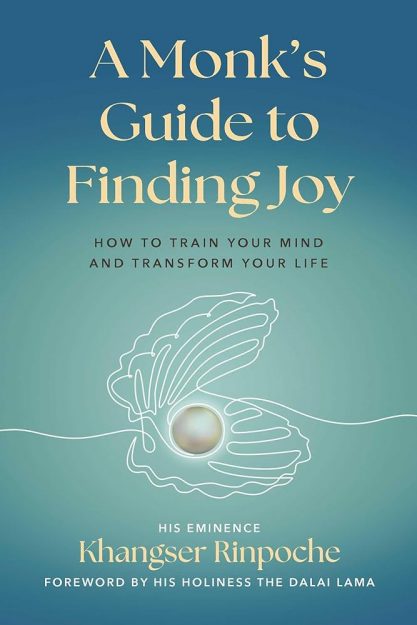
This article was excerpted and adapted from A Monk’s Guide to Finding Joy: How to Train Your Mind and Transform Your Life by Khangser Rinpoche, © Wisdom Publications July 2, 2024. Reprinted in arrangement with Wisdom Publications.

An Angry Person with a Zen Practice

The brief Lions Roar article below is much more than an American jazz singer, Bobby McFerrin lyric: Don’t Worry, Be Happy.

I highly recommend this piece written by Karen Maezen Miller. See excerpts below:

An Angry Person with a Zen Practice

by Karen Maezen Miller

I wasn’t an angry person until I became a Zen Buddhist. Sure, I yelled. I slammed things. I broke things. But I wouldn’t have called myself angry. It was always another person making me angry. How was that my fault?

But there was hope because I was an angry person with a Zen practice.

No one makes us feel, think, or do anything except as we allow.

Anger comes from our attachments.

We don’t get our way all the time, and besides, even when we do, it doesn’t last.

The wisdom of impermanence shows us the way to work with anger, that is, to not work with it at all.

Without my ruminations and reactions, anger does what all sensations do. It goes away by itself, providing I don’t chase after it.

One more thing has changed my relationship with anger: admitting it. When I feel myself getting angry around others, I try my best to say, “I’m angry right now.” Spoken, the words by themselves are safe. Unspoken, they smolder into fire and brimstone.

These days, though I still get angry, I’m no longer afraid of my anger. I don’t try to hide or avoid it. I remind myself not to rationalize it, justify it, or react in anger. I let it be, and then I let it be gone.

http://www.lionsroar.com/how-3-buddhist-teachers-work-with-difficult-emotions/

Ox-herding 3

I haven’t met Lynn J Kelly (yet) but do consider her a spiritual friend and teacher. I haven’t met Martine Batchelor (yet) but consider her, and her husband Stephen, spiritual mentors and teachers.

And so, I can highly recommend the blogpost below. May you be edified and encouraged by it as I have.

Everyone Thinks They’re an Artist

Finding your True Self through ceramics, or any other art form, takes time and focus and diligence and acceptance.

Below are excerpts from another Tricycle article by Christina Moon. Here’s hoping you also are inspired by her words and example.

http://www.cristinamoon.com/about

“Everyone Thinks They’re an Artist”

Ceramics, Zen, and the true purpose of Zen in the arts (and the arts in Zen) By Reverend Cristina Moon APR 25, 2024

The thing about approaching the arts through Zen is that, by looking at any art as more than just an art but as a Way, you start to see how the state of your mind, body, and spirit is reflected in everything you do. The product of your art is a snapshot of the state of your mind in the moments of creation. 

All of the rich and varied feedback that’s a part of Zen training told me the same thing. Because of my habits and attachments, I was far from my True Self. I was already me, of course, and perfectly so, but also just a little off. 

Nakazato Sensei likes to chide other potters, saying, “Everyone thinks they’re an artist.” Instead of trying to make art, he says, we should just make things that are useful. And we should make lots of them.

I can see clearly that my sensitivity and strength in handling the clay has grown.

As time passes, I continue to see myself reflected back in these small plates, which is to say that they are more straight, upright, sturdy, and striking—but still have a lot of room for improvement.

Reverend Cristina Moon lives and trains at Daihonzan Chozen-ji in Honolulu. Her first book, Three Years on the Great Mountain: A Memoir of Zen and Fearlessness, about her first three years living and training at Chozen-ji, is being published by Shambhala Publications on June 18, 2024. Available for pre-order now. Moon’s writings can be found at http://www.cristinamoon.com

http://www.cristinamoon.com/book-event