Category Archives: psychology

Prodigal Son – A Henri Nouwen Meditation

Thich Nhat Hanh, the Vietnamese Zen Master, would introduce his meditations with simple phrases or Gathas to set the tone for what could follow. One such gatha goes like this:

“I have arrived, I am home in the here, in the now. I am solid. I am free. In the ultimate, I dwell.”

Below is a meditation verse from Henri Nouwen, a Dutch-born Catholic priest and American psychology professor. He uses the returning home reference from The Prodigal Son parable.

May we “return home” many times each day.

You Are Home

September 14, 2024

I have been meditating on the story of the prodigal son. It is a story about returning. I realize the importance of returning over and over again. My life drifts away from God. I have to return. My heart moves away from my first love. I have to return. My mind wanders to strange images. I have to return.

Returning is a lifelong struggle. . . . I am moved by the fact that the father didn’t require any higher motivation. His love was so total and unconditional that he simply welcomed his son home.


For more information about Henri Nouwen see:

henrinouwen.org/about

Excerpts from How to Break the Chains of Thought

Like dominoes falling, it’s interesting to see how one thought leads to another … or not.

Lion’s Roar online magazine shares a full article on How to Break the Chains of Thought. Below are a few excerpts for your consideration. For the full article, go to http://www.lionsroar.com/break-the-chains-of-thought

How to Break the Chains of Thought

When you study your thought process, … you see how it rules your life. In the breaks and gaps between thoughts, you can experience awakened mind on the spot.

Dzogchen Ponlop Rinpoche 8 September 2024

We are all citizens of the Information Age, when attention-consuming data is abundant and human attention itself is regarded as a scarce commodity. In the noise and chaos of this flood of information, how often do you notice where your mind is and what it’s doing? …

The starting point for discovering the true nature or reality of your mind is just this awareness of thoughts. When you can see these patterns clearly, that’s the beginning of discovering the sanity and wakefulness within your own mind. …

Chaos and sanity coexist—they depend on each other. Without insanity, there is no sanity. So please don’t worry about your thoughts and the chaos of your mind. They can serve as the basis of your transformation.

When you look at your thoughts and emotions, the starting point is very important. It’s like chaos theory, which looks at the dynamics of highly sensitive systems. A very small change at the outset or starting point of a motion makes the system behave completely differently, and that very small change can make a big difference after a while. An often quoted example in popular culture is the “butterfly effect,” in which a butterfly flapping its wings in the forests of Brazil could cause a hurricane in the East China Sea.

It’s the same with thoughts. You may have just a glimmer of a judgmental thought about someone. It seems so small and harmless. But that tiny thought has the potential to intensify and color your next thought, and the next, in the end triggering deep-rooted habitual patterns that have a big effect. …

The interesting thing here is that within the seeming chaos or randomness of our thoughts, there are patterns, including how our thoughts and emotions interact. … thoughts are viewed as always at play with our emotional energies, driving them one way or the other.

We have so many thoughts—positive thoughts, negative thoughts, coarse thoughts, subtle thoughts—but when you look directly and closely at any thought, or any emotion, perception, or appearance of mind at all, what do you see?

The first thing you see is that the thought you’re looking at disappears. As soon as you think, “Oh, there is a thought, I am going to look at it,” it is gone. And after the thought is gone, then what do you see?

Between the dissolving of one thought and the arising of the next, there is a gap, an open space. When a thought arises, it’s there for just a moment, then starts to dissolve. When it dissolves, there is a clear, open space where there’s nothing happening until the next thought. If we can totally let go, rest, and relax, then that point where thoughts vanish is where we will find our natural liberation, our genuinely awakened heart.

With these momentary gaps, our chaotic thoughts are being quite kind, offering to give us a break and a chance for awakening. But usually we don’t take that opportunity. We run right over it. We are attached to our busy, workaholic pattern that keeps us moving on to the next thought, the next moment, the next experience. That’s one of the main patterns of our mind—to always be moving, instead of pausing and resting where we are, even for a moment.

Although thoughts are momentary, it feels like our mind is always thinking. That’s because we don’t notice the gaps. We create the illusion of continuity by linking thoughts together seamlessly, so they have a feeling of permanence and oneness.

... each momentary thought is like a link in a chain that connects to another link in the chain, and so on. Who knows where the chain began or where it will end? At some point, without even knowing it, we’ve created a chain that effectively binds us. We are a captive of our own thoughts. Positive thoughts we attach to may create a pretty golden chain, but we are still bound.

To accomplish our aims, it’s important for us to have a good understanding of our thoughts and how the patterns they form blind and control us. …

When you can see the full display and just let it go, there is liberation right there. Not liberation in a religious sense, but simple freedom from being controlled by your thoughts. You don’t have to take this on faith. You can discover it yourself. As you get closer to it, you can feel it, and then finally you can see it.

Most of all in this process, we need to have a genuine measure of compassion for ourselves and others. Even if it’s just a little, it can still have a profound and far-reaching effect, like the flapping of the wings of our butterfly. …

Seeing these patterns, we get to know our mind so that it works better for us and helps us to achieve our goals in this life. …

We see that thoughts are momentary, arising and then dissolving, and in the open space between them we can discover awakened mind on the spot.

Dzogchen Ponlop Rinpoche

Dzogchen Ponlop Rinpoche is the author of several books including, most recently, Emotional Rescue: How to Work with Your Emotions to Transform Hurt and Confusion into Energy That Empowers You.

THREE GOODNESSES – Richard Rohr

“the great thawing of all logic, reason, and worthiness”

Below is today’s reminder of the power of forgiveness from Richard Rohr and the Center for Action and Contemplation.


Three Goodnesses 

Among the most powerful of human experiences is to give or to receive forgiveness. When we forgive, we choose the goodness of others over their faults, we experience God’s goodness flowing through ourselves, and we also experience our own goodness in a way that surprises us.

We are still living in a world of meritocracy, of quid-pro-quo thinking, of performance and behavior that earns an award. Forgiveness is the great thawing of all logic, reason, and worthiness. It is a melting into the mystery of God as unearned love, unmerited grace, the humility and powerlessness of a Divine Lover.  

Without forgiveness, there will be no future.

People formed by such love are indestructible. Forgiveness might just be the very best description of what God’s goodness engenders in humanity. [2]   

Read this meditation on cac.org.
 
[1] Adapted from Richard Rohr, The Wisdom Pattern: Order, Disorder, Reorder (Cincinnati, OH: Franciscan Media, 2001, 2020), 155, 158–159, 162. 

[2] Adapted from Richard Rohr, The Universal Christ: How a Forgotten Reality Can Change Everything We See, Hope for, and Believe (New York: Convergent, 2019, 2021), 72. 

Order, Disorder, Reorder – Richard Rohr

I have experienced three major disorders in my life, to-date. With each I have gone on to experience three reorders. I know, I know, I should have learned the whole lesson the first time, right?

Unfortunately, some of us, especially me, are slow learners. We need to learn life lessons the harder way, it seems.

Fortunately, Richard Rohr and the Center for Action and Contemplation have some helpful advice to offer. Below is today’s daily meditation.

May we all learn (or relearn?) a life lesson today.

Richard Rohr’s Daily Meditations – from the Center for Action and Contemplation
Order, Disorder, Reorder

 
Richard Rohr shares his paradigm for the transformative process of spiritual maturity: 

It seems quite clear that we grow spiritually by passing beyond some perfect Order, through an often painful and seemingly unnecessary Disorder to an enlightened Reorder or “resurrection.” This is the “pattern that connects” and solidifies our relationship with everything around us.  

ORDER: At this first stage, if we are granted it (and not all are), we feel innocent and safe. Everything is basically good. It is our “first naïveté.” Those who try to stay in this first satisfying explanation of “how things should be” tend to refuse and avoid any confusion, conflict, inconsistencies, or suffering. Disorder or change is always to be avoided, the ego believes, so let’s just hunker down and pretend that my status quo is entirely good, should be good for everybody, and is always “true” and even the only truth.   

DISORDER: At some point in our lives, we will be deeply disappointed by what we were originally taught, by where our choices have led us, or by the seemingly random tragedies that take place in all our lives. There will be a death, a disease, a disruption to our normal way of thinking or being in the world. It is necessary if any real growth is to occur.  

This is the Disorder stage, or what we call from the Adam and Eve story the “fall.” Some people try to return to the original Order and do not accept reality, which prevents them from further growth. Others, especially today, seem to have given up and decided that “there is no universal order,” or at least no order to which they will submit. That’s the postmodern stance, which distrusts all grand narratives, including often any notions of reason, a common human nature, social progress, universal human norms, absolute truth, and objective reality. Permanent residence in this stage tends to make people rather negative and cynical, usually angry, and quite opinionated and dogmatic as they search for some solid ground. [1]  

REORDER: Only in the final Reorder stage can darkness and light coexist, can paradox be okay. We are finally at home in the only world that ever existed. This is true and contemplative knowing. Here death is a part of life, and failure is a part of victory. Opposites collide and unite, and everything belongs. [2]  

At the Reorder stage, we come to that true inner authority where I know something, and the only nature of the knowing is that it is okay because God is in every moment no matter what happens. Nothing needs to be excluded. I can live and work with all of it because apparently God can. For some unbelievable reason, contrary to logic and common sense, everything belongs. [3]  

Read this meditation on cac.org.
 
[1] Adapted from Richard Rohr, The Universal Christ: How a Forgotten Reality Can Change Everything We See, Hope for, and Believe (New York: Convergent, 2019, 2021), 247–249. See also “Disorder: Stage Two of a Three-Part Journey,” Daily Meditations, August 16, 2020. 

[2] Adapted from Richard Rohr, Everything Belongs: The Gift of Contemplative Prayer (New York: Crossroad, 1999, 2003), 159. 

[3] Adapted from Richard Rohr, How Do We Get Everything to Belong? (Albuquerque, NM: Center for Action and Contemplation, 2005).   

The Magic & Mystery of Aging: Excerpts

I’m approaching a milestone birthday, and my thoughts today are about aging. Synchronistical, there’s an archived Tricycle article that offers much reassurance on this very topic.

See excerpts below from Douglas Penick’s article. For the full article see: tricycle.org/magazine/buddhism-aging/


The Magic & Mystery of Aging

Old age as preparation for perfect awakening

By Douglas Penick Winter 2022

There are many discussions of how the young should manage the old, but there is not much discussion of how it feels for the old to find the same mind continuing, its clarity and curiosity.

Buddhaghosa, the great 5th-century Theravada Buddhist investigator of mind, wrote:

Aging has the characteristic of maturing (ripening) material instances. Its function is to lead on to death.

Aging is the basis for the bodily and mental suffering that arises owing to many conditions such as leadenness in all the limbs, decline and warping of the faculties, vanishing of youth, undermining of strength, loss of memory and intelligence, contempt on the part of others, and so on.

Hence it is said:

With leadenness in every limb,
With every faculty declining,
With vanishing of youthfulness,
With memory and wit grown dim,

With strength now drained by undermining,
With growing unattractiveness to spouse and kin,
To [spouse] and family and then
With dotage coming on, what pain
Alike of body and of mind
A mortal must expect to find!
Since aging all of this will bring,
Aging is well named suffering.

The Path of Purification, trans. Bikkhu Nanamoli

If you are reading this, your chances of ending up in a nursing home are just short of 50/50. That is to say, 4 out of 10 of Tricycle’s readers are likely to end their lives in institutional care. But as Meg Federico wrote, people have to make the most difficult decisions, plans concerning the last years of their lives, at a time they are least capable of doing so. Nonetheless, we will age, and something will happen to us. Atul Gawande, a distinguished surgeon and commentator on the care of the aged, describes the likely situation in which we who live in the Western post-industrial world will find ourselves:

The waning days of our lives are given over to treatments that addle our brains and sap our bodies of a sliver’s chance of benefit. They are spent in institutions—nursing homes and intensive care units—where regimens, anonymous routines cut us off from all the things that matter to us in life. Our reluctance to honestly examine the experience of aging and dying has increased the harm we inflict on people and denied them the comforts they most need. Lacking a coherent view of how people might live successfully all the way to their very end, we have allowed our fates to be controlled by the imperatives of medicine, technology, and strangers.

Being Mortal

“Old age. It’s a secret, a kind of hidden magic. It’s right there, this practice, and no one sees it. We’re being shown, given. It is how our lives actually work. What we are told we should not cling to is actually naturally being stripped away. . . . Resistance is not possible or only creates more confusion, pain.”

We see our body as a noun, an entity with fixed properties and functions. And because we tend to look at ourselves this way, when various qualities of our body change during the aging process, this is unpleasant; when our body cannot function as it used to, we are distraught, lost. If, however, we see our body as a verb, a combination of properties and functions constantly in motion, then it’s very different.

Dogen Zenji said: “When the world ends, and the fires blaze unobstructedly through everything, and all falls to ruin, we just follow circumstance.” (Trans. Kidder Smith)

Like light in air, we cannot stop,
Every instant dissolves.
Awakening is not something we make happen
Awakening happens without reference point
Without boundary.
Like light in air
Moments do not stop in one self or an other.
Dissolving
Reforming
Awakening breaks open in the experience of whatever and all.

Here’s Dogen again:

Greatly awakening has no beginning or end, returning to confusion had no beginning or end. Why? It just goes off everywhere, while the worlds are being destroyed.” (Trans. Kidder Smith)

Douglas Penick is a longtime Buddhist practitioner and has published three Gesar of Ling episodes. His books include the recent essay collection T The Age of Waiting, adapted from Tricycle articles, and the upcoming The Oceans of Cruelty.

I’m Losing It – Catastrophic Memory Loss

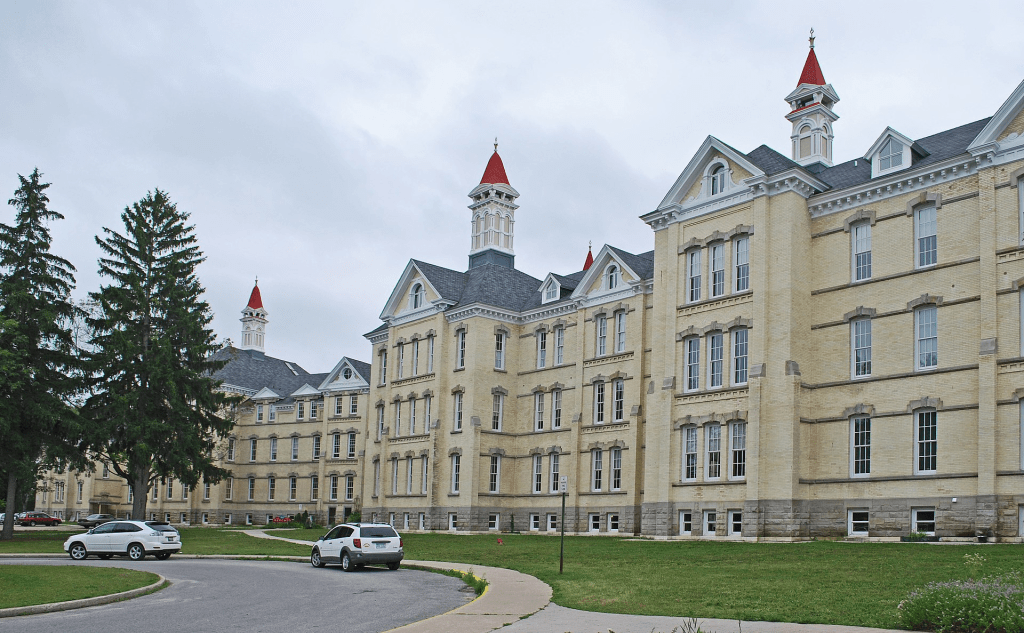
https://en.wikipedia.org/wiki/Traverse_City_State_Hospital#/media/File:NorthernMichiganAsylumCTraverseCityMI.JPG

A nurse working in the state psychiatric hospital system, our grandma explained that she was drawn into this work by watching her father, and later her older brother, suffer from Alzheimer’s Disease. Was it her observations or her personal light-hearted and reassuring demeanor, which led to her informing us of the “two types of Alzheimer’s: the funny kind and the scary.”

Grandma said that some of her patients would laugh at their forgetfulness and find it such a tickle to discover that they had forgotten their name, their location and what they were doing just a second ago. “Ha, ha, ha.” What a delight, every day, every hour, sometimes every minute, was a whole new adventure and “Oh, who are you again?” Grandma enjoyed working with these happy folks.

Sadly, there were other patients who would be frightened to discover that they didn’t know where they were, who you were, who they were, and become so disoriented that they would huddle or cry and be so fearful of what might happen to them. No matter how much grandma might say or do to console them, these patients would be distraught and distrustful of anyone’s attempts to assist them.

Grandma ensured me that our family was fortunate to have the “funny kind of Alzheimer’s.” “Nothing to worry about should you ever experience Alzheimer’s.”


Below are excerpts of the touching, Douglas Penick, article in the latest Tricycle magazine called “The Wall – What Remains When the Mind Goes?


“Month by month, I forget more
and more,
Betray the kindness of those
who taught me.
I drift in seductions of fatigue and
winter mist.

I forget liturgies, poems, practices,
Drifting on the errant life force of a vacant mind.
Layer after layer falls away.
There is
This wall
Before me
Here and now. …

But I know that if I were diagnosed with a profoundly mind-altering disease, I would find cultivating a different and broader kind of mental engagement more encouraging than struggling against encroaching deficits by playing Sudoku and doing crossword puzzles. …

The sudden disappearance of a routine memory: I cannot remember the name and even the atmosphere of a nearby street I walk on regularly. I can see it as I look down through leafless trees from the window in my high-rise apartment, but I no longer know what I’m looking at. It is a blank, a gap. …

For the full article see: tricycle.org/magazine/douglas-penick-memory/ and the companion article link displayed below.

Focus on Love, Not Sin REPOST

We can learn a lot from cat ladies. Take Julian of Norwich, for example.

Today’s repost comes from the Center for Action and Contemplation and offers us five provocative statements. Do any of these resonate for you and how might we respond?

  • Radical optimism
  • Sin is not real, only love is real
  • All is well
  • Waste no energy on regret
  • Get on with our holy task of loving

A Focus on Love, Not Sin 

Wednesday, August 14, 2024

Julian’s revelations offer a loving alternative to the focus on sin which characterized the theology of her time. Mirabai Starr writes:  

Julian of Norwich is known for her radically optimistic theology. Nowhere is this better illumined than in her reflections on sin. When Julian asked God to teach her about this troubling issue, he opened his Divine Being, and all she could see there was love. Every lesser truth dissolved in that boundless ocean…. 

Julian confesses, 

The truth is, I did not see any sin. I believe that sin has no substance, not a particle of being, and cannot be detected at all except by the pain it causes. It is only the pain that has substance, for a while, and it serves to purify us, and make us know ourselves and ask for mercy. [1]  

Starr clarifies where Julian located the impact of sin:  

Julian informs us that the suffering we cause ourselves through our acts of greed and unconsciousness is the only punishment we endure. God, who is All-Love, is “incapable of wrath.” And so it is a complete waste of time, Julian realized, to wallow in guilt. The truly humble thing to do when we have stumbled is to hoist ourselves to our feet as swiftly as we can and rush into the arms of God where we will remember who we really are.  

For Julian, sin has no substance because it is the absence of all that is good and kind, loving and caring—all that is of God. Sin is nothing but separation from our divine source. And separation from the Holy One is nothing but illusion. We are always and forever “oned” in love with our Beloved. Therefore, sin is not real; only love is real. Julian did not require a Divinity degree to arrive at this conclusion. She simply needed to travel to the boundary-land of death where she was enfolded in the loving embrace of the Holy One, who assured her that he had loved her since before he made her and would love her till the end of time. And it is with this great love, he revealed, that he loves all beings. Our only task is to remember this and rejoice.  

In the end, Julian says, it will all be clear.  

Then none of us will be moved in any way to say, Lord, if only things had been different, all would have been well. Instead, we shall all proclaim in one voice, Beloved One, may you be blessed, because it is so: all is well. [2]  

The fact that Julian “saw no wrath in God” does not tempt her to engage in harmful behaviors with impunity. On the contrary, the freedom she finds in God’s unconditional love makes her strive even more to be worthy of his mercy and grace. Yet she does not waste energy on regret. She suggests that we, too … get on with the holy task of loving God with all our hearts and all our minds and all our strength.  

References:  
[1] Julian of Norwich, The Showings: Uncovering the Face of the Feminine in Revelations of Divine Love, trans. Mirabai Starr (Charlottesville, VA: Hampton Roads, 2013, 2022), 68. Selection from chap. 27.  

[2] Showings, 223. Selection from chap. 85. 

Mirabai Starr, introduction to The Showings, xviii–xix. 

cac.org/daily-meditations/a-focus-on-love-not-sin/

Hitting Rock Bottom Can Develop Patience and Humility

My lifetime mantra was adopted from Yogi Bear. I just wanted to be “smarter than the average bear.” (See http://www.unfinishedman.com/smarter-than-the-average-bear/)

I’ve recently learned the hard way that my ignorance and greed are a powerful combination to bring me “back to earth” and, better yet, all the way to “rock bottom.”

Below is a recent post from the Center for Action and Contemplation which informs us that patience and humility are possible when we face our addictions and acknowledge our failings and what must change in our lives to overcome them.

May Richard Rohr’s words below bring some comfort and inspiration today.

Richard Rohr has learned from alcoholics and the Twelve Steps that it’s when we hit rock bottom that we realize how our suffering and God’s suffering are connected: 

Only those who have tried to breathe under water know how important breathing really is—and will never take it for granted again. They are the ones who do not take shipwreck or drowning lightly, the ones who can name “healing” correctly, the ones who know what they have been saved from, and the only ones who develop the patience and humility to ask the right questions of God and of themselves.  

It seems only the survivors know the full terror of the passage, the arms that held them through it all, and the power of the obstacles that were overcome. All they can do is thank God they made it through! For the rest of us, it is mere speculation, salvation theories, and “theology.”  

Those who have passed over to healing and sobriety eventually find a much bigger world of endurance, meaning, hope, self-esteem, deeper and true desire, and, most especially, a bottomless pool of love, both within and without. The Eastern fathers of the church called this transformation theosis, or the process of the divinization of the human person. This deep transformation is not achieved by magic, miracles, or priestcraft, but by a “vital spiritual experience” that is available to all human beings. It leads to an emotional sobriety, an immense freedom, a natural compassion, and a sense of divine union that is the deepest and most universal meaning of that much-used word salvation. Only those who have passed over know the real meaning of that word—and that it is not just a word at all. 

It is at precisely this point that the suffering God and a suffering soul can meet. It is at this point that human suffering makes spiritual sense, not to the rational mind, the logical mind, or even the “just and fair” mind, but to the logic of the soul, which I would state in this way:  

Suffering people can love and trust a suffering God.  
Only a suffering God can “save” suffering people.    

Reference:  
Adapted from Richard Rohr, Breathing under Water: Spirituality and the Twelve Steps (Cincinnati, OH: Franciscan Media, 2011, 2021), 116–119.  

Never Enough? Abandon Craving One Day at a Time

mindfulness is a means for overcoming craving.

Below are highlights of a recent Tricycle article on Cutting the Roots of Craving. I have three of Gunaratana’s books now and the provocative excerpt below comes from his latest book co-written by Veronique Ziegler.

May the words below offer some helpful advice to overcome our addiction for “more.”


Cutting the Roots of Craving

Desire is beginningless. Yet through right mindfulness we can learn to abandon it. By Bhante Henepola Gunaratana and Veronique Ziegler Jul 18, 2024

Everything we do pivots around craving and Its insatiability is such that it yields more craving

whenever we ask ourselves the question “Am I satisfied?” we always get the same answer: “Not yet.”

There is no point in time before which a state of desirelessness can be found.

in dependence upon feeling, there is craving.

Everything happens in your mind. When you talk, write, perform any deed whatsoever, watch your mind at all times in order to guard it against defilements and prevent craving from invading it.

Look at your own mind to see the invisible greed, anger, jealousy, and all the other defilements that are the real cause of your suffering.

If you end greed now, you attain liberation now. If you end greed one minute later, you attain liberation one minute later. If you end greed tomorrow, you attain liberation tomorrow.

Craving can be found in our very own mind. Understanding it is a personal exploration that must be undertaken individually, for the solution to abandon it is also in our own minds.

How to Abandon Craving

there is a great danger in sensual pleasures—not that they cause immediate harm or risk to one’s life (although some sensory pleasures can definitely be lethal) but that sense enjoyments are impermanent. And because they are impermanent they can never be satisfactory.

to live a happy and healthy life. We must use our senses, but we must do so with wisdom,

Mindfulness is a means for overcoming craving.

© 2024 by Bhante Gunaratana and Veronique Ziegler, Dependent Origination in Plain English. Reprinted by arrangement with Wisdom Publications.

Bhante Henepola Gunaratana is a Buddhist monk from Sri Lanka and the author of Mindfulness in Plain English. He is president of the Bhavana Society in High View, West Virginia, an organization that promotes meditation and monastic life.
Veronique Ziegler earned her doctorate degree in experimental high-energy physics from the University of Iowa working on the BaBar experiment at SLAC National Laboratory in Menlo Park, California. She then took a research assistant position at the same lab and later a staff scientist position at Jefferson National Laboratory in Newport News, Virginia, where she currently works full time and is involved in the lab particle spectroscopy experimental program. In 2018, she started attending Bhante Gunaratana’s dhamma classes. She has been an avid dhamma student ever since.

Speaking “The Naked Truth” to Power

Award-winning novelist, literary scholar and artist, Charles Johnson shares his take on the children’s classic The Emperor’s New Clothes in a Lion’s Roar article entitled The Dharma of Fiction. See Johnson’s excerpt below. For the full article, see http://www.lionsroar.com/the-dharma-of-fiction/

The Naked Truth

Charles Johnson on “The Emperor’s New Clothes.”

A truly great story like “The Emperor’s New Clothes” can be compared to an old, old coin. It has traversed continents and civilizations, picking up slight changes along the way, yet still bearing the palm oil and wisdom of the millions who’ve handled it.

We know the famous 1837 version by Hans Christian Andersen, but I was delighted to discover that there was a 1335 version in a collection titled El Conde Lucanor, by Don Juan Manuel, prince of Villena. According to Wikipedia, Andersen read this in a German translation from the Spanish. An even older Indian variant exists as well.

All versions of the story that I’m aware of have the same basic premise. A silly king and his royal entourage are tricked by cunning weavers who supposedly present him with finely wrought clothing—with an interesting catch. They claim, depending on the version, that anyone who was born “illegitimate” or not fathered by the man he or she thinks is their father, or who is unworthy of the official positions they hold, or is a fool, will not be able to see such finery.

‘What’s this?’ thought the Emperor. ‘I can see nothing at all! That is terrible. Am I stupid? Am I not fit to be Emperor?’—Hans Christian Andersen

Naturally, everyone fearing disapproval, shame, or social ostracism says, yes, they can see the invisible clothes!

While not intentionally influenced by Buddhism, this story speaks beautifully to our zeitgeist today, and to the power of collective illusions. We conform. We go along to get along socially. We act and talk as if we believe, for example, that there is something enduring and substantive called the “self,” because everyone speaks that way. And how often have we heard award-winning films, novels, and products praised to the skies, only to realize on inspection, like the child in Andersen’s version, that there is no “there” there? We act as if we believe. Even wrong speech can be powerful, especially if it appeals to our vanities and fears, seducing the mind to accept what it knows—by the evidence of its senses—is not true.

It is a child in Andersen’s version of the story who sees reality clearly. The child has a Zen-like beginner’s mind, one unconditioned by fears of personal loss or gain. It is the child innocently blurting out, “But he hasn’t got anything on,” that liberates the intimidated crowd watching the promenading, naked king to at last speak truth to power.

May we all one day have the courage of that child.