Category Archives: poetry

High Coo – Oct 3 – Happy Birthday James Herriot

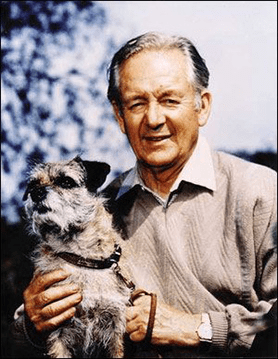
James Herriot

James Alfred Wight (3 October 1916 – 23 February 1995), better known by his pen name James Herriot, was a British veterinary surgeon and author.

“He is best known for writing a series of eight books set in the 1930s–1950s Yorkshire Dales about veterinary practice, animals, and their owners, which began with If Only They Could Talk, first published in 1970. Over the decades, the series of books has sold some 60 million copies.

The franchise based on his writings was very successful. In addition to the books, there have been several television and film adaptations including the 1975 film All Creatures Great and Small; a BBC television series of the same name, which ran for 90 episodes.” See https://en.wikipedia.org/wiki/James_Herriot

“Wight’s obituary confirmed his modesty and preference to stay away from the public eye. “It doesn’t give me any kick at all,” he once said. “It’s not my world. I wouldn’t be happy there. I wouldn’t give up being a vet if I had a million pounds. I’m too fond of animals.” By 1995, some 50 million of the James Herriot books had been sold. Wight was well aware that clients were unimpressed with the fame that accompanied a best-selling author. “If a farmer calls me with a sick animal, he couldn’t care less if I were George Bernard Shaw,” Wight once said. See  “James Herriot Dies at 78; Wrote ‘All Creatures Great and Small'”The Buffalo News. 24 February 1995. Retrieved 3 March 2021.

Today’s humble haiku – Happy Birthday James (Wight) Herriot

You loved animals

more than fame – fortunately

you shared their stories
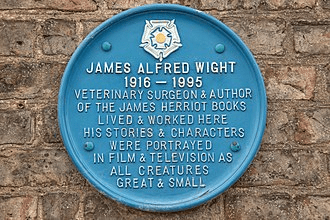
Commemorative plaque at 23 Kirkgate in Thirsk

High Coo – Oct 1 – Feast Day of St. Therese of Lisieux

St. Therese of Lisieux b.1873 – d.1897

Known as the Little Flower who practiced the Little Way, Marie Françoise-Thérèse Martin was born in Alencon, Orne, France and died twenty-four years later in Lisieux, France. In her very short life, cut short due to tuberculosis, she composed her autobiography, The Story of a Soul, which, after extensive editing, went on to become a highly circulated publication. (See https://en.wikipedia.org/wiki/Therese_of_Lisieux)

Singer/songwriter Billy Joel released his hit song “Only the Good Die Young” in 1977. His lyrics may provide a hint of the significant influence of the Little Flower on young Catholic women of the 20th Century.

For her part, St. Therese wrote:

“I will seek out a means of getting to Heaven by a little way – very short and very straight little way that is wholly new. We live in an age of inventions; nowadays the rich need not trouble to climb the stairs, they have lifts (elevators) instead. Well, I mean to try and find a lift by which I may be raised unto God, for I am too tiny to climb the steep stairway of perfection. […] Thine Arms, then, O Jesus, are the lift which must raise me up even unto Heaven. To get there I need not grow. On the contrary, I must remain little, I must become still less.”

Saint Thérèse de Lisieux (2012). The Story of a Soul (L’Histoire d’une Âme). The Autobiography of St. Therese of Lisieux with Additional Writings and Sayings of St. Therese

My humble haiku response is: Happy Day, St. Therese

Born to be a saint

you achieved your death’s desire –

happy day, Therese

Therese at age 15. https://en.wikipedia.org/wiki/Th%C3%A9r%C3%A8se_of_Lisieux#Holy_Face_of_Jesus_devotion

High Coo – Sept 30 – Rumi Day

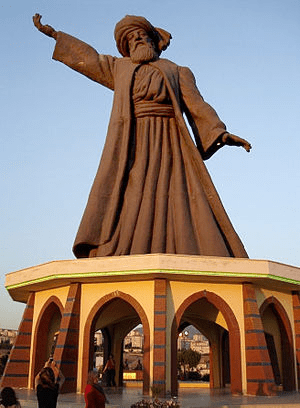
Statue of Rumi in Buca, Turkey

Jalāl al-Dīn Muḥammad Rūmī, more popularly known simply as Rumi, was born on this day in 1207 in present-day Afghanistan. He later died on December 17, 1273 in present-day Turkey. He was a 13th-century Persian poet and Sufi Mystic.  Rumi’s influence transcends national borders and ethnic divisions. His poems have been widely translated into many of the world’s languages and he has been described as the “most popular poet” and the “best selling poet” in the United States. (See https://en.wikipedia.org/wiki/Rumi)

Rumi was a firm believer in the use of music, poetry, and dance as a means of approaching God. His poetry is divided into common themes: mystical, passion, and life and death. Madonna and Philip Glass are among his many admirers: Madonna recorded readings of Rumi’s poetry, and Glass’s “Monsters of Grace” is based on Rumi’s art. (See https://nationaltoday.com/rumi-day/)

Rumi’s poetry speaks of love which infuses the world. Rumi’s longing and desire to attain the ideal of Love is evident in this excerpt from his book the Masnavi:

“I died to the mineral state and became a plant.

I died to the vegetal state and reached animality.

I died to the animal state and became a man,

Then what should I fear? I have never become less from dying.”

(See Ibrahim Gamard (with gratitude for R.A. Nicholson’s 1930 British translation). The Mathnawî-yé Ma’nawî – Rhymed Couplets of Deep Spiritual Meaning of Jalaluddin Rumi.)

My humble haiku response: Rumi Day

overwhelmed by love

devastated by love’s loss

love seeks love always

Rumi’s tomb in Konya, Turkey

High Coo – Sept 29 – Confucius Day

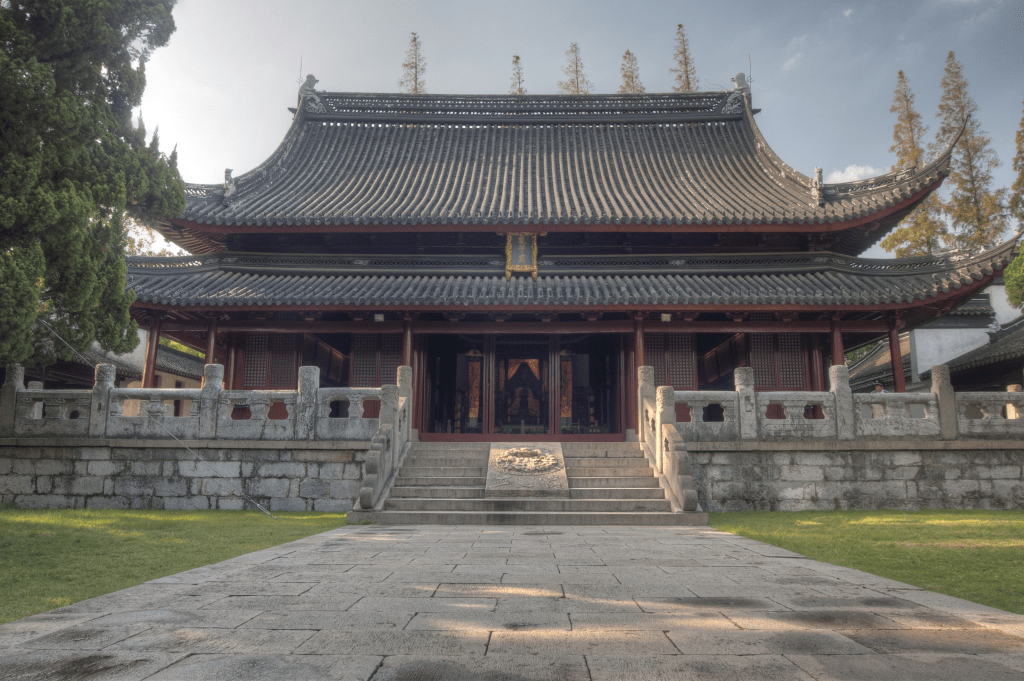
The Temple of Confucius in Jiading, now a suburb of Shanghai. See https://en.wikipedia.org/wiki/Confucius

Confucius Day is celebrated on September 29. See https://nationaltoday.com/confucius-day/

Confucius, or Master Kong, was born on September 28, 551 BCE and lived for nearly 72 years before dying in 479 BCE. Known as a philosopher and master teacher, Confucius presented himself as a “transmitter who invented nothing” yet considered himself a transmitter of values which emphasized personal and governmental morality, correctness of social relationships, justice, kindness, and sincerity.

“His teachings require examination and context to be understood. A good example is found in this famous anecdote:

廄焚。子退朝,曰:傷人乎?不問馬。

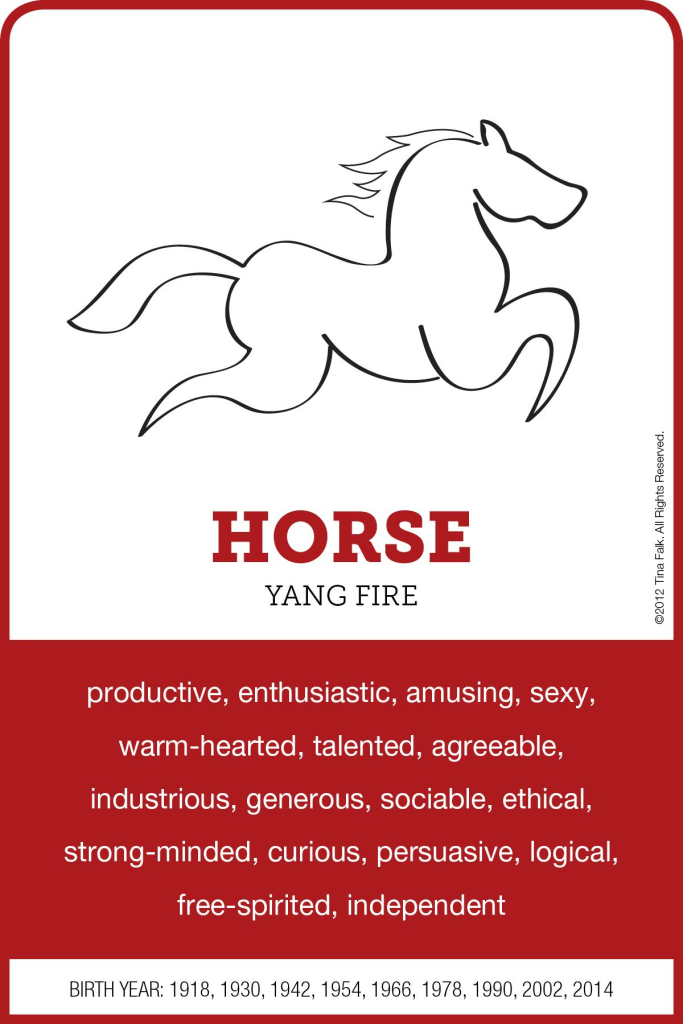
When the stables were burnt down, on returning from court Confucius said, “Was anyone hurt?” He did not ask about the horses.

— Analects X.11 (tr. Waley), 10–13 (tr. Legge), or X-17 (tr. Lau)

By not asking about the horses, Confucius demonstrates that the sage values human beings over property (which animals seem to represent in this example); readers are led to reflect on whether their response would follow Confucius’s and to pursue self-improvement if it would not have.” (See https://en.wikipedia.org/wiki/Confucius)

My humble haiku response is Confucius Day

horses are horses,

humans are humans – are not

both worth honoring?

calendarinspirationdesign.com

High Coo – Our First O-bon

https://stoneanddust.com/2018/08/11/japans-days-of-the-dead-celebrating-o-bon/

There is an annual Japanese holiday which remembers deceased ancestors. The actual date varies by region but usually falls between mid-July to mid-August. It is not an official holiday, rather a religious and traditional holiday which includes using lanterns to guide the dead, making food offerings to temples and celebrating with dancing. See https://www.jrailpass.com/blog/obon-festival-in-japan

Here is today’s humble haiku which recognizes this holiday, past and future, yet also celebrates the life still happening on this side of existence.

Our First O-bon

our day of the dead

has not yet arrived – still time

to explore this shore

Obon – Japan’s Day of the Dead @ asiahighlights.com

High Coo – Sept 26 – Happy Birthday T.S. Eliot

T. S. Eliot (b. 9/26/1888 d. 1/4/1965) photo from HuffPost

Born in St. Louis, Missouri, Thomas Stearns (T. S.) Eliot moved to England at the age of 25 and became an English citizen at 39 thus renouncing his American citizenship.

“During an interview in 1959, Eliot said of his nationality and its role in his work: ‘I’d say that my poetry has obviously more in common with my distinguished contemporaries in America than with anything written in my generation in England. That I’m sure of. … It wouldn’t be what it is, and I imagine it wouldn’t be so good; putting it as modestly as I can, it wouldn’t be what it is if I’d been born in England, and it wouldn’t be what it is if I’d stayed in America. It’s a combination of things. But in its sources, in its emotional springs, it comes from America.'” (See  Hall, Donald (Spring–Summer 1959). “The Art of Poetry No. 1” (PDF). The Paris Review. Archived from the original (PDF) on 3 October 2009. Retrieved 7 November 2009.)

Awarded the Nobel Prize for Literature in 1948, (see https://en.wikipedia.org/wiki/1948_Nobel_Prize_in_Literature), Eliot was known as one of the most famous and influential poets of the last century. Among many others, he is credited for his influence on Virginia Woolf, Ezra Pound, F. Scott Fitzgerald, James Joyce, Bob Dylan and Andrew Lloyd Webber. Note the musical Cats is based on Eliot’s book of poetry Old Possum’s Book of Practical Cats (1939) and the movie Tom and Viv recounts his life with his first wife. (See https://en.wikipedia.org/wiki/T._S._Eliot)

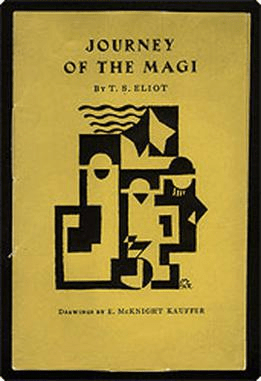
His most famous poems include The Waste Land, Hollow Men, Ash Wednesday and Four Quartets. However, my current favorite of his is Journey of the Magi which is a short 43-line poem. This poem recounts the original trip to the Bethlehem manger and it’s last 8 lines are:

Birth or Death? There was a Birth, certainly
We had evidence and no doubt. I had seen birth and death,
But had thought they were different; this Birth was
Hard and bitter agony for us, like Death, our death.
We returned to our places, these Kingdoms,
But no longer at ease here, in the old dispensation,
With an alien people clutching their gods.
I should be glad of another death.

https://allpoetry.com/The-Journey-Of-The-Magi

Here is my humble haiku response: Happy Birthday T.S. Eliot

Bridging two countries,

two lives, two wives and two deaths –

this is that and that

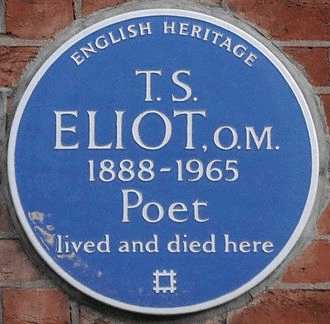
Blue plaque, 3 Kensington Court Gardens, Kensington, London, home from 1957 until his death in 1965

Reposting Today’s Message from Poetry.org

poetry.org

The birthday of the world

On the birthday of the world I begin to contemplate what I have done and left undone, but this year not so much rebuilding  

of my perennially damaged psyche, shoring up eroding friendships, digging out stumps of old resentments that refuse to rot on their own.  

No, this year I want to call myself to task for what I have done and not done for peace. How much have I dared in opposition?  

How much have I put on the line for freedom? For mine and others? As these freedoms are pared, sliced and diced, where   have I spoken out?

Who have I tried to move? In this holy season, I stand self-convicted of sloth in a time when lies choke   the mind and rhetoric bends reason to slithering choking pythons.

Here I stand before the gates opening, the fire dazzling   my eyes, and as I approach what judges me, I judge myself. Give me weapons of minute destruction. Let my words turn into sparks.
Marge Piercy, “The Birthday of the World” from The Crooked Inheritance. Copyright © 2006 by Marge Piercy. Used by permission of Alfred A. Knopf, an imprint of the Knopf Doubleday Publishing Group, a division of Random House LLC. All rights reserved.

A Note from the Editor

Today is the beginning of Rosh Hashanah, the Jewish new year celebration. Three unique sets of prayers are added to the morning service during Rosh Hashanah: Malkhuyot, which address the sovereignty of God; Zikhronot, which present God as the one who remembers past deeds; and Shofarot, in which participants stand in nervous anticipation of the future. Each of these sections culminates in blasts of the shofar or horn, the most potent symbol of the holiday.

High Coo – Sept 25 – Remember Your Ancestors

Hiram J. Cole 1845 – 1913 Ontario, CA

Family lore suggested my first great grandfather Cole had emigrated from Ireland to Canada. After a personal genealogy study, I surprisingly discovered three great grandfathers had been born in Canada, their five predecessors came from New York before my oldest known six great grandfathers were born in Holland. So far, the oldest records go back to 1450.

Yesterday was Ancestors’ Day in Cambodia which is a far distance from North America or Europe but why quibble. I’m choosing to recognize my ancestors today because my eighth great-grandfather, Jacob, was born on 9/25/1639 in New Amsterdam. Note: New Amsterdam was founded by the Dutch in 1624 and was renamed New York by the English in 1664. My grandfather would have been 25-years old when New York was established. He went on to live another 55 years and died at the age of 80 in 1719.

Here is today’s haiku: Remember Your Ancestors

It’s a miracle

or crazy coincidence –

grateful for my life

Trees bowing to the river by Patrick J. Cole

High Coo – Sept 24 – Happy Birthday Casey

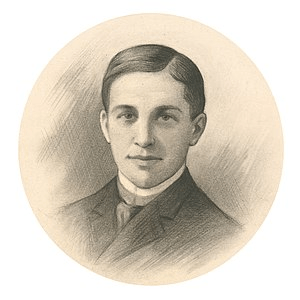
Ernest Lawrence Thayer (1863 – 1940)

“Ernest Lawrence Thayer was an American writer and poet who wrote the poem “Casey” (or “Casey at the Bat”), which is “the single most famous baseball poem ever written” according to the Baseball Almanac, and “the nation’s best-known piece of comic verse—a ballad that began a native legend as colorful and permanent as that of Johnny Appleseed or Paul Bunyan.” https://www.poetry.com/poem/12844/casey-at-the-bat

Final stanza of Casey at the Bat:

Oh, somewhere in this favored land the sun is shining bright;
The band is playing somewhere, and somewhere hearts are light,
And somewhere men are laughing, and little children shout;
But there is no joy in Mudville–great Casey has struck out.

https://www.poetry.com/poem/12844/casey-at-the-bat

Today is my brother, Casey’s, birthday and here is today’s haiku:

Happy Birthday Casey

Greater than your name,

no Mudville or strikeouts here.

Nothing but good cheer

Holliston, Massachusetts – Mudville Village, Welcome Sign

For more information see https://en.wikipedia.org/wiki/Casey_at_the_Bat