Category Archives: psychology

The Golden Rule?

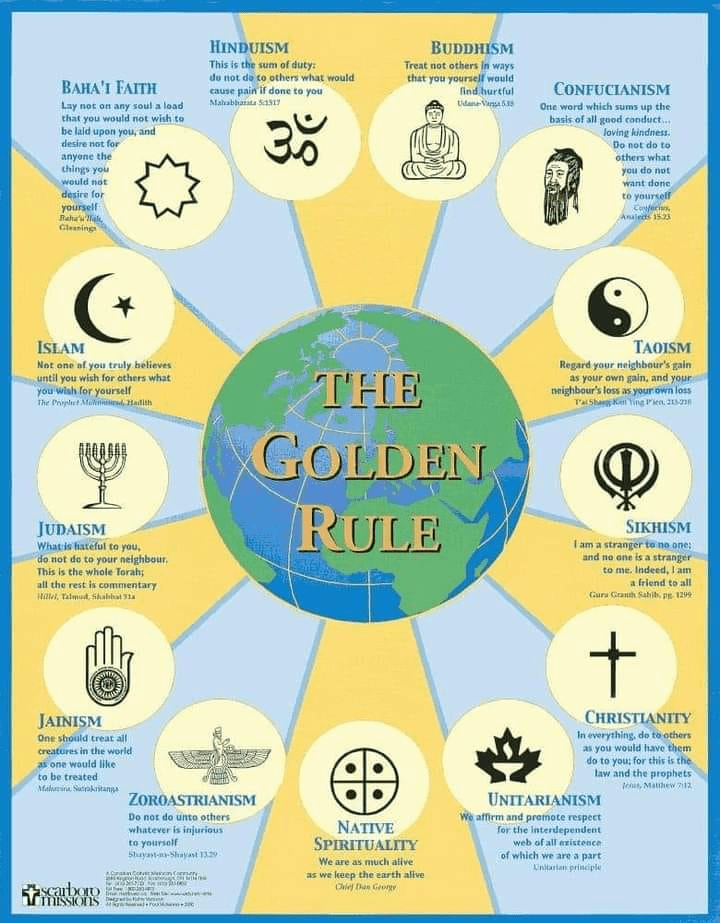
Supposedly, the Golden Rule is something most faith traditions agree on. Supposedly, people without a faith tradition can agree on it as well. Does “the Golden Rule make a good one-sentence summary of what morality is about” for you?

The golden rule captures the spirit behind morality. It helps us to see the point behind moral rules. It engages our reasoning, instead of imposing an answer. It counteracts self-centeredness. And it concretely applies ideas like fairness and concern. So, the Golden Rule makes a good one-sentence summary of what morality is about.” Harry Gensler, philosopher. philosophynow.org/issues/125/The_Not_So_Golden_Rule

http://www.scarboromissions.ca/golden-rule

We Would Change

Oh, to spoon in June and point to the moon and read our future in a newly discovered rune. You know that tune, right?

Below is beautifully written reminder from Joan Chittister that everything changes in June.

We would change

Clearly, June is the time for being in the world in new ways, for throwing off the cold and dark spots of life.

flowers confront us with our responsibility for beauty.
 
June is the month that calls us out of our houses, out of ourselves,

Be a tribute to creation. Be a part of the chorus of life.
 
“I wish you happiness now and whatever will bring happiness to you in the future.”

Beauty and human warmth would take root in us like a clear, hot June day. We would change.

                   —selections from A Monastery Almanac by Joan Chittister

For more great writing check out this website: joanchittister.org/

From Fundamentalism to Atheism

Blind faith? Faith can move mountains? Faith of our fathers? Author Richard Fast offers a critique on faith worth reading, I think.

“I’m NOT trying to sell Atheism … “God” forbid. I’m selling the concept of searching and finding your faith.”

Check out an excerpt from Richard Fast’s provocative article recently published in Backyard Church

I Finally Found Peace When I Accepted Atheism

The more I searched for answers outside myself, the more frustration and anxiety I felt.

I became an Atheist. I had found my answer.

I didn’t require a God or a particular faith to settle my tormented soul. With total peace of mind, I could accept that there doesn’t have to be a God. The universe could just be a beautiful mystery.

I didn’t have to invent or conjure anything to calm my soul. I didn’t have to force myself into mental contortions to follow someone else’s belief; I could happily accept that there are many questions to which I will never know the answers, and I’m okay with that.

Conclusion: True “faith” feels right.

If history has taught us anything, there’s very little we can honestly know. Finding faith is a uniquely human experience that makes the challenging road of life a little easier to travel.

But many years of searching, thinking, deep introspection, and an acceptance of Atheism (the unknowable) have finally given me peace of mind.

I’m NOT trying to sell Atheism … “God” forbid. I’m selling the concept of searching and finding your faith.

Whatever that may be, I sincerely hope that you find your faith, as I’ve finally found mine.

I am the author of The Challenge of Choice … how to make a “good” decision when it REALLY matters!

Excerpt from How to Free Yourself from the 7 Obsessions

I hate to wait and that has been a life-long challenge for me. Below is an excerpt from a recent Lion’s Roar article that helps me better understand why.


Valerie Mason-John, M.A. is a public speaker and master trainer in the field of conflict transformation, leadership and mindfulness, the author of ten books and the Co-Founder of Eight Step Recovery, an alternative to the 12-step program for addiction.

http://www.valeriemason-john.com

How to Free Yourself from the 7 Obsessions

To free ourselves from habitual patterns, says Valerie Mason-John, we need to see how they have become part of our identity.

VALERIE MASON-JOHN 8 MAY 2024

Watch your thoughts; they become habits.
Watch your habits; they become stories.
Watch your stories; they become excuses.
Watch your excuses; they become relapses.
Watch your relapses; they become dis-eases.
Watch your dis-eases; they become vicious cycles.
Watch your vicious cycles; they become your wheel of life.

Every time we habitually react, the past is present.

We transcend our habits by allowing a part of our superego to die.

For more from Valerie Mason-John check out these two websites:

http://www.lionsroar.com/how-to-free-yourself-from-the-7-obsessions/

http://www.valeriemason-john.com

An Integrated Life

Doctor (and Sister) Joan Chittister shares her weekly Vision and Viewpoint newsletter today with her comments below on the importance of “living an integrated life.” You can learn more about her and the Benedictine religious community in Erie, Pennsylvania at this website: joanchittister.org/~joanchit/


Do not lie, even to yourself

Mahatma Gandhi wrote, “Happiness is when what you think, what you say, and what you do are in harmony.” Gandhi could have been a Benedictine. Humility is about living an integrated life, a life in which each part is in harmony with every other dimension.
 
The person who lives a lie, for instance, no matter how effective otherwise, is in tension every moment of the day.
 
The truth is that we are meant to be transparent.

Be what you say you are. Do not lie, even to yourself. Don’t live two lives

At the end, three things measure both our integrity and the harmony of our own lives: self-control, respect, and freedom from self-deception.

a process of slow and self-emptying transformation
 
enjoy the rest of the adventure called life, learning, becoming, growing as we go.

                  —from Radical Spirit (Random House), by Joan Chittister 

joanchittister.org/books-page/radical-spirit-12-ways-live-free-and-authentic-life

Finding Home in Ourselves

“Don’t forget … to call yourself Home.” Kaitlin Curtice

This is a beautiful excerpt from the Center for Action and Contemplation about Kaitlin Curtice’s writing on the sacred legacy of home.

Check out both links identified below. You will be comforted and edified.


http://www.kaitlincurtice.com

Finding Home in Ourselves
 
Author Kaitlin Curtice writes about the sacred legacy of home:  

May we always return to the places where the stories begin, to challenge them, to accept and honor them, and to whisper to ourselves and one another that we are always, always arriving. 

Don’t forget, 
my love, 
to live. 


Don’t forget 
to love yourself, 
all of you, 
from every season 
and every place, 
because you never know 
when they will 
come knocking for 
a cup of coffee 
and an overdue hug. 


call yourself Home

Love Is Home

Felicia Murrell acknowledges that our first homes are not always safe

How are you preparing a home of unconditional acceptance for yourself?

Today’s Center for Action And Contemplation message offers a provocative post on where we can find our true home. Check out this beautifully written message by Felicia Murrell and her quotes from The Wizard of Oz written by L. Frank Baum.


“Home,” says Glinda the Good, “is a place we all must find, child. It’s not just a place where you eat or sleep. Home is knowing. Knowing your mind, knowing your heart, knowing your courage. If we know ourselves, we’re always home, anywhere.”


https://feliciamurrell.com/

Love is Home
 
Felicia Murrell acknowledges that our first homes are not always safe:  

For some, home is terror, a place to flee with no desire to return or revisit.

Often, when we think of home, we think only of an external place,

Love is home.  

Home is both an external dwelling and an internal abode. Home is the place where we belong, our place of acceptance and welcome. There, in this shame and judgment-free embryonic cocoon of love, we practice unconditional acceptance; we learn to relate to ourselves and the world around us.  

How are you preparing a home of unconditional acceptance for yourself?

“Home,” says Glinda the Good, “is a place we all must find, child. It’s not just a place where you eat or sleep. Home is knowing. Knowing your mind, knowing your heart, knowing your courage. If we know ourselves, we’re always home, anywhere.” [3] 

 [3] Joel Schumacher, The Wiz: Screenplay, adapted from The Wonderful Wizard of Oz, by L. Frank Baum (New York: Studio Duplicating Service, 1977). 

An Unfaithful Nursery Rhyme


Bob and Beth looked forward to death

ending their pain thereafter

Bob fell down and broke his crown

and Beth came tumbling after

Sisyphus fell into the abyss

carrying his shitbag upward

Sally Forth lost her True North

sought truth through tears and cuss words

Tiny Tim cycled on in

upon a trike of virtue

Trueheart Tess sorting through the mess

sought justice for Tim and her too


How many lives will be broken today?

How many ways can we repair the damage caused by an affair?