Category Archives: psychology

The Healing of Tears

Washing out the toxins. Shedding the pains of our life and our world.

I’m not a crier by nature (or is it nurture?) so tears are not something I enjoy or receive comfort from. Yet, tears can be healing.

Below are excerpts from today’s meditation from the Center for Action and Contemplation. Perhaps it will bring a welcome tear to your eyes. cac.org/daily-meditations/the-healing-of-tears/

The Healing of Tears 

Friday, June 28, 2024

Blessed are those who mourn, for they shall be comforted. —Matthew 5:4 

There’s a therapeutic, healing meaning to tears.

those who can grieve, those who can cry, are those who will understand.  

Weeping over our sin and the sin of the world is an entirely different mode than self-hatred or hatred of others.

recognize the sad reality

That might seem ridiculous, and it is especially a stumbling block for many men in our culture. Young men have often been told not to cry because it will make us look vulnerable. So, we men—and many women too—stuff our tears.

He was falling apart, becoming his most radiant, his most needful. And little did I know, he was showing me how to do the same. [2]  

References: 
[1] Adapted from Richard Rohr, Jesus’ Alternative Plan: The Sermon on the Mount (Cincinnati, OH: Franciscan Media, 1996, 2022), 139–140.  

[2] Ross Gay, Inciting Joy: Essays (Chapel Hill, NC: Algonquin Books, 2022), 228–229. 

An Angry Person with a Zen Practice

The brief Lions Roar article below is much more than an American jazz singer, Bobby McFerrin lyric: Don’t Worry, Be Happy.

I highly recommend this piece written by Karen Maezen Miller. See excerpts below:

An Angry Person with a Zen Practice

by Karen Maezen Miller

I wasn’t an angry person until I became a Zen Buddhist. Sure, I yelled. I slammed things. I broke things. But I wouldn’t have called myself angry. It was always another person making me angry. How was that my fault?

But there was hope because I was an angry person with a Zen practice.

No one makes us feel, think, or do anything except as we allow.

Anger comes from our attachments.

We don’t get our way all the time, and besides, even when we do, it doesn’t last.

The wisdom of impermanence shows us the way to work with anger, that is, to not work with it at all.

Without my ruminations and reactions, anger does what all sensations do. It goes away by itself, providing I don’t chase after it.

One more thing has changed my relationship with anger: admitting it. When I feel myself getting angry around others, I try my best to say, “I’m angry right now.” Spoken, the words by themselves are safe. Unspoken, they smolder into fire and brimstone.

These days, though I still get angry, I’m no longer afraid of my anger. I don’t try to hide or avoid it. I remind myself not to rationalize it, justify it, or react in anger. I let it be, and then I let it be gone.

http://www.lionsroar.com/how-3-buddhist-teachers-work-with-difficult-emotions/

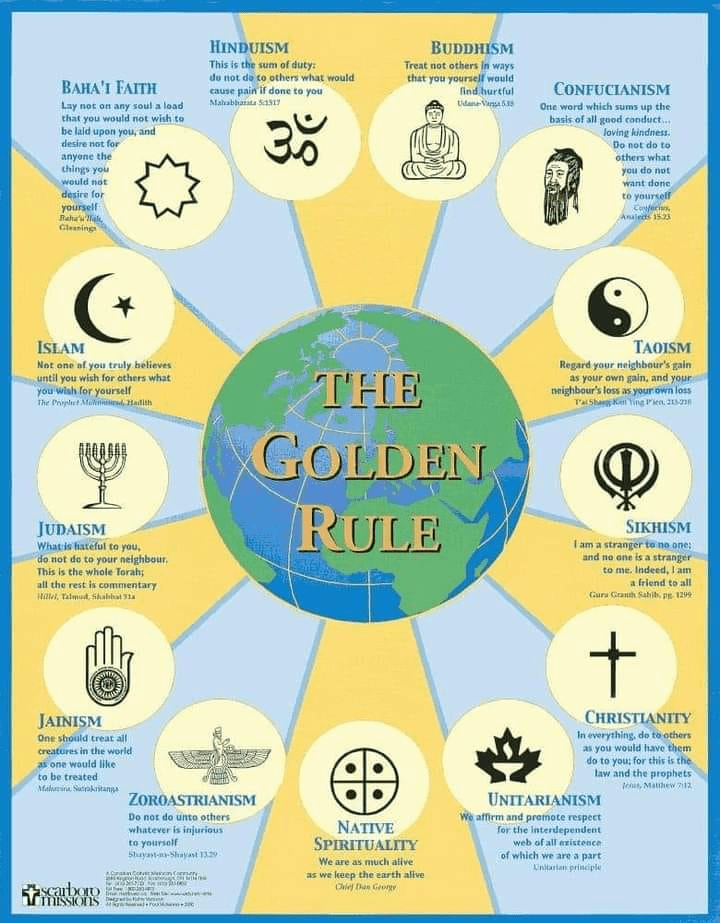
The Golden Rule?

Supposedly, the Golden Rule is something most faith traditions agree on. Supposedly, people without a faith tradition can agree on it as well. Does “the Golden Rule make a good one-sentence summary of what morality is about” for you?

The golden rule captures the spirit behind morality. It helps us to see the point behind moral rules. It engages our reasoning, instead of imposing an answer. It counteracts self-centeredness. And it concretely applies ideas like fairness and concern. So, the Golden Rule makes a good one-sentence summary of what morality is about.” Harry Gensler, philosopher. philosophynow.org/issues/125/The_Not_So_Golden_Rule

http://www.scarboromissions.ca/golden-rule

We Would Change

Oh, to spoon in June and point to the moon and read our future in a newly discovered rune. You know that tune, right?

Below is beautifully written reminder from Joan Chittister that everything changes in June.

We would change

Clearly, June is the time for being in the world in new ways, for throwing off the cold and dark spots of life.

flowers confront us with our responsibility for beauty.
 
June is the month that calls us out of our houses, out of ourselves,

Be a tribute to creation. Be a part of the chorus of life.
 
“I wish you happiness now and whatever will bring happiness to you in the future.”

Beauty and human warmth would take root in us like a clear, hot June day. We would change.

                   —selections from A Monastery Almanac by Joan Chittister

For more great writing check out this website: joanchittister.org/

From Fundamentalism to Atheism

Blind faith? Faith can move mountains? Faith of our fathers? Author Richard Fast offers a critique on faith worth reading, I think.

“I’m NOT trying to sell Atheism … “God” forbid. I’m selling the concept of searching and finding your faith.”

Check out an excerpt from Richard Fast’s provocative article recently published in Backyard Church

I Finally Found Peace When I Accepted Atheism

The more I searched for answers outside myself, the more frustration and anxiety I felt.

I became an Atheist. I had found my answer.

I didn’t require a God or a particular faith to settle my tormented soul. With total peace of mind, I could accept that there doesn’t have to be a God. The universe could just be a beautiful mystery.

I didn’t have to invent or conjure anything to calm my soul. I didn’t have to force myself into mental contortions to follow someone else’s belief; I could happily accept that there are many questions to which I will never know the answers, and I’m okay with that.

Conclusion: True “faith” feels right.

If history has taught us anything, there’s very little we can honestly know. Finding faith is a uniquely human experience that makes the challenging road of life a little easier to travel.

But many years of searching, thinking, deep introspection, and an acceptance of Atheism (the unknowable) have finally given me peace of mind.

I’m NOT trying to sell Atheism … “God” forbid. I’m selling the concept of searching and finding your faith.

Whatever that may be, I sincerely hope that you find your faith, as I’ve finally found mine.

I am the author of The Challenge of Choice … how to make a “good” decision when it REALLY matters!

Excerpt from How to Free Yourself from the 7 Obsessions

I hate to wait and that has been a life-long challenge for me. Below is an excerpt from a recent Lion’s Roar article that helps me better understand why.


Valerie Mason-John, M.A. is a public speaker and master trainer in the field of conflict transformation, leadership and mindfulness, the author of ten books and the Co-Founder of Eight Step Recovery, an alternative to the 12-step program for addiction.

http://www.valeriemason-john.com

How to Free Yourself from the 7 Obsessions

To free ourselves from habitual patterns, says Valerie Mason-John, we need to see how they have become part of our identity.

VALERIE MASON-JOHN 8 MAY 2024

Watch your thoughts; they become habits.
Watch your habits; they become stories.
Watch your stories; they become excuses.
Watch your excuses; they become relapses.
Watch your relapses; they become dis-eases.
Watch your dis-eases; they become vicious cycles.
Watch your vicious cycles; they become your wheel of life.

Every time we habitually react, the past is present.

We transcend our habits by allowing a part of our superego to die.

For more from Valerie Mason-John check out these two websites:

http://www.lionsroar.com/how-to-free-yourself-from-the-7-obsessions/

http://www.valeriemason-john.com

An Integrated Life

Doctor (and Sister) Joan Chittister shares her weekly Vision and Viewpoint newsletter today with her comments below on the importance of “living an integrated life.” You can learn more about her and the Benedictine religious community in Erie, Pennsylvania at this website: joanchittister.org/~joanchit/


Do not lie, even to yourself

Mahatma Gandhi wrote, “Happiness is when what you think, what you say, and what you do are in harmony.” Gandhi could have been a Benedictine. Humility is about living an integrated life, a life in which each part is in harmony with every other dimension.
 
The person who lives a lie, for instance, no matter how effective otherwise, is in tension every moment of the day.
 
The truth is that we are meant to be transparent.

Be what you say you are. Do not lie, even to yourself. Don’t live two lives

At the end, three things measure both our integrity and the harmony of our own lives: self-control, respect, and freedom from self-deception.

a process of slow and self-emptying transformation
 
enjoy the rest of the adventure called life, learning, becoming, growing as we go.

                  —from Radical Spirit (Random House), by Joan Chittister 

joanchittister.org/books-page/radical-spirit-12-ways-live-free-and-authentic-life