I attended a powerful session yesterday on the importance of remembering all the change that’s been accomplished to-date and moving forward more skillfully when discerning how these changes were made. Bernard Unti, PhD of Philosophy from the American University provided a rich history of animal protection progress starting in Europe and then through the U.S. Here’s a few highlights of what he said:
“Organized animal protection is now 200 years old … skillful use of our history can help us engage more supporters in the future.” Dr. Bernard Unti, presented on the four key themes from a historical and contemporary perspective and showed how these themes have led to real (but not-yet-complete) improvement in our human-animal relations.
The four themes are:
relationship between cruelty to animals and interpersonal violence (e.g., how we treat non-human animals leads to how we treat fellow humans – beat your animals = beat your spouse, kids, elders, …)
connection between animal causes and other social justice causes (e.g., temperance, feminism, work safety …)
social values and communicating change (e.g., Black Beauty, Be Kind to Animals Week, Scouting …)
Bottom line: change comes from communicatingwhat we are for versus what we are against and wear our values gracefully (i.e., recognize incremental improvement and patiently win one person at a time).”
It’s Spring and I’m exploring the many types of deep friendships we encounter during our life. One reference I just discovered is reposted below from, believe it or not, the Brides website: written by Christine Coppa and referencing Dr. Michael Tobin.
Today’s senryu: Soul Friends and Soulmates
who are we today
who reminds us we are one
let’s begin anew
I’m interested in your comments on this topic. Do you have a soul friend and/or mate?
The idea of meeting your soulmate is the glorious stuff of rom-coms—and apparently real-life, everyday people, too.
What Is a Soulmate
According to Dr. Michael Tobin, a soulmate is someone who you feel deeply connected to, but not in a dependent or needy way. The guiding principle in a relationship between soulmates is that needs are equally met because a soulmate relationship should challenge you to move from selfishness to giving.
“It’s the realization that this person who shares your life is a part of yourself,” says family and marital psychologist Dr. Michael Tobin. “A soulmate is an individual that has a lasting impact on your life. Your soulmate is your fellow traveler on the journey of life—you need one another to grow beyond the limitations of your individual selves.”
If you’re wondering if you’ve met your soulmate—or are currently with your unique flame, Dr. Tobin has optimistic news for you: “I believe everyone could discover their soulmate. However, to find your soulmate, you must first understand that humans are not meant to be alone and that the purpose of a relationship is not merely to get our individual needs met—but rather as a challenge to grow—and to help our partners reach their potential.”
As for when you might meet your particular person, Dr. Tobin saysthat there isn’t a perfect age or life stage for discovering your soulmate—and that is exciting news. “I know a 74-year-old woman who reconnected with her high school flame after a 56-year separation. She calls him her soulmate. They were meant to be together during the later years of their lives.”
You might be wondering if you met your soulmate on a vacation, subway stop, or that time in the rain when a stranger invited you to share an umbrella—but didn’t realize it at the time. According to Dr. Tobin, yes, this is possible. “Everything in life is about timing. I believe it’s a matter of self-knowledge. When you understand that a relationship is not about control or the simple need of fulfillment but is essential to our psychological and spiritual development, then you’re open to the possibility of meeting your soulmate.”
If you’re curious about what to do if you feel like you’ve experienced a ships-in-the-night experience, Dr. Tobin suggests embracing it because it may actually have been what he says is known as a “soul crossing.” He explains that this is a brief encounter with someone who crosses our path and has a lasting impact on the direction we choose in life.
Knowing or understanding the signs you met your soulmate is interesting in itself because there isn’t just one generic type of soulmate out there. Most people equate the term “soulmate” with romantic love. Ahead, the types of soulmates that exist and how to know if you’ve found one.
Types of Soulmates
Not all soulmates are the stuff of life-long romance. Here are six different kinds to look out for in your own life.
Romantic Soulmates
“Romantic soulmates ignite one another’s passion throughout their time together,” explains Dr. Tobin. “They have the capacity to bring one another to heights of physical and emotional pleasure.” However, we’ve all experienced breakups, even if we were with someone who hit the hot and heavy marks. “Passion can be a brief flame that burns hot and then extinguishes. For those rare romantic soulmates, the flame burns continuously because they’re both committed to keeping the fire lit throughout their time together.”
Soul Partners
Has it been years since you connected with a friend from elementary school, but when you do, you just click? “A soul partner is that person who you haven’t seen in years, and when you reunite, feel like time and separation have no bearing on the depth of the connection,” explains Dr. Tobin.
Karmic Soulmates
You know you’ve met a karmic soulmate when you’re in sync about common purposes. “You’re both here together to make a difference in the world, and your skills complement one another—you’re ideal partners to fulfill a shared mission.” This kind of relationship doesn’t require love or intimacy and instead relies on putting your best selves forward to achieve something that matters.
Companion Soulmates
This is the yin to your yang, the peanut butter to your jelly—you get it. “Friends are an essential part of our lifetime journey, and those of the soulmate type help us laugh when we’re in pain, nurture us when we’re suffering, flow with us when we’re riding high, challenge us to be real, love us with our warts, and never abandon us in anger. And we do the same with them.”
Kindred Soulmates
You know you’ve found a kindred soulmate when you pretty much agree on all of the small and big stuff. “You love the same things; laugh at the same jokes; agree and disagree with love and affection; compete with gusto but without bitterness or jealousy. These people share the same journey toward truth and love,” Dr. Tobin says.
Soul Contracts
This is an interesting type of soulmate because it’s when two people are bound by a common commitment to speak the truth, be emotionally open with one another, own up to deceits, and be authentic. A soul contract might look like a married couple, where one spouse cheated, but they stay together, not for the kids or appearances but because there’s a deep law of attraction within pulling them together for their lifetime.
Signs You’ve Found Your Soulmate
The signs you’ve met your soulmate are kind of infinite and can overlap with the different kinds of soulmates you encounter in your lifetime. Dr. Tobin believes an important truth about relationships is that you have to create love and nurture soulmate connections. “Love isn’t delivered to us because we believe we deserve it. We must work at being loving and then we’ll receive love in return.”
They Give You a Sense of Calm and Storm
He also says that a sense of both calm and storm is an indicator light. “Sometimes a soulmate is here to shake us out of complacency, to challenge us to think and to act differently, to grow beyond our comfort zones. This is never smooth and peaceful. Yet with that same soulmate, there are and will be moments of exquisite connection, serenity, and harmony.”
You Feel One Another’s Pain
Another sign you’ve met your match is the way you react to their pain. “It’s hard to imagine soulmates who don’t bleed with one another, who don’t feel one another’s pain, who are absent of empathy and compassion,” Dr. Tobin says.
As a final note, “Soulmates may be like two strands of spaghetti entangled in such a way that they don’t know where one begins and the other ends,” says Dr. Tobin. And at the same time, some soulmate relationships serve their purpose and expire. The good news is we may all experience a soulmate connection at some point in our life.
On this day in 1941, Virginia Woolf committed suicide by drowning in the river behind her house. She was feeling the return of massive depression. She wrote a love letter/suicide note to her husband. Her writing was often controversial and, so it might be expected, that even her suicide note would be misquoted, misinterpreted and misjudged.
Today’s senryu: Those vs. These Terrible Times
life can be cruel
inside and outside our mind
stop judging – be kind
There’s an excellent piece by Maria Popova on The Marginalian website that provides an explanation of how “self-righteousness is the enemy of compassion.” And, as might be expected, the “self-righteous” ones include so called “Christians” and “journalists.” This piece also recommends the book, Afterwords – Letters on the Death of Virginia Woolf, edited by Sybil Oldfield, (c) 2005, Rutgers University Press
Re-reading Power vs. Force by David R. Hawkins, M.D., Ph.D., (c) 2012 Author’s Official Authoritative Edition, I was reminded that it was time to “raise my sights” from choosing joy to choosing enlightenment.
While both joy and enlightenment are in the “extraordinary outcomes” pinnacle, why stop at joy when there are still two higher vibrations levels available?
Today’s senryu: Levels of Consciousness
getting past my self
we perceive a greater truth:
interbeing Self
May we all be happy, productive, without stress and synchronistically extraordinary.
“What’s in a name? That which we call a rose By any other name would smell as sweet.” Spoken by Juliet, Act 2 Scene 2 of Shakespeare’s Romeo and Juliet
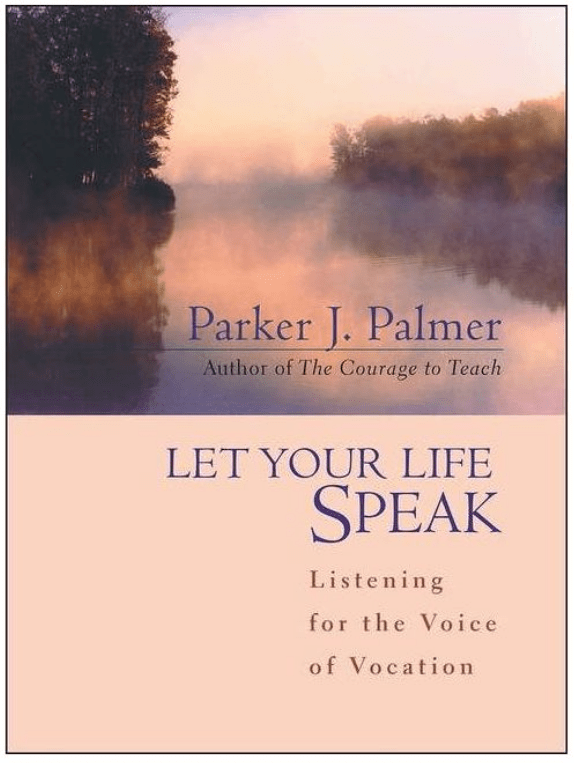
“Parker J. Palmer is an American author, educator, and activist who focuses on issues in education, community, leadership, spirituality and social change. He has published ten books and numerous essays and poems and is founder and Senior Partner Emeritus of the Center for Courage and Renewal.”https://en.wikipedia.org/wiki/Parker_Palmer
Only 117 pages, Palmer’s small book, Let Your Life Speak, (c) 2000 by Jossey-Bass, is filled with candor and wisdom about his (and our) search for right livelihood, for a meaningful vocation.
A couple of quotes from this book inspired by his Quaker practice are:
“there is much guidance in what does not and cannot happen in my life as there is in what can and does – maybe more.” p.39
“If I try to be or do something noble that has nothing to do with who I am, I may look good to others and to myself for a while. But the fact that I am exceeding my limits will eventually have consequences. I will distort myself, the other, and our relationship – and may end up doing more damage than if I had never set out to do this particular ‘good’. … It took me a long time to understand that although everyone needs to be loved, I cannot be the source of that gift to everyone who asks me for it. There are some relations in which I am capable of love and others in which I am not. To pretend otherwise, to put out promissory notes I am unable to honor, is to damage my own integrity and that of the person in need.” pp.47-48
“We can make choices about what we are going to project, and with those choices we help grow the world … Our complicity in world making is a source of awesome and sometimes painful responsibility – and a source of profound hope for change.” p.78
“Spring teaches me to look more carefully for the green stems of possibility, for the intuitive hunch that may turn into a larger insight, for the glance or touch that may thaw a frozen relationship, for the stranger’s act of kindness that make the world seem hospitable again. … if you receive a gift, you keep it alive not by clinging to it but by passing it along.” pp.104-105
In his book Living Between Worlds, (c) 2020 Sounds True, Dr. James Hollis, asks:
“What betrayal of the soul transpires when we collude with our debilitating fears? And who, besides us, will pay those debts of unlived life – our children, our partners, our colleagues, our society? Do we not see the best thing we can do for others is really to bring our best, most nearly authentic selves to engage them?” (p. 42)
“‘Our vocation is not simply to be, but to work together with God in the creation of our own life, our own identity, our own destiny.‘
The search for true identity requires an honest self-love. Love of self is not selfishness but a humble recognition of our lives as true, good and beautiful. Without real love of self, all other loves are distorted. “
“If we rely on stories to drive behavior, we can’t accomplish anything, and relationships deteriorate … Teams can only grow and flourish from the hunger and drive of each individual … Team success isn’t always about what the group does but how each member contributes.“
I’m listening to Bhikkhu Bodhi‘s audio book The Noble Eightfold Path – The Way to the End of Suffering (c) 1984. Here are a couple of early passages:
“It would be pointless to pose the question which of the two aspects of the Dhamma has greater value, the doctrine or the path. But if we did risk the pointless by asking that question, the answer would have to be the path. The path claims primacy because it is precisely this that brings the teaching to life. The path translates the Dhamma from a collection of abstract formulas into a continually unfolding disclosure of truth. It gives an outlet from the problem of suffering with which the teaching starts. And it makes the teaching’s goal, liberation from suffering, accessible to us in our own experience, where alone it takes on authentic meaning.
To follow the Noble Eightfold Path is a matter of practice rather than intellectual knowledge, but to apply the path correctly it has to be properly understood. In fact, right understanding of the path is itself a part of the practice. It is a facet of right view, the first path factor, the forerunner and guide for the rest of the path. Thus, though initial enthusiasm might suggest that the task of intellectual comprehension may be shelved as a bothersome distraction, mature consideration reveals it to be quite essential to ultimate success in the practice.
The search for a spiritual path is born out of suffering. It does not start with lights and ecstasy, but with the hard tacks of pain, disappointment, and confusion. However, for suffering to give birth to a genuine spiritual search, it must amount to more than something passively received.”
From another perspective, I’m fond of the book The Knowing-Doing Gap by Jeffrey Pfeffer and Robert I. Sutton (c) 2000 where the authors explain “knowing comes from doing and teaching others how … in a world of conceptual frameworks, fancy graphics presentations, and, in general, lots of words, there is much too little appreciation for the power, and indeed the necessity, of not just talking and thinking but of doing – and this includes explaining and teaching – as a way of knowing.”
The book goes on to quote a senior executive who says, “Where we go from an awareness state to a real knowledge is where we have problems. We are aware of it but we don’t have the knowledge because we’ve never had to teach it or implement it. And I see that’s a huge gap.” p. 248-249
Can we ever truly know without actually doing something with that knowledge?
The Tibetan singing bell invites us to relax … the facilitator invites us to be calm and quiet our mind … and then the trip begins.
when was the first time I meditated? Oh yeah, 8th grade, Sister Del Rey, at that parochial school in Beaver Dam, Wisconsin, what was its name? …. Oh well, can’t remember everything …
it was a homework assignment: find a quiet place and let your mind float …
I remember a green jade Buddha statue floating … I wasn’t attending a Buddhist school … ha!
was it 30 minutes, I’m sure I’m exaggerating, probably only 15 at most … must write down what thoughts come and go during this experiment … I only remember that floating Buddha today, but I also remember feeling refreshed afterward even after all these years …
thoughts come and go like clouds on a windy day … oh, Thay’ you made this Zen Buddhist thing so easy for us
it was maybe fifteen years later that my significant other (now my second wife of many years) invited me to try TM … transcendental meditation … that was a nice experience … I even purchased a mantra … did that for a while but
something about Zen Buddhism … Thomas Merton … D. T. Suzuki … Thich Nhat Hanh … sangha … bellmaster …

 Life Matters