Category Archives: psychology

Never Enough? Abandon Craving One Day at a Time

mindfulness is a means for overcoming craving.

Below are highlights of a recent Tricycle article on Cutting the Roots of Craving. I have three of Gunaratana’s books now and the provocative excerpt below comes from his latest book co-written by Veronique Ziegler.

May the words below offer some helpful advice to overcome our addiction for “more.”


Cutting the Roots of Craving

Desire is beginningless. Yet through right mindfulness we can learn to abandon it. By Bhante Henepola Gunaratana and Veronique Ziegler Jul 18, 2024

Everything we do pivots around craving and Its insatiability is such that it yields more craving

whenever we ask ourselves the question “Am I satisfied?” we always get the same answer: “Not yet.”

There is no point in time before which a state of desirelessness can be found.

in dependence upon feeling, there is craving.

Everything happens in your mind. When you talk, write, perform any deed whatsoever, watch your mind at all times in order to guard it against defilements and prevent craving from invading it.

Look at your own mind to see the invisible greed, anger, jealousy, and all the other defilements that are the real cause of your suffering.

If you end greed now, you attain liberation now. If you end greed one minute later, you attain liberation one minute later. If you end greed tomorrow, you attain liberation tomorrow.

Craving can be found in our very own mind. Understanding it is a personal exploration that must be undertaken individually, for the solution to abandon it is also in our own minds.

How to Abandon Craving

there is a great danger in sensual pleasures—not that they cause immediate harm or risk to one’s life (although some sensory pleasures can definitely be lethal) but that sense enjoyments are impermanent. And because they are impermanent they can never be satisfactory.

to live a happy and healthy life. We must use our senses, but we must do so with wisdom,

Mindfulness is a means for overcoming craving.

© 2024 by Bhante Gunaratana and Veronique Ziegler, Dependent Origination in Plain English. Reprinted by arrangement with Wisdom Publications.

Bhante Henepola Gunaratana is a Buddhist monk from Sri Lanka and the author of Mindfulness in Plain English. He is president of the Bhavana Society in High View, West Virginia, an organization that promotes meditation and monastic life.
Veronique Ziegler earned her doctorate degree in experimental high-energy physics from the University of Iowa working on the BaBar experiment at SLAC National Laboratory in Menlo Park, California. She then took a research assistant position at the same lab and later a staff scientist position at Jefferson National Laboratory in Newport News, Virginia, where she currently works full time and is involved in the lab particle spectroscopy experimental program. In 2018, she started attending Bhante Gunaratana’s dhamma classes. She has been an avid dhamma student ever since.

Speaking “The Naked Truth” to Power

Award-winning novelist, literary scholar and artist, Charles Johnson shares his take on the children’s classic The Emperor’s New Clothes in a Lion’s Roar article entitled The Dharma of Fiction. See Johnson’s excerpt below. For the full article, see http://www.lionsroar.com/the-dharma-of-fiction/

The Naked Truth

Charles Johnson on “The Emperor’s New Clothes.”

A truly great story like “The Emperor’s New Clothes” can be compared to an old, old coin. It has traversed continents and civilizations, picking up slight changes along the way, yet still bearing the palm oil and wisdom of the millions who’ve handled it.

We know the famous 1837 version by Hans Christian Andersen, but I was delighted to discover that there was a 1335 version in a collection titled El Conde Lucanor, by Don Juan Manuel, prince of Villena. According to Wikipedia, Andersen read this in a German translation from the Spanish. An even older Indian variant exists as well.

All versions of the story that I’m aware of have the same basic premise. A silly king and his royal entourage are tricked by cunning weavers who supposedly present him with finely wrought clothing—with an interesting catch. They claim, depending on the version, that anyone who was born “illegitimate” or not fathered by the man he or she thinks is their father, or who is unworthy of the official positions they hold, or is a fool, will not be able to see such finery.

‘What’s this?’ thought the Emperor. ‘I can see nothing at all! That is terrible. Am I stupid? Am I not fit to be Emperor?’—Hans Christian Andersen

Naturally, everyone fearing disapproval, shame, or social ostracism says, yes, they can see the invisible clothes!

While not intentionally influenced by Buddhism, this story speaks beautifully to our zeitgeist today, and to the power of collective illusions. We conform. We go along to get along socially. We act and talk as if we believe, for example, that there is something enduring and substantive called the “self,” because everyone speaks that way. And how often have we heard award-winning films, novels, and products praised to the skies, only to realize on inspection, like the child in Andersen’s version, that there is no “there” there? We act as if we believe. Even wrong speech can be powerful, especially if it appeals to our vanities and fears, seducing the mind to accept what it knows—by the evidence of its senses—is not true.

It is a child in Andersen’s version of the story who sees reality clearly. The child has a Zen-like beginner’s mind, one unconditioned by fears of personal loss or gain. It is the child innocently blurting out, “But he hasn’t got anything on,” that liberates the intimidated crowd watching the promenading, naked king to at last speak truth to power.

May we all one day have the courage of that child.

There She Was – Virginia Woolf’s Mrs. Dalloway Highlights

Five authors contribute to the Lion’s Roar article The Dharma of Fiction where fiction reveals greater truths. The first contribution comes from Emily France on insights gained from Virginia Woolf’s Mrs. Dalloway. See an article excerpt below.

For the full article check out http://www.lionsroar.com/the-dharma-of-fiction/

There She Was

Emily France on Mrs. Dalloway.

Virginia Woolf’s novel Mrs. Dalloway follows a single day in the life of a British socialite in 1923. The plot is simple. Mrs. Dalloway buys flowers in a London shop, has a visit from a former suitor, and hosts a party. But the novel isn’t about all that. It’s about the vast inner life of one woman, her mind a field of immeasurable size. Woolf painstakingly traces every thought her heroine experiences, and this is part of what makes it remarkable: it was one of the first novels to follow the stream of consciousness.

Woolf wrote Mrs. Dalloway in the wake of World War I, when writers were turning away from the chaotic details of outward events to the fragmented movements of inner ones. Mrs. Dalloway is pummeled by delicious memories of her youth, feelings of inadequacy in the present, and fears about what may come. And aging! Oh, the horror of all this aging. The powerful undertow of mind is pleasing and terrifying by turns. And it’s nothing if not familiar.

Mrs. Dalloway’s story captures the very essence of dukkha, the Buddhist term for a dissatisfaction that permeates our lives, even at the best of times. She feels something is off-kilter. Things aren’t as they’re supposed to be. Desperate for a solution, her mind tries to solve the puzzle of this discomfort.

‘Moments like this are buds on the tree of life. Flowers of darkness they are.’—Virginia Woolf

I see a woman at peace. Awakened to her life.

Surviving God

http://www.amazon.com/Surviving-God-Vision-through-Survivors

Below is an excerpt from today’s Suffering and Survival meditation from the Center for Action and Contemplation.

For a world without misogyny, racism, sexual abuse or violence, the transformation process is a process with ups and downs. flashbacks, and panic attacks.”

Two professors, Grace Ji-Sun Kim and Susan M. Shaw, speak out about surviving sexual abuse.

Theologians Grace Ji-Sun Kim and Susan Shaw show how Jesus is a survivor of violent abuse who leads the way for other survivors to find transformation:  

“For Jesus, the way of God is the way of feeding the hungry, clothing the naked, helping the stranger in a ditch, and demanding equity and justice, whether from judges, religious leaders, or politicians. Surviving with Jesus can redirect our anger, our han, our despair. [3] We can learn to accept ourselves, and we can work to create a better world. Things won’t just be hunky-dory. Transformation is a process. The accurate language for faith is not that “we are saved” but that we are “being saved.”

Susan once heard poet Maya Angelou tell the story of a young man who asked her if she were “saved.” “Are you?” Angelou responded. “Yes,” he replied. “Really?” she countered, “Already?”

Transformation is a process—and for survivors, it’s a process with its ups and downs, flashbacks, and panic attacks. But, as the resurrection confirms, it is the better way; it is God’s way.  

Surviving with Jesus gives us hope that a different kind of world is possible—a world without sexual abuse, without misogyny and racism, and without violence. That’s a world worth surviving for and working toward with faith that in each of us God truly is making all things new.” [4] 

References:   
[1] Thomas Hobbes, Leviathan, chap. 13. 

[2] Adapted from Richard Rohr, Breathing under Water: Spirituality and the Twelve Steps (Cincinnati, OH: Franciscan Media, 2011, 2021), 113–115.  

[3] Han is a concept in Minjung theology, which originated in South Korea; it refers to “an accumulation of the suppressed and condensed experience of oppression.” See Jae Hoon Lee, The Exploration of the Inner Wounds—Han (Atlanta, GA: Scholars Press, 1994), 139.  

[4] Grace Ji-Sun Kim and Susan M. Shaw, Surviving God: A New Vision of God through the Eyes of Sexual Abuse Survivors (Minneapolis, MN: Broadleaf Books, 2024), 195. 

For the complete post see: cac.org/daily-meditations/surviving-with-jesus/

The Value of Simplicity – KISSS

A fresh cup of coffee to start the day, re-reading a familiar passage from a favorite book, letting go of unnecessary complexity in our lives, oh what joy can be received from a simple life!

Keeping it short, sweet and simple (KISSS) is a mantra worth remembering.

Below is an excerpt from a Tricycle article on Full Simplicity written by Kim Allen for a Buddhist take on the art of living more simply and skillfully.

http://www.uncontrived.org/books.html

The Value of Simplicity

Doing more with less: A teaching from the Metta Sutta By Kim Allen

“(The) idea of valuing simplicity is a notion that is consonant with the early (Buddhist) teachings. Choosing just one of many examples, we can find the value of simplicity expressed in the opening lines of the Metta Sutta (Sn 1.8).

This is what should be done
By one who is skilled in goodness
And who knows the path of peace:

Let them be able and upright,
Straightforward and gentle in speech.
Humble and not conceited,

Contented and easily satisfied.
Unburdened with duties and frugal in their ways.
Peaceful and calm, and wise and skillful,
Not proud and demanding in nature.

These verses suggest a link between goodwill (metta), ethical behavior, and simplicity.

Once we turn our mind toward the value of simplicity, we will notice ways in which complication has burdened or tangled our relationship with life. Here are a few possibilities for practice that can be extracted from these lines:

  • Simplicity of body: Moving more slowly (peaceful and calm); maintaining a balanced posture (upright); using fewer material resources (frugal in their ways),
  • Simplicity of speech: Speaking straightforwardly with just as many words as needed (straightforward in speech); refraining from complaining or demanding (not proud and demanding); speaking words of harmony (gentle in speech; skillful), and
  • Simplicity of mind: Being satisfied with little (contentment; humility); honesty (upright); seeing in wise ways (wise and skillful); choosing non-busyness (unburdened with duties).

Centering (your) simplicity practice on these few lines from the Metta Sutta could go very far … Pragmatic wisdom also guides how we view and think about life activities:

  • possessions must be managed, such as maintaining our car, computer, and phone;
  • cleaning our clothes and living space;
  • handling the purchase, preparation, and clean-up of food for meals;
  • caring for our body and health in many ways, and
  • the necessary task of acquiring money also takes significant energy, and even if we have enough money, it takes time and attention to manage financial resources.”

Excerpted with permission of the author from Full Simplicity: The Art of Renunciation and Letting Go, by Kim Allen, an exploration of how to fully embrace the dharma life as a layperson.

Kim Allen is an Insight teacher who draws from a background in long retreat practice, sutta study, and contemplative living to bring classical dharma to modern life. Her website is http://www.uncontrived.org.

See tricycle.org/article/value-of-simplicity/ for the full article.

http://www.uncontrived.org/about-kim-allen.html

Not Unmanly to Cry – Daily Stoic

Ryan Holiday of Daily Stoic has a great new book that just came out: RIGHT THING, RIGHT NOW. He also continues to share his Daily Stoic message free to all. Today’s message can be found here: dailystoic.com/are-you-allowed-to-cry/

Yes, it’s not unmanly to cry. Here’s Holiday’s pearl of wisdom of today:

A Stoic is invulnerable. A Stoic is tough. A Stoic is emotionless. A Stoic doesn’t—can’t—cry, right? Well, Marcus Aurelius sure seemed to think otherwise.​

Here we have him weeping over the death of a beloved tutor (let the boy be human, Antoninus said when someone tried to stop him). Here we have him breaking down at the thought of becoming emperor. Here we have him crying over the loss of so many during the plague. Here we have him tearing up at the assassinated body of his rival, Avidius Cassius, mourning the murdered opportunity to grant the man clemency.

The point is: Marcus Aurelius didn’t see any contradiction with these shows of emotion. He didn’t think it was unmanly to be sad or to mourn. In fact, the only time we do have Marcus talking about an emotion not being “manly” is in reference to losing your temper. (We have a great Daily Stoic course on “taming your temper,” by the way).

Besides that, the Stoics would say it’s OK to let it out sometimes. Don’t feel bad if that’s what you need. Life can be a bit of a pressure cooker at times, and like an actual pressure cooker, you’ve got to hit the release valve every so often so that the whole thing doesn’t explode in your face. You’re only human. So be human—not just once, but all the time—and let yourself feel.”

Ugly Middles & Perseverance

Writing, like life, is not a cake walk and sometimes it’s just plain ugly.

I’m enjoying the 100 Day Book Writing Program offered by The Write Practice. Below is one of the helpful reminders from the program creator, Joe Bunting.

See thewritepractice.com for more information.


Middles are always the hardest. In A Million Miles in a Thousand Years, Donald Miller said every story is like paddling a rowboat to an island. When you first start, you feel like you’re making a lot of progress. The shore recedes quickly and the island feels so close you could touch it.

But once you get out into open water, it’s easy to think you’re not even moving. The shore you left seems far away and the island you’re going to isn’t getting closer. You’re not making any progress, and you wonder if you should just quit.

This is where most people, including myself, get stuck in their writing.

We have no problem starting stories. We don’t even have a hard time finishing them. But the middle is a story graveyard, littered with corpses of books, blog posts, and articles.

If you keep going though, almost miraculously, the opposite shore appears. You’re almost there. You can tell you’re just a few paddle strokes from land.

Don’t give up in the Ugly Middle. The breakthrough will always come just after the hardest part.

Even when it’s messy, keep writing. Even when you’re stuck, keep writing. Even when you feel like you’ve made no progress and the end is as far away as ever, keep writing.

And when you can see the shore, when you realize you finally, at last, know what your book is about, remember the feeling. You’ll need that memory for the next time you find yourself in the Ugly Middle.” Joe Bunting

Facing the Hurt

Facing the hurt and rediscovering mercy. Today’s post from the Center for Action and Contemplation quotes Anne Lamott and Richard Rohr as they speak to Step 8 of the Twelve Steps:

“Made a list of all persons we had harmed and became willing to make amends to them all.”

Facing the Hurt 

If you are bringing your gift to the altar, and there remember that your brother or sister has anything against you, go first and be reconciled to him or her, and then come back and present your gift. Matthew 5:23–24 

Made a list of all persons we had harmed, and became willing to make amends to them all.   
—Step 8 of the Twelve Steps 

Father Richard names the importance of acknowledging wrong and harm, while trusting in the gift of grace: 

Despite the higher economy of grace and mercy lived and taught by Jesus, he didn’t entirely throw out the lower economy of merit or “satisfaction.” They build on one another, and the lower by itself is inadequate to life’s truly great tasks—love, forgiveness, endurance of unjust suffering, and death itself. When we move to more mature stages of love and transformation, we don’t jump over earlier stages. We must go back and rectify earlier wrongs. Otherwise, there may be no healing or open future for us—or for those we have hurt.  

God fully forgives us, but the impact or “karma” of our mistakes remains, and we must still go back and repair the bonds we’ve broken. Otherwise, others may not be able to forgive us, nor will we likely forgive ourselves. “Amazing grace” is not a way to avoid honest human relationships. Rather, it’s a way to redo them—but now, gracefully—for the liberation of both sides. Nothing just goes away in the spiritual world; all must be reconciled and accounted for. [1]  

Anne Lamott recounts how her son held her accountable after she posted insensitive comments online, and reflects on experiencing mercy

[My son] asked me to apologize publicly. I didn’t want to, because the hundreds of people who attacked me were so vicious…. My son said that this was not the point. The point was that I had done something beneath me that had hurt a lot of people, and that I needed to make things right.  

We talked on the phone about this and he said: “I love you, but you were wrong. You did an awful thing. Please apologize. I’m not going to let this go. And I won’t let you go, either.” He was in tears. I was sick to my stomach.  

Later he sent an e-mail: “You need to do the right thing, Mom. I love you.”   

I wrote to the public that I was deeply, unambiguously sorry, even though I secretly still felt misunderstood…. I did this imperfectly, the best I could, admitting I was wrong. I expressed contrition. It was awful.  

My son was grateful, but distant for a time…. Extending mercy had cost him, and extending mercy to myself cost me even more deeply, and it grew us both, my having screwed up on such a big stage. It taught me that mercy is a cloak that will wrap around you and protect you…. It can help you rest and breathe again for the time being, which is all we ever have. [2]  

References:  
[1] Selected from Richard RohrBreathing under Water: Spirituality and the Twelve Steps, 10th anniv. ed.(Cincinnati, OH: Franciscan Media, 2011,2021), 65. 

[2] Anne LamottHallelujah Anyway: Rediscovering Mercy (New York: Riverhead Books, 2017), 41–42. 

cac.org/daily-meditations/facing-the-hurt/

Writing Love Letters to Monsters

Holding two truths is not just about holding someone else’s truth that you don’t like; it’s about knowing we also have a truth, and we get to hold that, too. It takes discipline and practice to be able to hold both truths without needing an answer—and without losing ourselves along the way.Kai Cheng Thom

Below is an excerpt from Writing Love Letters to Monsters, an archived Tricycle interview with Kai Cheng Thom. For the full article, see tricycle.org/article/kai-cheng-thom-interview

Writing Love Letters to Monsters

What does it mean to love the people—and the parts of ourselves—that we do not believe are worthy of love?

Interview excerpts with Kai Cheng Thom by Sarah Fleming  AUG 09, 2023

When writer Kai Cheng Thom felt like the world was collapsing, she posed a question to herself: What happens when we imagine loving the people—and the parts of ourselves—that we do not believe are worthy of love?

Over the course of her career, Thom has worked as an activist, sex worker, psychotherapist, conflict mediator, and community healer. In each of these roles, she has witnessed both our essential goodness and the violence that we are capable of.

As a way of reckoning with our sacredness and our potential to cause harm, she began writing love letters—to ancestors and exes, to her past and future selves, to those who have harmed her and those she has harmed, and to everyone she believed was beyond saving. “I needed to know that I could love them,” she writes, “because that meant I could still love myself—as hopeless and lost as I had become.”

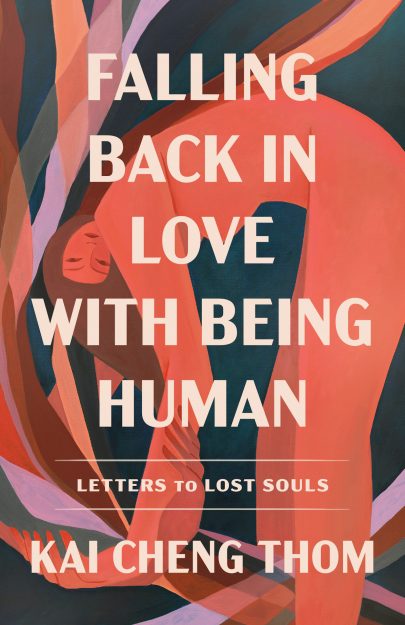
The result, Falling Back in Love with Being Human: Letters to Lost Souls, is Thom’s “act of prayer in a collapsing world”—a spell to summon the language to help her fall back in love with herself and the people around her. Tricycle sat down with Thom to discuss the Buddhist rituals that inform her work, how writing helps her to hold seemingly contradictory truths, and what it means to choose love as a daily practice.

Throughout the book, you explore what it means to love others and the parts of ourselves that we might consider monstrous, and you define a monster as a creature made of the truth that no one else dares to speak. How did you come to this notion of what it means to be a monster, and how have you reclaimed the monstrous? In the Western psychological tradition, Carl Jung wrote about the monsters within us, and he took a lot of inspiration from Buddhism and Hinduism. In thinking about the monstrous, I draw from Jung’s work, as well as different understandings of demons in Buddhist spirituality, especially practices of looking for the demons inside ourselves and learning to sit with them.

On a more personal level, I was raised evangelical Christian, and like many queer and trans people, I grew up being told that I was full of sin and that queer people were sinful monsters. Homophobia and transphobia were really present in my day-to-day. I was trying to repress the sin inside of me, and at the same time, I loved and longed for the sin outside me. I think this happens to us often: we desire the monstrous even as we fear it.

This can be complicated. Queerness is something beautiful that has been labeled as monstrous, but some things classified as monstrous are truly dangerous, like anger and rage. Our monsters need space to live and breathe, and if we’re not careful with them, they can result in harm and abuse.

You’ve mentioned your evangelical upbringing, and many of the letters in the book have a liturgical rhythm to them. How have you reclaimed liturgies and practices from a tradition that harmed you? There’s beauty in every monster and wisdom in every beast. The beast of evangelical Christianity is full of beauty, and its liturgy is something that I love, and Jesus is actually someone that I love. The part of Christianity that has stuck with me, beyond all of the pageantry, is the concept of grace. In Christianity, grace is the idea that we are all full of sin, but we can receive divine love anyway. I just love that. I don’t know if there is a God out there, but I think that human beings can offer one another divine love even in light of all that we’ve done wrong. I want to keep that idea around forever.

Are there any Buddhist rituals or practices that have particularly influenced you? There is a Tibetan Buddhist meditation about sitting and visualizing our demons and just being there and saying hello. That’s a practice that I will always love. But the Buddhist worldview that informs my life the most is the idea that paradox is where enlightenment is born—it’s not about resolving or conquering paradox by choosing one side; rather, it’s in the tension of more than one truth being true that a new wisdom arises. I think it’s so important to allow more than one thing to be true, especially when we’re talking about the nature of good and evil and people who may have harmed us.

Does writing help you to hold multiple truths? Definitely. In writing, I get to put both truths onto the page and then see if there is any new wisdom that arises, and then that wisdom becomes the basis of the poem. Language allows me to be in the chaos of competing truths and to give that chaos form, which is another paradox. Language gives form to the chaos of our internal experience and then somehow makes it more beautiful and bearable.

In the final letter, you write about your practice of choosing love. So what does it look like to choose love on a daily basis? There are many spiritual practices centered on choosing love, like lovingkindness meditation. But I think on the day-to-day level, choosing love is about resisting the spirit of panic and fear. One thing I’ve learned from my work in mediation and dialogue facilitation is that we need to be very careful about our tendency toward othering and monster-making. When we’re in groups, it can be so easy to get caught up in the spirit of panic. At the heart of panic is deep fear, and this fear can lead to toxic and possibly dangerous situations.

It can be so scary to live in the world. Choosing love is about choosing courage: the courage to take a relational risk that is meaningful. Maybe there’s someone in your community that you’re irritated by or that you disagree with. Actually choosing love might mean starting a conversation with them. I often think about the tragedies that occur when we say that our fear and our right to feel comfortable legitimizes or strengthens the call for the restriction on others’ freedom of others. Choosing love is about saying that it’s OK for me to be a little bit scared or uncomfortable so that we can all be free.

What are you hoping readers will take away from the book? I hope that people who read the book might feel inspired to put it into practice. One important lesson from Buddhist practice is that falling back in love doesn’t really work if we are trying to fall back in love with other people first. Generally, it’s more sustainable if we start with ourselves. If we just try to love the oppressor without loving ourselves first, then we run the risk of internalizing our own oppression or gaslighting ourselves. It must begin with self-love, falling back in love with ourselves, and then we can fall back in love with others. Of course, it’s not linear—it’s a cycle we go through over and over again.

A lot of people react to my work with fear, and I get that. But holding two truths is not just about holding someone else’s truth that you don’t like; it’s about knowing we also have a truth, and we get to hold that, too. It takes discipline and practice to be able to hold both truths without needing an answer—and without losing ourselves along the way.

kai cheng thom interview

Sarah Fleming is Tricycle‘s audio editor.
Kai Cheng Thom is a writer, performance artist, and community healer based in Toronto. Her most recent book is Falling Back in Love with Being Human: Love Letters to Lost Souls

The Terror Within

Below is an excerpt of the archived article from Tricycle: The Terror Within.

It reminds us to release our terrors and stop hiding from our fears.

Thank you, Zenju Earthlyn Manuel, for your words of compassion and wisdom.

For the full article see: tricycle.org/article/zenju-earthlyn-manuel-fear/

The Terror Within

Fear and anxiety builds up over a lifetime, but we can release our terrors moment by moment.

By Zenju Earthlyn Manuel 

“The stories my parents told of the South and race relations brought even more terror. And on an unforgettable night in 1966, right in Inglewood, California, a cross was burned on our front lawn. Why do I mention these things? I share them to demonstrate how fear and anxiety can accumulate over a lifespan. Most of us are unaware of the extent of the fear that we carry. Fear builds upon itself, or more precisely, fear creates more fear. As a result, our accumulated fear becomes a deep-seated terror that is challenging to uproot. If we view fear as terror—as a pervasive human condition rather than one bound to singular events, and incidents—we are more likely to feel the urgency of attending to it. We constantly speak of terrorism in the world, but we don’t necessarily acknowledge the terror that has invaded our inner worlds. Instead, we present ourselves as brave or courageous.

Many of us are afraid of fear, and afraid of admitting, even to ourselves, that we feel it. We push back the visceral body experience of fear so effectively we think we have eliminated the fear itself. However, if we look around or within, we find that fear is often hidden and masked: the person who appears to be the center of the party might well be a person who fears her own invisibility or rejection. Perhaps the person who conducts eloquent presentations at the workplace is in fact afraid of losing his job. The person that espouses to be an ally may be conquering some kind of fear within. The longer we mask our fear the more we experience the terror of our inauthenticity—perhaps creating chronic anxiety and despair. An ongoing red alert sounds off in response to threats that the terror we mask might be exposed. We might even say that the terror, as in the outer world, can become systemic within us. We become our own terrorist. 

We try many strategies to eliminate this feeling of terror by rearranging our external lives like furniture in our house. If I changed the way I look, I’d be less afraid; if I had more money to maintain a particular appearance, I’d be less afraid. If I live in a particular city or neighborhood, I’d be less afraid. But all of these strategies are bound to fail. At some point we need to confront the terror from within.

In my experience … first we need to unmask the fear; we need to let go of pretending we have no fear. If we pretend to be unafraid, we look as if we are disinterested or disconnected from everyone and everything.

Once I was getting ready for a television interview, the very first of many about a book I had just published in 1998. On my way to the studio, fear rode my back like a monkey. Thoughts ran rapid, and each one amounted to “I am not enough.” In the guest room, I met a famous civil rights attorney waiting for his time to be interviewed. He smiled and assured me all would go well. Clearly, he had seen my lack of breath and stiff movements. My terror was visible, and I was embarrassed. I realized in that moment that for most my life I had made great efforts at appearing calm while being completely terrified. Luckily, it turned out that once the cameras began to roll and my interview started, I found myself speaking from the heart about what was important to me; the adrenaline subsided and I was no longer afraid. Of course, when the cameras were turned off, the fear resumed. This time, it was a different fear—the fear of what I had said instead of what I was going to say.

How can we continue to release terror? Surely, it doesn’t work to try to unload the entire mass of fear inside at once. We can release terror moment by moment, bit by bit. In meditation we learn to cultivate and stretch the moments of being unencumbered, those places of non-suffering. We can experience the state of non-suffering with each breath, moment by moment, breathing in and breathing out. In meditation we feel the fear without having to do anything about it in the moment. We simply breathe. There is no past or future. We are not harming or being harmed. The terror within is being attended to in a gentle way. There may be tears or trembling. We are alive.

Buddha taught that there are five primary mental conditions that can impede our practice of meditation or mindfulness. My study of these conditions shed light on unacknowledged fear in my life. I could see that fear is embedded within each hindrance: 

  1. Sensual desire: Living with parents who were considered poor, I promised myself never to be poor. Therefore, my intense desire for material gain was expressed at the expense of my true happiness.  The fear of “not having,” and striving to “have,” fueled an illusionary fear of never having a satisfied life. The very quest for riches contributed to the inner poverty and loneliness that terrified me. In meditation, both the hindrance of desire and the attendant dissatisfaction are easily accessible. With a single breath, we can notice the fear that arises with sensual desire. On the out breath, such a fear can be released with care and gentleness. Each breath decreases the intensity of the fear.
  2. Ill will: Most of my life, the exclusion based on race, gender, and sexual orientation has brought forth rage. To say the least, I have had an enormous share of not being the chosen one. For many years I found it much easier to be enraged than to go beneath the rage to the fear that I would not ever belong or fit in with others in this society. A rage fueled by my very embodiment separated me from others, causing a cycle of more fear, alienation, and rage. Through paying attention to the breath in meditation, I was able to pause the cycle.
  3. Sloth and torpor (lifelessness): In a dull-minded state it is almost impossible to detect fear enmeshed with the dullness. Within the cloud of what Buddhists call sloth and torpor there is often the fear of taking action or the fear of not succeeding if one did take action. For years, I regretfully worked for others for fear of not being capable of manifesting my own dreams and visions. I remained on jobs while experiencing boredom and feeling constantly “tired.” In the slowing down and stillness of meditation, I saw my unacknowledged fear. I could see that I was afraid that others would not be interested in what I had to offer. In breathing in and out, I could begin to release the illusion that I was an inferior being (or superior one for that matter). In such a letting go of illusion, the entangled fear inside my lifelessness was released giving way to enthusiasm and clear visioning for my life.
  4. Restlessness and remorse: When I am restless, I meet life fearing that there is constant danger ahead, as if everything is a crisis or something is happening out of my control. Fear is enmeshed with restlessness and remorse. If I act on the restlessness, then remorse—compounded by regret and self-loathing—is guaranteed. When I’ve spoken from such restlessness, anxious to prevent some imagined harm, I’ve said words that have sometimes harmed others—I’ve found that I cannot be both restless and skillful. In meditation, we are invited to still the waters of our lives. We quiet the mind, releasing conjured stories and fantasies. When the waters are still long enough, we see our reflection. Once I’ve seen my restless and remorseful self in meditation, I can begin to release the restlessness and entangled fear, lessening the likelihood of later remorse.
  5. Doubt: Doubt is a distrust of what we sense in life. Distrust creates fear. … Eventually, I noticed the liberation occurring in my life and the fear of my new path washed away. Once I understood and trusted the teachings, I had something on which to build conviction—something to stand on during life’s inevitable waves of fear.  

While working with the hindrances, we may not eliminate fear. But it is possible to reduce fear by first recognizing it as part of the make-up of living beings. In my own life, once I understood that it was okay to be afraid, the healing began. The wisdom in my bones came alive and I became aware in the midst of fear and anxiety that the mind and body were begging to purge the terror within.

Meditation assists me in seeing the roots of the emotions, and that all emotions are old. When I notice terror rising to the surface, I note, “I am in the past.” Then, I ask, “What is going on here, right now?” When I am angry or enraged, I know to say, “I am terrified of something.” I refrain from being ashamed of experiencing these emotions. Only through acknowledging and releasing blind emotions can I experience the inner unencumbered and harmonious being that is always present despite the suffering.

We cannot fully practice any call for liberation without our lives being fully exposed. There is no hiding.” 

Learn more from Zenju in her Dharma Talk: It’s Beyond Me: Freedom from Managing Your Life.

Reprinted by permission from Inquiring Mind, Fall 2012 (Vol. 29 #1). © 2012 by Inquiring Mind.

[This story was first published in 2015]

Zenju Earthlyn Manuel is a Zen priest, author, and artist based in New Mexico. Her most recent book is The Shamanic Bones of Zen: Revealing the Ancestral Spirit and Mystical Heart of a Sacred Tradition.