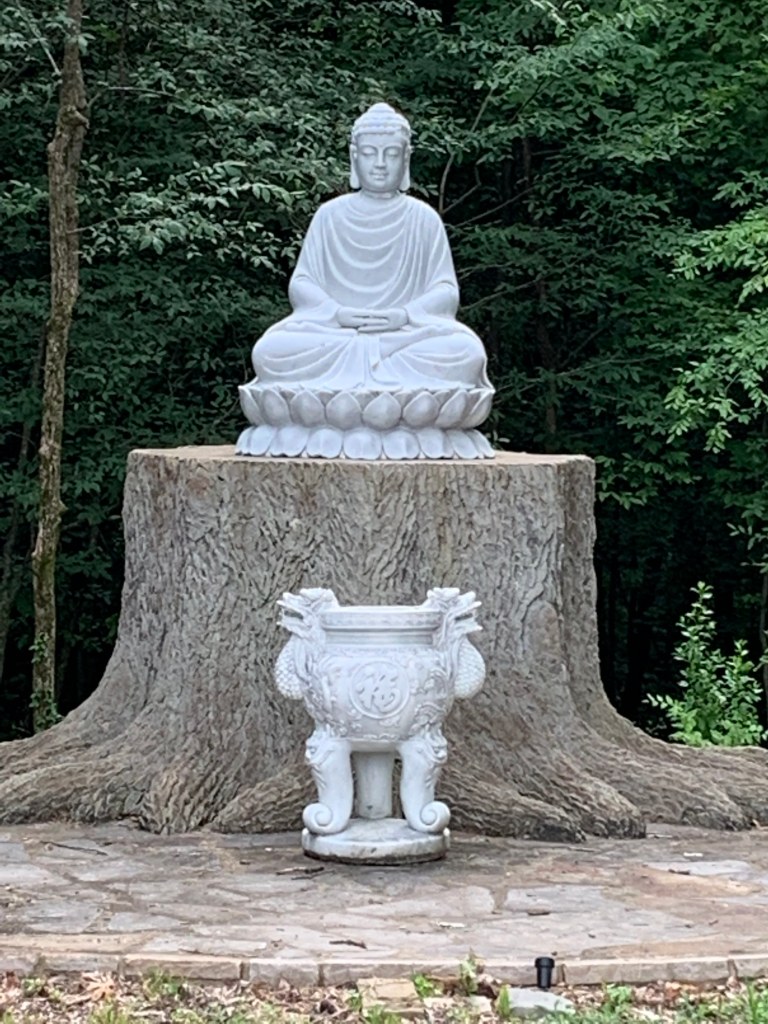
I will be celebrating this new moon at a meditation retreat center that includes monastic and lay people sharing observations on the state of our four-fold sangha practice. Previous retreats with this group have generated surprises and new insights. We shall see what this day brings.
First, the Tricycle article, Where to Find Joy and How to Cultivate It, (August 27, 2021) is co-authored by Christina Feldman and Jaya Rudgard, both mindfulness teachers in the Insight Meditation community. One of their main points is: the best way to find joy is to create it. Their 1,500 wordcount article can be found in its entirety here: https://tricycle.org/article/cultivating-joyfulness/
Second, the authors make a reference to The Dhammapada; specifically, verses 197 – 198 on Happiness. My copy of this book, see translation mentioned above, says:
“Ah, so happily we live, without hate among those with hate. Among people who hate we live without hate.
Ah, so happily we live, without misery among those in misery. Among people in misery we live without misery.” p.53
The point of the article, the quote and this post is that we are very unlikely to find ourselves in a perfect place, with perfect people all enjoying perfect joy. More likely we will need to work with ourselves and with a small group of kindred spirits to cultivate joy for one another.
I welcome your thoughts and your translations on how you find joy …. individually and together with others.
Donated by Kokichi Takahashi, courtesy of Hiroshima Peace Memorial museum
One day after a Saturday lecture, my Buddhist teacher Shunryu Suzuki opened the floor to questions. This was in 1968, at the height of the Vietnam War. I was in my early twenties at the time, working as an antiwar activist by day and learning about Buddhist meditation at Suzuki’s temple on weekends. I raised my hand and asked the question that was troubling me and so many of us in the room. “Suzuki Roshi,” I said, “What is war?”
He pointed to the goza mat in front of him, a six-by-three-foot thin rush mat on which two people were seated, and said, “When two people sit down on one mat, each person smooths the wrinkles on his side of the mat. When the wrinkles meet in the middle, that’s war.”
What a strange response, was my first thought. Then I remembered that Suzuki had lived through World War II as a temple priest in Japan. It was never clear why he wasn’t drafted into the Japanese army. Some people said it was because he was too short. Others said it was because temple priests were needed at home. Though he never talked about what he had experienced during the war, we all knew that it had been a traumatic and searing time for him. He once told us, “You Americans have seen the worst of my country. I came here to show you the best.” By that he meant Buddhism and Zen meditation. In any case, Suzuki’s answer to my question had to be taken seriously. He knew far more about war than any of us young Americans did.
At the time, his answer triggered a vigorous discussion in the whole group about the war in Vietnam and the fact that on this same day there was a big antiwar demonstration in the park—many of us had been conflicted about whether to go to the demonstration or come to Suzuki’s temple. Suzuki listened patiently to the back-and-forth of our discussion without saying anything. I’m sure that he appreciated our sincerity, but at the same time, given his own war experience, we probably struck him as young and naive.
His answer taught us that war was not just some vast, abstract governmental action happening out there in the world, against which we had to demonstrate and protest.
I’ve had decades since then to ponder his answer, and on deeper reflection I have realized that the story has many nuances and implications. Clearly the notion that each person wants their side of the mat to be smooth is an observation about a certain aspect of human nature. We tend to take care of our own needs first, or the needs of our family, community, or tribe, before we include the needs of anyone outside those circles. Only an unusually perceptive and aware person would take into account the needs of others when it causes inconvenience or suffering to themselves or their own group. There is a theory of moral stages created by the American psychologist Lawrence Kohlberg that maps a person’s ethical development from infancy through childhood and adulthood. According to this representation, to act from an awareness of “the greatest good for the greatest number,” to quote the famous dictum of philosopher John Locke, demonstrates a high level of moral development. Such principles form the basis of modern liberal democracies, including our own.
The highest moral stage, according to Kohlberg, is “transcendent morality,” in which a person’s awareness of the common good is so broad and evolved that it includes sacrificing one’s own well-being, or even one’s life, in the service of the universal welfare of all beings. This is the moral stance of such heroes as Mahatma Gandhi and Martin Luther King Jr., as well as of Buddhism itself. Suzuki Roshi’s comment about the wrinkles in the mat, I believe, emanated from that kind of Buddhist understanding. Given that understanding, it must have been horrific for Suzuki to watch helplessly as his entire country was swept up in a terrible war which it lost at the cost of more than two million young men. I once saw a photograph of the young Suzuki presiding over a ceremony at his temple to send the temple bell off to a factory to be melted down into bullets. He looked so sad in the photograph. I have often wondered how many funerals of young men Suzuki presided over during those war years. Assuredly, there were many.
In today’s world, one war that we are all facing is an internal war—some say a “cold civil war”—between political factions, red and blue, right and left. His answer might apply to that war too. There are so many ways in which Suzuki Roshi could have responded to my question, so many philosophical or religious doctrines that might have framed and explained the subject of war. But he did not do that. Instead, he just pointed to what was right in front of him: two people sitting on a straw mat. His answer taught us that war was not just some vast, abstract governmental action happening out there in the world, against which we had to demonstrate and protest. The real war starts right here, within each of us, and the first challenge is to face the conflict that lives within our own hearts. He didn’t directly say whether we should have gone to the antiwar demonstration or come to his temple for meditation, but his response to that was implicit in the answer he did give. If you want to truly know what war is, he was saying, sit down on a straw mat with one other person and don’t try to smooth out just your side. Be willing to accept the wrinkles that are always there, for everyone.
Thank you to Tricycle! As a nonprofit, they depend on readers like you to keep Buddhist teachings and practices widely available. Lewis Richmond is a Buddhist priest, meditation teacher, and a transmitted disciple of Shunryu Suzuki Roshi. He is the author of five books, including the award-winning Aging as a Spiritual Practice: A Contemplative Guide to Growing Older and Wiser, and his essays have appeared in Tricycle, Buddhadharma, Turning Wheel, and Lion’s Roar. He currently writes a weekly column for The Good Men Project.
Today is the International Day for Countering Hate Speech. The United Nations General Assembly adopted a resolution to counter hate speech which is defined as “any kind of speech or writing that attacks or discriminates against a person or a group based on religion, ethnicity, nationality, race, color, descent, gender, or any other identity factor. Speech should not be a weapon for creating more mayhem in this volatile world.”
For information on how to speak more truthfully and lovingly please refer to your faith tradition reminders. For one example you might consider the Metta (Loving-Kindness) Sutta at https://www.insightmeditationcenter.org/metta-sutta/ or the fine art rendition shown below.
“With Ch’an, I better understand myself, my mission in time and space. No drama and dharma are what I seek; decent and solid is my true face.
When change is where we live, from dyana to zazen I count, at least to five; breath to body to kindness, twelve links and paramount.
The flower tells me no fixed formula to finding a peaceful moon. Observer and observed, no mind; full, half, Burmese, or kneeling rune.
Lying down or walking; all are healing. Breathing from belly my half-smile arises. I hear One Love in every sone. Zazen, kinhin, and chanting surprises:
plan, do, check, act through all my days, kaizen by point or by the whole. I ask why at least five times to comfort any painful earhole.
To love thee with smiles and tears and breath, I fondly count till my counting ends and love Thee better through birth and death.”
*With a nod to Elizabeth Barrett Browning’s “Sonnet 43“
“He asked me if I thought he’d make it: survive his surgery. ‘Yes, I do’, I replied clear and plain. ‘There’s still a lot for you to do.’
He said he wasn’t afraid to die and agreed that much remained undone.
He showed me his office filled with papers, talked about requests for his archives, recalled his written yet unpublished work, his thoughts for more to write. Talked about his son’s wedding to come, looked forward to a granddaughter’s visit that night, his garden needed tending, he could get back in shape easily if he could only breathe easier … it wasn’t asthma after all you see … but the need for surgery (or two).
He wasn’t afraid to die and there was still plenty to do beforehand. His life still mattered – that’s why.”
“Before we were born, before the universe even, when only love existed, events began, action was taken, love was revealed.
If dharma is truth, then dharma is love, and dharma is love in action.
There is thought, there is speech, and there is action … behavior …what we do.
I do not know another’s thought. I may or may not hear you speak, but I see your behavior, I see what you do.
Someone said, believe half of what you see and nothing of what you hear. Someone said, be careful of your thoughts because they will lead to speech and be careful of your speech for it will lead to action.
Careful, careful, careful, but, I can only believe your action.”
Lady Julian Says It’s AllLove Revealed from NATURAL BEAUTY AND OTHER POEMS, p.32
“Stumbling into enlightenment – heard that phrase before. Must look it up and read it once again. Truth is never once and done; repeatedly it calls. We’re ever drawn to the light, like I am to Zen.
We go without breath for only so long, so too with water or food. Our physical existence is dependent upon matter, both beautiful and crude.
Likewise, our spiritual life depends upon a love that flows free from one to another to others still. Truth lives in community.”