Tag Archives: senryu

Mar 25 – Levels of Consciousness

Re-reading Power vs. Force by David R. Hawkins, M.D., Ph.D., (c) 2012 Author’s Official Authoritative Edition, I was reminded that it was time to “raise my sights” from choosing joy to choosing enlightenment.

While both joy and enlightenment are in the “extraordinary outcomes” pinnacle, why stop at joy when there are still two higher vibrations levels available?

Today’s senryu: Levels of Consciousness

getting past my self

we perceive a greater truth:

interbeing Self

May we all be happy, productive, without stress and synchronistically extraordinary.

Mar 23 – What’s in a Name?

Some days my mind jumps from one thought to another so quickly it’s hard to connect the dots. Today is like that for me.

nosweatshakespeare.com/quotes/soliloquies/whats-in-a-name/

“What’s in a name? That which we call a rose
By any other name would smell as sweet.” Spoken by Juliet, Act 2 Scene 2 of Shakespeare’s Romeo and Juliet

Today’s senryu: What’s in a Name?

a whore’s spaghetti

so tainted by love apples

childhood favorite

(See https://recipes.howstuffworks.com/tomato-called-a-love-apple.htm)

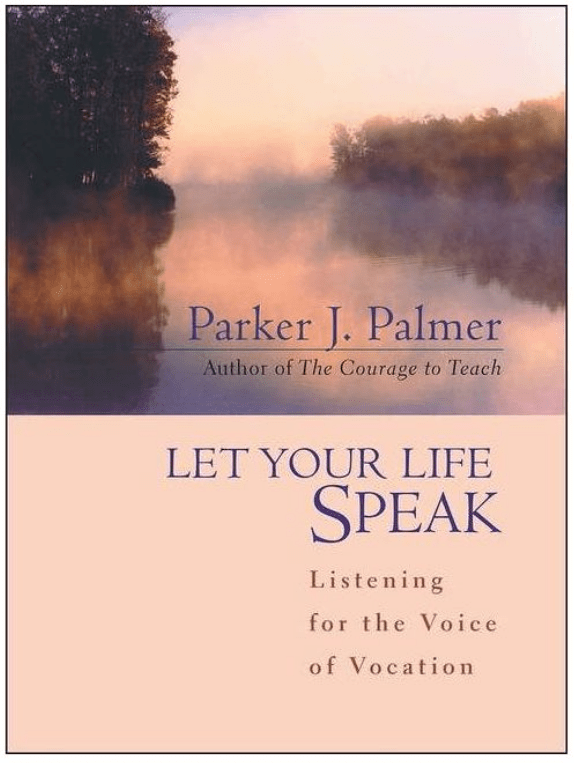
Mar 18 – Let Your Life Speak by Parker Palmer

Parker J. Palmer is an American author, educator, and activist who focuses on issues in education, community, leadership, spirituality and social change. He has published ten books and numerous essays and poems and is founder and Senior Partner Emeritus of the Center for Courage and Renewal.” https://en.wikipedia.org/wiki/Parker_Palmer

Only 117 pages, Palmer’s small book, Let Your Life Speak, (c) 2000 by Jossey-Bass, is filled with candor and wisdom about his (and our) search for right livelihood, for a meaningful vocation.

A couple of quotes from this book inspired by his Quaker practice are:

“there is much guidance in what does not and cannot happen in my life as there is in what can and does – maybe more.” p.39

“If I try to be or do something noble that has nothing to do with who I am, I may look good to others and to myself for a while. But the fact that I am exceeding my limits will eventually have consequences. I will distort myself, the other, and our relationship – and may end up doing more damage than if I had never set out to do this particular ‘good’. … It took me a long time to understand that although everyone needs to be loved, I cannot be the source of that gift to everyone who asks me for it. There are some relations in which I am capable of love and others in which I am not. To pretend otherwise, to put out promissory notes I am unable to honor, is to damage my own integrity and that of the person in need.” pp.47-48

“We can make choices about what we are going to project, and with those choices we help grow the world … Our complicity in world making is a source of awesome and sometimes painful responsibility – and a source of profound hope for change.” p.78

“Spring teaches me to look more carefully for the green stems of possibility, for the intuitive hunch that may turn into a larger insight, for the glance or touch that may thaw a frozen relationship, for the stranger’s act of kindness that make the world seem hospitable again. … if you receive a gift, you keep it alive not by clinging to it but by passing it along.” pp.104-105

Today’s senryu: Let Your Life Speak

I can do myself,

I cannot do you – that is

yours to make happen.

http://www.target.com/p/let-your-life-speak-by-parker-j-palmer-hardcover

Mar 15 – Two Types of Ancestors

Sister Annabel Laity – author at the Plum Village Shop plumvillage.shop

In her book, Mindfulness – Walking with Jesus and Buddha (c) 2021, Sister Annabel Laity identifies the two types of ancestors:

“Our blood ancestors are not the only source of our lives. We also have spiritual ancestors who transmit to us the spiritual direction that our life takes … Our blood ancestors are one of our roots, and our spiritual ancestors are no less important a root … Mindful of our blood and our spiritual ancestors, we shall see their qualities that we want to continue, and we shall also see their shortcomings. We cannot reject our ancestors, because of their mistaken ways. Who are we, who are by no means perfect, to do that? … We accept all our ancestors as they are, and we feel well because, by accepting them, we are accepting ourselves.pp. 116-117

Today’s senryu: Two Types of Ancestors

Dearest sister and

crazy old uncle Friedrich,

did God really die?

https://en.wikipedia.org/wiki/Thus_Spoke_Zarathustra

Nietzsche dismissed Schopenhauer and Christianity and Buddhism as pessimistic and nihilistic, but, according to Benjamin A. Elman, “[w]hen understood on its own terms, Buddhism cannot be dismissed as pessimistic or nihilistic“. Moreover, answers which Nietzsche assembled to the questions he was asking, not only generally but also in Zarathustra, put him “very close to some basic doctrines found in Buddhism”. An example is when Zarathustra says that “the soul is only a word for something about the body“. https://en.wikipedia.org/wiki/Thus_Spoke_Zarathustra

Mar 14 – “What Betrayal of the Soul”

In his book Living Between Worlds, (c) 2020 Sounds True, Dr. James Hollis, asks:

“What betrayal of the soul transpires when we collude with our debilitating fears? And who, besides us, will pay those debts of unlived life – our children, our partners, our colleagues, our society? Do we not see the best thing we can do for others is really to bring our best, most nearly authentic selves to engage them?” (p. 42)

Today’s senryu: What Betrayal of the Soul

Hide it or use it,

share it or lose it – what calls

out to you today?

Mar 11 – Our True Self or 1+1+1

Ilia Delio, Chair in Theology at Villanova University, shares how Thomas Merton informed herstory in Discovering the true self in God with Merton’s guidance. (See https://www.ncronline.org/blogs/ncr-today/discovering-true-self-god-mertons-guidance). Delio begins by quoting Merton and then elaborates:

“‘Our vocation is not simply to be, but to work together with God in the creation of our own life, our own identity, our own destiny.

The search for true identity requires an honest self-love. Love of self is not selfishness but a humble recognition of our lives as true, good and beautiful. Without real love of self, all other loves are distorted. “

https://www.linkedin.com/in/marybeth-weiss/

Marybeth Weiss, VP for People & Culture, has a related message in her article, There Is No “I” in Team, but There Is a “Me”: Building a Better Team Starting with You. (See https://trainingindustry.com/articles/strategy-alignment-and-planning/there-is-no-i-in-team-but-there-is-a-me-building-a-better-team-starting-with-you/). Weiss offers:

“If we rely on stories to drive behavior, we can’t accomplish anything, and relationships deteriorate … Teams can only grow and flourish from the hunger and drive of each individualTeam success isn’t always about what the group does but how each member contributes.

Today’s senryu: our true self

one plus one plus one

equals infinity – yes,

we’re more, together

Feb 10 – Why Wait?

Are you ever impatient with impermanence? Does time marching on ever bring solace? Is life itself exasperating? Just three questions on a Friday morning resulting in three senryus linked below.

Today’s linked senryus: Why Wait?

At your service or

at your mercy – I’m tired;

tired of waiting …

Godot or Bardot

daydreams no longer work – I’m

tired of waiting …

Time is not my friend

I know I am breathing – so?

tired of waiting …

The Knowing – Doing Gap

Today’s senryu: The Knowing – Doing Gap

I know what to do

but have not done it just yet.

Do I really know?

I’m listening to Bhikkhu Bodhi‘s audio book The Noble Eightfold Path – The Way to the End of Suffering (c) 1984. Here are a couple of early passages:

“It would be pointless to pose the question which of the two aspects of the Dhamma has greater value, the doctrine or the path. But if we did risk the pointless by asking that question, the answer would have to be the path. The path claims primacy because it is precisely this that brings the teaching to life. The path translates the Dhamma from a collection of abstract formulas into a continually unfolding disclosure of truth. It gives an outlet from the problem of suffering with which the teaching starts. And it makes the teaching’s goal, liberation from suffering, accessible to us in our own experience, where alone it takes on authentic meaning.

To follow the Noble Eightfold Path is a matter of practice rather than intellectual knowledge, but to apply the path correctly it has to be properly understood. In fact, right understanding of the path is itself a part of the practice. It is a facet of right view, the first path factor, the forerunner and guide for the rest of the path. Thus, though initial enthusiasm might suggest that the task of intellectual comprehension may be shelved as a bothersome distraction, mature consideration reveals it to be quite essential to ultimate success in the practice.

The search for a spiritual path is born out of suffering. It does not start with lights and ecstasy, but with the hard tacks of pain, disappointment, and confusion. However, for
suffering to give birth to a genuine spiritual search, it must amount to more than something passively received.”

From another perspective, I’m fond of the book The Knowing-Doing Gap by Jeffrey Pfeffer and Robert I. Sutton (c) 2000 where the authors explain knowing comes from doing and teaching others how … in a world of conceptual frameworks, fancy graphics presentations, and, in general, lots of words, there is much too little appreciation for the power, and indeed the necessity, of not just talking and thinking but of doing – and this includes explaining and teaching – as a way of knowing.”

The book goes on to quote a senior executive who says, “Where we go from an awareness state to a real knowledge is where we have problems. We are aware of it but we don’t have the knowledge because we’ve never had to teach it or implement it. And I see that’s a huge gap.” p. 248-249

Can we ever truly know without actually doing something with that knowledge?