Category Archives: death

Why Love What You Will Lose?

Tricycle’s online magazine offers a provocative article which discusses two key questions: Why love what you will lose? and What else is there to love?

Below is a highlight from this worthy article. To read the entire article see the link at the bottom of this post.

  • Suffering is, strangely, both sickness and medicine, impossible to tease apart in the end. … That we suffer and share this great fact of impermanence together is profound medicine in itself, a medicine that releases compassion, love, connectedness, and forgiveness as the healing source. 

From A Fire Runs through All Things: Zen Koans for Facing the Climate Crisis by Susan Murphy © 2023 by Susan Murphy. Reprinted in arrangement with Shambhala Publications, Inc. Boulder, CO

We Too Suffer, Die and Rise Anew

Below is today’s message from the Center for Action and Contemplation. In it, Richard Rohr explains how we miss the message if we focus on religion versus the natural life cycle of … life.

Hope you enjoy a couple of highlights from Richard Rohr’s Easter message:

An Example for Us All

Monday, April 21, 2025  

We got into trouble when we made the person and the message of Jesus into a formal religion, whereby we had an object of worship; then we had to have a priesthood, formal rules and rituals. I’m not saying we should throw those things out, but once we emphasize cult and moral code, we have a religion. When we emphasize experience, unitive experience, we have the world Jesus is moving around in. Once we made Jesus into a form of religion, we projected the whole message onto him alone. He died, he suffered, he rose from the dead, he ascended and returned to God. We thought that by celebrating these wonderful feasts like Easter that this somehow meant that we were members of the club.    …………

Easter is the great feast of the triumph of universal grace, the triumph of universal salvation, not just the salvation of the body of Jesus. What we’re talking about creates a people of hope, and a culture of hope that doesn’t slip into cynicism and despair. Easter is saying, we don’t need to go there. Love is going to win. Life is going to win. Grace is going to win. Hallelujah! 

Parting Is Such Sweet Sorrow & Waiting Is Never Easy

Instead of rushing to a desired new future we must often dwell in a state of unknowing. In between crucifixion and resurrection is a long waiting period and I’ve never been good at waiting. How about you?

Today’s message from the Center for Action and Contemplation comes from Dr. Christine Valters Paintner of the Abbey of the Arts. Highlights below address the liminal space of moving from a painful past to a new future … from letting go “of things, people, identities, or securities” and wondering “what will rise up out of the ashes of our lives.”

Lingering In-Between 

Christine Valters Paintner invites us to the patience necessary to receive the wisdom of Holy Saturday:  

For me, Holy Saturday evokes much about the human condition. It helps us examine the ways we are called to let go of things, people, identities, or securities. We wonder what will rise up out of the ashes of our lives…. 

Instead of rushing to resurrection, we must dwell in the space of unknowing. We must hold death and life in tension. One day, we can help others live through these scary and tense landscapes. The wisdom of the Triduum is that we must be fully present to both the starkness of Friday and the Saturday space between before we can really experience the Resurrection. We must know the terrible experience of loss wrought in our world. This pain can teach us more when the promise of new life dawns, and we will appreciate its light because we know the darkness….  

Much of our lives are spent in Holy Saturday places but we spend so much energy resisting, longing for resolution and closure. Our practice this day is to really enter into the liminal zone, to be present to it with every cell of our being.  

Honor the mystery

Reference:   
[1] Christine Valters Paintner, The Soul of a Pilgrim: Eight Practices for the Journey Within (Sorin Books, 2015), 122–123.  

The Magic & Mystery of Aging: Excerpts

I’m approaching a milestone birthday, and my thoughts today are about aging. Synchronistical, there’s an archived Tricycle article that offers much reassurance on this very topic.

See excerpts below from Douglas Penick’s article. For the full article see: tricycle.org/magazine/buddhism-aging/


The Magic & Mystery of Aging

Old age as preparation for perfect awakening

By Douglas Penick Winter 2022

There are many discussions of how the young should manage the old, but there is not much discussion of how it feels for the old to find the same mind continuing, its clarity and curiosity.

Buddhaghosa, the great 5th-century Theravada Buddhist investigator of mind, wrote:

Aging has the characteristic of maturing (ripening) material instances. Its function is to lead on to death.

Aging is the basis for the bodily and mental suffering that arises owing to many conditions such as leadenness in all the limbs, decline and warping of the faculties, vanishing of youth, undermining of strength, loss of memory and intelligence, contempt on the part of others, and so on.

Hence it is said:

With leadenness in every limb,
With every faculty declining,
With vanishing of youthfulness,
With memory and wit grown dim,

With strength now drained by undermining,
With growing unattractiveness to spouse and kin,
To [spouse] and family and then
With dotage coming on, what pain
Alike of body and of mind
A mortal must expect to find!
Since aging all of this will bring,
Aging is well named suffering.

The Path of Purification, trans. Bikkhu Nanamoli

If you are reading this, your chances of ending up in a nursing home are just short of 50/50. That is to say, 4 out of 10 of Tricycle’s readers are likely to end their lives in institutional care. But as Meg Federico wrote, people have to make the most difficult decisions, plans concerning the last years of their lives, at a time they are least capable of doing so. Nonetheless, we will age, and something will happen to us. Atul Gawande, a distinguished surgeon and commentator on the care of the aged, describes the likely situation in which we who live in the Western post-industrial world will find ourselves:

The waning days of our lives are given over to treatments that addle our brains and sap our bodies of a sliver’s chance of benefit. They are spent in institutions—nursing homes and intensive care units—where regimens, anonymous routines cut us off from all the things that matter to us in life. Our reluctance to honestly examine the experience of aging and dying has increased the harm we inflict on people and denied them the comforts they most need. Lacking a coherent view of how people might live successfully all the way to their very end, we have allowed our fates to be controlled by the imperatives of medicine, technology, and strangers.

Being Mortal

“Old age. It’s a secret, a kind of hidden magic. It’s right there, this practice, and no one sees it. We’re being shown, given. It is how our lives actually work. What we are told we should not cling to is actually naturally being stripped away. . . . Resistance is not possible or only creates more confusion, pain.”

We see our body as a noun, an entity with fixed properties and functions. And because we tend to look at ourselves this way, when various qualities of our body change during the aging process, this is unpleasant; when our body cannot function as it used to, we are distraught, lost. If, however, we see our body as a verb, a combination of properties and functions constantly in motion, then it’s very different.

Dogen Zenji said: “When the world ends, and the fires blaze unobstructedly through everything, and all falls to ruin, we just follow circumstance.” (Trans. Kidder Smith)

Like light in air, we cannot stop,
Every instant dissolves.
Awakening is not something we make happen
Awakening happens without reference point
Without boundary.
Like light in air
Moments do not stop in one self or an other.
Dissolving
Reforming
Awakening breaks open in the experience of whatever and all.

Here’s Dogen again:

Greatly awakening has no beginning or end, returning to confusion had no beginning or end. Why? It just goes off everywhere, while the worlds are being destroyed.” (Trans. Kidder Smith)

Douglas Penick is a longtime Buddhist practitioner and has published three Gesar of Ling episodes. His books include the recent essay collection T The Age of Waiting, adapted from Tricycle articles, and the upcoming The Oceans of Cruelty.

I’m Losing It – Catastrophic Memory Loss

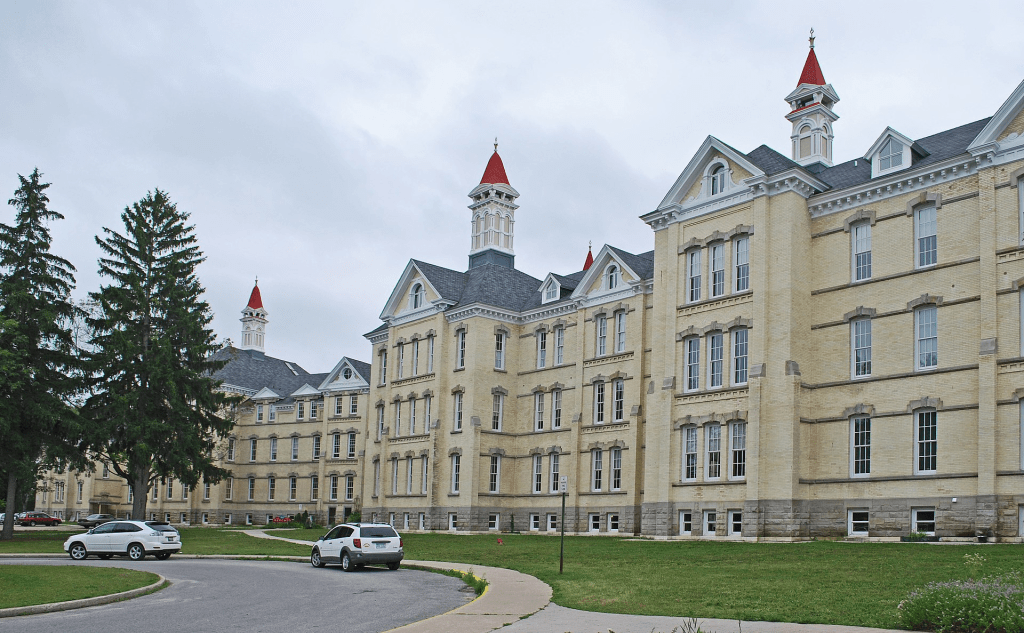
https://en.wikipedia.org/wiki/Traverse_City_State_Hospital#/media/File:NorthernMichiganAsylumCTraverseCityMI.JPG

A nurse working in the state psychiatric hospital system, our grandma explained that she was drawn into this work by watching her father, and later her older brother, suffer from Alzheimer’s Disease. Was it her observations or her personal light-hearted and reassuring demeanor, which led to her informing us of the “two types of Alzheimer’s: the funny kind and the scary.”

Grandma said that some of her patients would laugh at their forgetfulness and find it such a tickle to discover that they had forgotten their name, their location and what they were doing just a second ago. “Ha, ha, ha.” What a delight, every day, every hour, sometimes every minute, was a whole new adventure and “Oh, who are you again?” Grandma enjoyed working with these happy folks.

Sadly, there were other patients who would be frightened to discover that they didn’t know where they were, who you were, who they were, and become so disoriented that they would huddle or cry and be so fearful of what might happen to them. No matter how much grandma might say or do to console them, these patients would be distraught and distrustful of anyone’s attempts to assist them.

Grandma ensured me that our family was fortunate to have the “funny kind of Alzheimer’s.” “Nothing to worry about should you ever experience Alzheimer’s.”


Below are excerpts of the touching, Douglas Penick, article in the latest Tricycle magazine called “The Wall – What Remains When the Mind Goes?


“Month by month, I forget more
and more,
Betray the kindness of those
who taught me.
I drift in seductions of fatigue and
winter mist.

I forget liturgies, poems, practices,
Drifting on the errant life force of a vacant mind.
Layer after layer falls away.
There is
This wall
Before me
Here and now. …

But I know that if I were diagnosed with a profoundly mind-altering disease, I would find cultivating a different and broader kind of mental engagement more encouraging than struggling against encroaching deficits by playing Sudoku and doing crossword puzzles. …

The sudden disappearance of a routine memory: I cannot remember the name and even the atmosphere of a nearby street I walk on regularly. I can see it as I look down through leafless trees from the window in my high-rise apartment, but I no longer know what I’m looking at. It is a blank, a gap. …

For the full article see: tricycle.org/magazine/douglas-penick-memory/ and the companion article link displayed below.

Two, Two, Two Things in One

Hot & Steamy

this is not triple x

this is my dog’s first dump of the day

large, firm and steaming with its salute to the sun

on this fine spring morning

mid-50s temp at 7:30am

oh, glorious excrement

to honor another opportunity

to process life’s bounty

Forecasters

calendars, like meteorologists,

or even those predicting the apocalypse,

can look foolish when their forecasts ring false

for example, spring begins on March 20

no, not true in Michigan,

calendars say what they say

but in reality

a Michigan spring begins later

oh, sure, in March there may be a sneak peak

but winter returns … to tamp down premature joy

suffering and joy …

the same is true for the other seasons too

each begins with a tease

only to truly arrive

much later than forecasted

Jun 28 – One Week Later

Zorro and me a few months back

Today’s dogryu: One Week Later

miss you so, Zorro

grateful for the time we had

still holding you close


http://www.strayrescue.org

I return to Stray Rescue today to walk some big dogs. Plenty of dogs looking for love and attention. The feelings are mutual.

In his book HOW TO LIVE WHEN A LOVED ONE DIES, Thich Nhat Hanh explains:

Letting Emotions Flow Through You

Do not be afraid of your painful feelings and difficult emotions. If we try to repress our painful feelings, we create a lack of circulation in our psyche which can lead to depression or other psychological problems. Just as the body needs good circulation of the blood to remain healthy, we also need good psychological circulation. …

Mindfulness is the blood of our psyche. Like the blood in the body, it has the power to eliminate toxins and heal our pain. Every time our pain is embraced by mindfulness, it loses some of its strength; it becomes weaker each time. …

When mindfulness circulates in our consciousness, we begin to experience well-being. We needn’t be afraid of our pain when we know that our mindfulness is also there, ready to embrace and transform it.” p.56

http://www.penguinrandomhouse.com/books/667266/how-to-live-when-a-loved-one-dies-by-thich-nhat-hanh

The Messiness of Life by Terry Hershey

Zorro not feeling well (picture taken by me, also not feeling well)

Today, June 21, 2023, I will be asked to decide on end-of-life procedures for my beloved 12-year-old male Chihuahua. To say I am sad cannot express how low I feel.

As an animal chaplain, I have taken a vow to “honor animal lives and heal human hearts.” Today, I will honor Zorro and someday, maybe not today, I will heal my own heart. I know I will need help to do this and I’m uncomfortable asking for help. Giving help is easier for me than asking for it or even accepting it when it is offered.

Life is messy and Terry Hershey’s message below is especially meaningful for me today.

The Messiness of Life

Messiness exposes vulnerability. I will admit, vulnerability is not my strong suit. I do prefer self-sufficiency. And rising above. And yet, self-reliance sounds laudable, but can be an obstacle, because it is difficult to say the words “help” or “thank you.” So, here’s the good news: There is power in embracing vulnerability. And vulnerability never exempts us from the sacrament of the present. Because vulnerability allows us to rest in that touch, that blessing.

—from the book This Is the Life: Mindfulness, Finding Grace, and the Power of the Present Moment
by Terry Hershey

May 7 – Last Day of Retreat

magnoliagrovemonastery.org/photo-gallery

Sunday morning coming down … the last day of retreat is for final talks and final goodbyes. Some people linger as long as possible while others pack up early and are eager to return to home, family, work, and/or civilization.

The vast majority of retreatants are making promises to themselves and/or others to return again. There are many goodbye hugs and well wishes shared.

Today’s senryu: Last Day of Retreat

renewed spirits and

relief to move forward – yes

impermanence is

The six-hour drive home includes a lot of debriefing with car mates that had similar yet different experiences than you. Since retreatants are assigned living quarters by gender and meditation groups by chance, it’s very likely that each traveler has a different perspective on what was their favorite part of the retreat.

So long, Magnolia Grove.

magnoliagrovemonastery.org/photo-gallery