Category Archives: death

Jan 30 – Remembering Mahatma Gandhi

With thanks to Sister Joan Chittister, I am reminded of the life and legacy of Mohandas Karamchand Gandhi (2 October 1869 – 30 January 1948).

January 30: Mahatma Gandhi, the great Indian teacher of nonviolence, died on this day in 1948. One of the greatest pacifists of all time, in 1948 Gandhi was himself assassinated by religious conservatives who promoted the political division he sought to overcome. It would seem that Gandhi failed. Yet, multitudes around the world, including Martin Luther King, Jr., have followed his tenets. To allow your own life to seed another’s, is fruit enough to last a lifetime.
         —from A Monastery Almanac by Joan Chittister

Today’s senryu: Remembering Mahatma Gandhi

A man of extremes

you would not be ignored when

life’s demands beckoned

For more information on this great soul, see https://en.wikipedia.org/wiki/Mahatma_Gandhi

Jan 18 – A Poet More People Should Remember – Edna St. Vincent Millay

Edna St. Vincent Millay (February 22, 1892 – October 19, 1950) was an American lyrical poet and playwright. Millay was a renowned social figure and noted feminist in New York City during the Roaring Twenties and beyond. She wrote much of her prose and hackwork verse under the pseudonym Nancy Boyd.” https://en.wikipedia.org/wiki/Edna_St._Vincent_Millay

Pulitzer-Prize-winning poet (1923), feminist bisexual socialist, Vincent (as she called herself) was dismissed later in life for her use of traditional poetic forms.

She died after years of suffering and morphine use due to a car accident and finally falling down her stairs at home from a broken neck and the heart attack immediately preceding it.

One of her earlier poems seems fitting here: Dirge Without Music

I am not resigned to the shutting away of loving hearts in the hard ground.

So it is, and so it will be, for so it has been, time out of mind:

Into the darkness they go, the wise and the lovely.  Crowned

With lilies and with laurel they go; but I am not resigned.

Lovers and thinkers, into the earth with you.

Be one with the dull, the indiscriminate dust.

A fragment of what you felt, of what you knew,

A formula, a phrase remains,—but the best is lost.

The answers quick and keen, the honest look, the laughter, the love,—

They are gone.  They are gone to feed the roses.  Elegant and curled

Is the blossom.  Fragrant is the blossom.  I know.  But I do not approve.

More precious was the light in your eyes than all the roses in the world.

Down, down, down into the darkness of the grave

Gently they go, the beautiful, the tender, the kind;

Quietly they go, the intelligent, the witty, the brave.

I know.  But I do not approve.  And I am not resigned.

Edna St. Vincent Millay, “Dirge Without Music” from Collected Poems © 1928, 1955 by Edna St. Vincent Millay and Norma Millay Ellis. Reprinted with permission of Elizabeth Barnett and Holly Peppe, Literary Executors, The Millay Society. https://www.poetryfoundation.org/poems/52773/dirge-without-music

Jan 17 – A Poet More People Should Know – Mary Lou Kownacki

Sister Mary Lou Kownacki, OSB
November 29, 1941 ─ January 6, 2023

“Sister Mary Lou published several books of poetry as well as chapbooks of prayers and poems. Her writing appeared in National Catholic ReporterSojournersCommonweal, and others. She compiled and edited numerous books during her time at Pax Christi and later for other publishers including Orbis Books … Her book Between Two Souls: Conversations with Ryokan (Eerdmans) won a first place Independent Publisher Book Award (IPPY) in 2005.” https://eriebenedictines.org/story/memoriam-sister-mary-lou-kownacki-osb

“Of the hundreds of poems that Sister Mary Lou wrote, this one, published in her 2004 book, Between Two Soulsseems especially relevant now.

A Friend’s Funeral

She never gave in to weakness
The eulogist said.
And I prayed my mourners
Would hear a friend who preached:
She gave in to every weakness,
All commandments broken with abandon,
All vows stretched to the altar rail and
Pushed through the pews.
In this way
She immersed herself in the human condition.
Weakness was her strongest virtue.
       —Mary Lou Kownacki

from this week’s Vision and Viewpoint e-newsletter from Joan Chittister.

Here is my humble senryu in response: I Wish We’d Met Sooner

our paths crossed too late

to share a bright high noon – yet

sunsets still bring smiles

Thank you, Mary Lou Kownacki, Joan Chittister, and this week’s e-newsletter “compilers” Jacqueline Sanchez-Small, Anne McCarthy, and Benetvision Staff. See https://joanchittister.org/~joanchit/content/newsletters

Jan 15 – Tomorrow is Martin Luther King, Jr. Day

Change is difficult, for us and for the collective. Unfortunately, when we make progress, it’s easy to assume that it will continue without our continued effort. No, we must not give up. Our efforts to sustain the progress is needed today and everyday going forward. It takes all of us to make a Beloved Community.

Today’s senryu: Tomorrow is Martin Luther King, Jr. Day

listen to prophets,

become a prophet, and change

the future for good

Martin Luther King, Jr. and Thich Nhat Hanh statues in the Beloved Community Garden at Magnolia Grove Monastery https://magnoliagrovemonastery.org/photo-gallery/#bwg2/25

See today’s daily meditation from the Center for Action AND Contemplation below and here: https://cac.org/daily-meditations/disrupting-the-status-quo-2023-01-15/

Disrupting the Status Quo

Richard Rohr describes how speaking truth to power is an essential part of the prophet’s mission:

One of the gifts of the prophets is that they evoke a crisis where one did not appear to exist before their truth-telling. In the 1960s, Martin Luther King Jr. was blamed for creating violence—but those who had eyes to see and were ready to hear recognized, “My God, the violence was already there!” Structural violence was inherent in the system, but it was denied and disguised. No one was willing to talk about it. Martin Luther King Jr., Rosa Parks, and others said, “We’re going to talk about it.”

Prophets always talk about the untalkable and open a huge new area of “talkability.” For those who are willing to go there, it helps us see what we didn’t know how to see until they helped us to see it. That’s how we begin to recognize a prophet—there is this widening of seeing, this deepening of a truth that was always there.

Prophets generate a crisis, so it’s almost understandable why they’re usually called troublemakers and so often killed. They generate the crisis because while everybody else is saying the emperor is beautifully clothed, they are willing to say, “No, he’s naked.” We’re not supposed to say that the emperor has no clothes!

It’s the nature of culture to have its agreed-upon lies. Culture holds itself together by projecting its shadow side elsewhere. That’s called the “scapegoat mechanism.” René Girard, Gil Bailie, and others have pointed out that the scapegoat mechanism is the subtext of the entire biblical revelation. It’s the tendency to export our evil elsewhere and to hate it there, and therefore to remain in splendid delusion. If there isn’t a willingness to be critical of our country, our institution, and ourselves, we certainly can’t be prophets. [1]

When the prophet is missing from the story, the shadow side of things is always out of control, as in much of the world today, where we do not honor wisdom or truth.

It seems the prophet’s job is first to deconstruct current illusions, which is the status quo, and then reconstruct on a new and honest foundation. That is why the prophet is never popular with the comfortable or with those in power. Only a holy few have any patience with the deconstruction of egos and institutions.

The prophets are “radical” teachers in the truest sense of the word. The Latin radix means root, and the prophets go to the root causes and root vices and “root” them out! Their educational method is to expose and accuse with no holds barred. Ministers and religion in general tend to concentrate on effects and symptoms, usually a mopping up exercise after the fact. As someone once put it, we throw life preservers to people drowning in the swollen stream, which is all well and good—but prophets work far upstream to find out why the stream is swollen in the first place. [2]

[1] Adapted from Joan Chittister and Richard RohrProphets Then, Prophets Now (Albuquerque, NM: Center for Action and Contemplation, 2006). Available as MP3 download.

[2] Adapted from Richard Rohr, Soul Brothers: Men in the Bible Speak to Men Today (Maryknoll, NY: Orbis Books, 2004), 31, 39, 40.

High Coo – Dec 22 – RIP Samuel Beckett

Samuel Beckett b. 4/13/1906 – d. 12/22/1989

Thirty-three years ago today, Irish playwright, novelist and poet, Samuel Beckett died. He was 83.

“One of the most influential and widely-discussed avant-garde writers of the 20th century. His most famous plays, “Waiting for Godot”, “Endgame” and “Happy Days”, display his absurdist, anti-realist traditions. https://www.onthisday.com/people/samuel-beckett

Today’s senryu: RIP Samuel Beckett

no cure for failure

that’s what earthlings do – so let’s

dance first – think later

See Samuel Beckett quotes here: https://www.goodreads.com/author/quotes/1433597.Samuel_Beckett

Check out Beckett’s most popular books here https://www.amazon.com/s?k=samuel+beckett+books.

Dec 3 – How to Live When a Loved One Dies

https://www.parallax.org/authors/thich-nhat-hanh/

“Our loved ones are in us and we are in them. When a loved one dies, a part of us also dies.” p.2

“We are in the habit of identifying ourselves with our bodies. The idea that we are this body is deeply entrenched in us. But your loved one is not just their body; they are much more than that …. The idea that “This body is me and I am this body” is a belief we must let go of. If we do not, we will suffer a great deal. We are life, and life is far vaster than this body, this concept, this mind …. We are not limited to our physical body, even when we are alive. We inter-are with our ancestors, our descendants, and the whole of the cosmos. We do not have a separate self; we are interconnected with all of life, and we, and everything, are always in transformation.” p.100-101

I miss Lexie.

I’m grateful for the reminders Thich Nhat Hanh offers us.

May we all have a peaceful weekend.

Dec 1 – Some Days Are Stone

Lexie

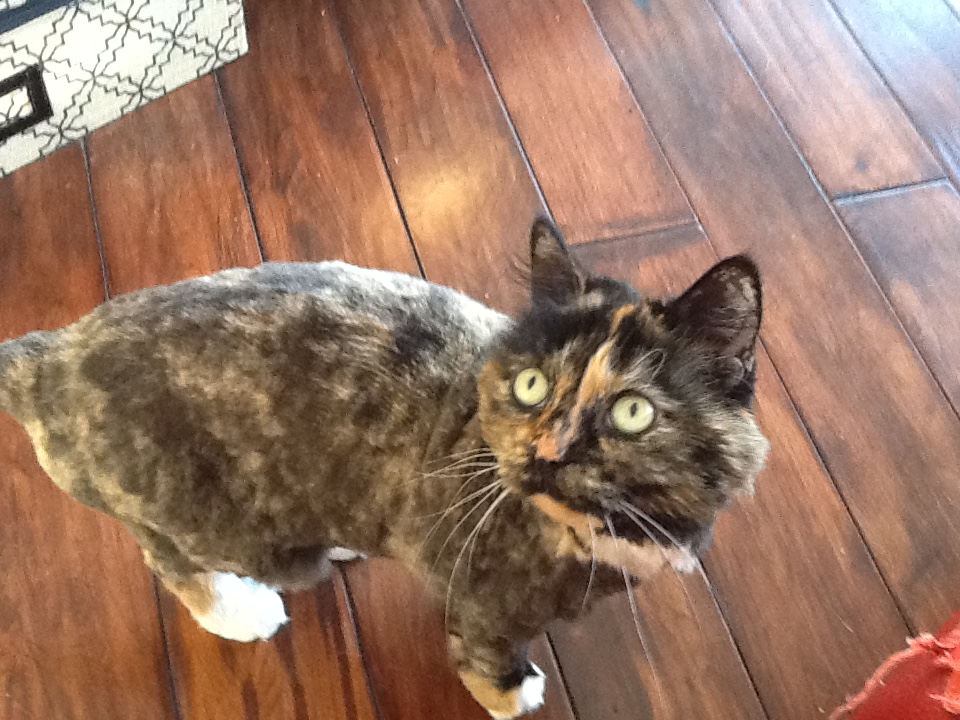
After fourteen years together, I delivered our beautiful cat, Lexie, to veterinary specialists for a throat scope early this morning. In a few short weeks she had gone from a social, vocal and loving feline companion to a hoarse, weak, barely eating cat choosing to hide from the family.

An x-ray late last week and a CT-scan earlier this week, revealed a mass in her throat. Veterinary specialists advised a throat scope but forewarned us Lexie might not survive the procedure. They told us a throat scope could tell us more about the mass and any possible treatment options.

We were mentally prepared for the worst but still hoped for any good news. Sadly, we were not fully prepared emotionally to hear the final diagnosis and recommendation. The throat scope revealed Lexie had cancer and it had progressed beyond any recommended treatment. They could revive her for a final goodbye, but euthanasia appeared to be the most compassionate next step.

My wife and I returned to say our goodbyes. We petted and hugged her. We apologized for not knowing how to help her earlier than we had. We thanked her for our fourteen years together. We asked her to wait for us at Rainbow Bridge. We told her we would miss her terribly and would place her cremains on our memorial bookcase with other loved ones from our “furever” family.

My wife held Lexie as our beloved feline received two injections into her IV. She was gone almost instantly. See https://www.vet.cornell.edu/departments-centers-and-institutes/cornell-feline-health-center/health-information/feline-health-topics/euthanasia-what-expect-and-what-questions-ask-first

Love is hard, grief is hard, and some days are very hard.

November 18 – Remembering A Deceased Loved One

Remembering a loved one doesn’t necessarily need to end at the memorial service or the death site. Both of these actions are appropriate responses yet more may be desired to keep the loved one’s memory closer to home, closer to you on a daily basis.

Two writings offer some helpful advice. First is an article by Allison Grinberg-Funes (https://www.eterneva.com/resources/memorialize-loved-ones) in which she offers Ideas for Memorializing Deceased Loved Ones:

  1. Turn their ashes into a cremation diamond
  2. Visit their final resting place
  3. Do something they enjoyed or you did together
  4. Have a memorial release with balloons or butterflies
  5. Listen to their favorite songs or watch their favorite movies
  6. Look through old photos with friends and family
  7. Plant a tree, shrub, or flowers and visit it
  8. Create a memorial website or Facebook page
  9. Donate to their favorite charity
  10. Eat or cook their favorite food
  11. Write them a letter, poem or song.

The second writing is a section from Thich Nhat Hanh’s book How To Live When A Loved One Dies (c) 2020, Parallax Press called Making An Altar For Your Loved One:

“When we have lost someone we love, we often feel the need to express our deep love and gratitude to them…and we want to keep their memory alive…Making a shrine or altar is a concrete way of expressing our love and care, and of helping us feel connected to them. We can set up a small table and place a photograph of our loved one, a candle, some flowers, and other meaningful things on it.” p.133 http://www.parallax.org/product/how-to-live-when-a-loved-one-dies/

Check out both sources for more information.

In the meantime, here is today’s brief poem: Remembering A Deceased Loved One

our lives together

made great memories for us –

thank you forever

High Coo – Nov 17 – Losing My Attachment Figures

https://theawkwardarchaeologist.wordpress.com/2019/03/11

Attachment theory is a very popular concept among psychologists and has been for a few decades now. It states that humans – in fact, all mammals – have an innate drive to seek out close emotional relationships with other people, who can become our ‘attachment figures’. Humans seem to have developed a particularly flexible attachment system. By this, I mean that we can become emotionally attached to a wide number of other people, from relatives to friends to romantic partners. Even non-humans can be our attachment figures – think about the bond you might have with a beloved pet, for example. Even inanimate objects can be attachment figures – the notion of a child and their teddy is a common attachment bond in many Western countries.” Maddie Bleasdale, aka The Awkward Archaeologist (see link above).

A recent Animal Chaplaincy class discussed how a loved pet (aka companion animal) can be a traumatic event for someone, especially when that loved one was a “primary attachment figure.” The guest speaker, Janel Griffieth, a Senior Director for CARE (Companions and Animals for Reform and Equity (https://careawo.org/about-us/) gave a powerful presentation about her personal experiences and why knowing more about trauma, resiliency, hope and the Attachment Theory can help animal chaplains be more empathetic when humans are emotionally devastated by the loss of their trusted non-human companion.

Today’s poem: Losing My Attachment Figures

the moment you died

I was sad, lonely, bereft –

I walk with you now

The book below, by Thich Nhat Hanh, has been helpful for me, perhaps it may be helpful to someone you know. https://www.parallax.org/product/how-to-live-when-a-loved-one-dies/

High Coo – Nov 16 – 3 Questions at Rainbow Bridge

Today’s senryu: 3 Questions at Rainbow Bridge

Together again?

Secure attachment regained?

Trust in the Pure Land?

Today is one of those days when big questions collide for me. I’m trying to sort out a few of them and would appreciate your insights.

The human-animal bond is a mutually beneficial and dynamic relationship between people and animals that is influenced by behaviors essential to the health and wellbeing of both.” https://vetexplainspets.com/human-animal-bond/

The Rainbow Bridge is a meadow where animals wait for their humans to join them, and the bridge that takes them all to Heaven, together.https://en.wikipedia.org/wiki/Rainbow_Bridge_(pets)

“It is only because of our misunderstanding that we think the person we love no longer exists after they ‘pass away.’  This is because we are attached to one of the forms, one of the many manifestations of that person.  When that form is gone, we suffer and feel sad.  The person we love is still there.  He is around us, within us and smiling at us.  In our delusion we cannot recognize him, and we say: ‘He no longer is.’  We ask over and over, ‘Where are you?  Why did you leave me all alone?’  Our pain is great because of our misunderstanding.  But the cloud is not lost.  Our beloved is not lost.  The cloud is manifesting in a different form.  Our beloved is manifesting in a different form.  If we can understand this, then we will suffer much less.” Thich Nhat HanhNo Death, No Fear