Category Archives: Observations

The Radical Among Us – Chiara Di Offreduccio

Below are excerpts from a recent post from Joan Chittister titled the radical among us which remembers Clare of Assisi, co-builder of the Franciscan movement.

The feast of Saint Clare of Assisi is August 11.

Chief among Francis’ followers was a woman who was a leader in her own right. The young noblewoman Chiara Di Offreduccio, Clare, was an intelligent, educated, and pious person. Her own family castle had been sacked during the social upheavals in Assisi. She was well-bred, well-to-do, and meant for the better things in life. When she heard Francis preach, however, she knew that his call to radical poverty was hers as well.

Clare was the one, in other words, who really proved that what Francis talked about was doable for people in general, even pampered upper-class ones.

In the end, Francis and Clare brought five things to the world that shocked all of Europe into a new consciousness and that call to us yet today. They brought a call to peace; a consciousness of the poor; a sign that it is possible to be happy without things; a radical reading of the Gospel of Christ that depoliticizes the meaning of conversion; and a new sense of the feminine. 

Perhaps poverty is not the sign of the inept. Perhaps poverty is not a mark of lack of character. Perhaps poverty is a sinful residue of a sinful system that blames the victim for its victimage. Perhaps poverty is something about which we all have a responsibility.

The legacy of two intrepidly simple people who would not accept life as it was because it could be so much better is as much a gift to the twenty first century as it was to the thirteenth.
            ––from A Passion for Life: Fragments of the Face of God, by Joan Chittister

joanchittister.org/

The Value of Simplicity – KISSS

A fresh cup of coffee to start the day, re-reading a familiar passage from a favorite book, letting go of unnecessary complexity in our lives, oh what joy can be received from a simple life!

Keeping it short, sweet and simple (KISSS) is a mantra worth remembering.

Below is an excerpt from a Tricycle article on Full Simplicity written by Kim Allen for a Buddhist take on the art of living more simply and skillfully.

http://www.uncontrived.org/books.html

The Value of Simplicity

Doing more with less: A teaching from the Metta Sutta By Kim Allen

“(The) idea of valuing simplicity is a notion that is consonant with the early (Buddhist) teachings. Choosing just one of many examples, we can find the value of simplicity expressed in the opening lines of the Metta Sutta (Sn 1.8).

This is what should be done
By one who is skilled in goodness
And who knows the path of peace:

Let them be able and upright,
Straightforward and gentle in speech.
Humble and not conceited,

Contented and easily satisfied.
Unburdened with duties and frugal in their ways.
Peaceful and calm, and wise and skillful,
Not proud and demanding in nature.

These verses suggest a link between goodwill (metta), ethical behavior, and simplicity.

Once we turn our mind toward the value of simplicity, we will notice ways in which complication has burdened or tangled our relationship with life. Here are a few possibilities for practice that can be extracted from these lines:

  • Simplicity of body: Moving more slowly (peaceful and calm); maintaining a balanced posture (upright); using fewer material resources (frugal in their ways),
  • Simplicity of speech: Speaking straightforwardly with just as many words as needed (straightforward in speech); refraining from complaining or demanding (not proud and demanding); speaking words of harmony (gentle in speech; skillful), and
  • Simplicity of mind: Being satisfied with little (contentment; humility); honesty (upright); seeing in wise ways (wise and skillful); choosing non-busyness (unburdened with duties).

Centering (your) simplicity practice on these few lines from the Metta Sutta could go very far … Pragmatic wisdom also guides how we view and think about life activities:

  • possessions must be managed, such as maintaining our car, computer, and phone;
  • cleaning our clothes and living space;
  • handling the purchase, preparation, and clean-up of food for meals;
  • caring for our body and health in many ways, and
  • the necessary task of acquiring money also takes significant energy, and even if we have enough money, it takes time and attention to manage financial resources.”

Excerpted with permission of the author from Full Simplicity: The Art of Renunciation and Letting Go, by Kim Allen, an exploration of how to fully embrace the dharma life as a layperson.

Kim Allen is an Insight teacher who draws from a background in long retreat practice, sutta study, and contemplative living to bring classical dharma to modern life. Her website is http://www.uncontrived.org.

See tricycle.org/article/value-of-simplicity/ for the full article.

http://www.uncontrived.org/about-kim-allen.html

It’s All How You Look at It

Converting “wounds into a call for deeper understanding” is another way of reframing our lives, finding a cloud’s silver lining or a pony in the horseshit, and learning from our suffering how to love anew.

Below are excerpts from today’s meditation from Henri Nouwen. May we all find comfort and wisdom today.


It’s All How You Look at It

Our great temptations are boredom and bitterness.

we are tempted to give in to a paralyzing boredom or to strike back in destructive bitterness.

turning wounds into a call for deeper understanding, and sadness into a birthplace of joy.

Then Job replied to the Lord, “I know that you can do all things; no plan of yours can be thwarted. You asked, ‘Who is this that obscures my counsel without knowledge?’ Surely, I spoke of things I did not understand, things too wonderful for me to know.’ “

JOB 42:1-3 (NIV)

The Healing of Tears

Washing out the toxins. Shedding the pains of our life and our world.

I’m not a crier by nature (or is it nurture?) so tears are not something I enjoy or receive comfort from. Yet, tears can be healing.

Below are excerpts from today’s meditation from the Center for Action and Contemplation. Perhaps it will bring a welcome tear to your eyes. cac.org/daily-meditations/the-healing-of-tears/

The Healing of Tears 

Friday, June 28, 2024

Blessed are those who mourn, for they shall be comforted. —Matthew 5:4 

There’s a therapeutic, healing meaning to tears.

those who can grieve, those who can cry, are those who will understand.  

Weeping over our sin and the sin of the world is an entirely different mode than self-hatred or hatred of others.

recognize the sad reality

That might seem ridiculous, and it is especially a stumbling block for many men in our culture. Young men have often been told not to cry because it will make us look vulnerable. So, we men—and many women too—stuff our tears.

He was falling apart, becoming his most radiant, his most needful. And little did I know, he was showing me how to do the same. [2]  

References: 
[1] Adapted from Richard Rohr, Jesus’ Alternative Plan: The Sermon on the Mount (Cincinnati, OH: Franciscan Media, 1996, 2022), 139–140.  

[2] Ross Gay, Inciting Joy: Essays (Chapel Hill, NC: Algonquin Books, 2022), 228–229. 

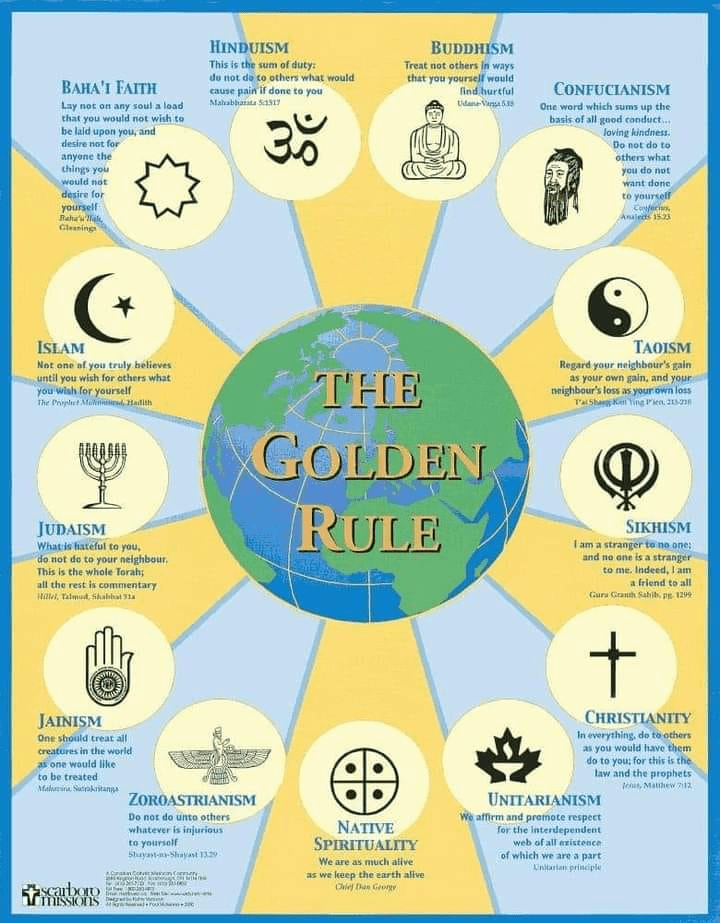
The Golden Rule?

Supposedly, the Golden Rule is something most faith traditions agree on. Supposedly, people without a faith tradition can agree on it as well. Does “the Golden Rule make a good one-sentence summary of what morality is about” for you?

The golden rule captures the spirit behind morality. It helps us to see the point behind moral rules. It engages our reasoning, instead of imposing an answer. It counteracts self-centeredness. And it concretely applies ideas like fairness and concern. So, the Golden Rule makes a good one-sentence summary of what morality is about.” Harry Gensler, philosopher. philosophynow.org/issues/125/The_Not_So_Golden_Rule

http://www.scarboromissions.ca/golden-rule

Job’s Emotional Courage

To truly know anything, we must first feel everything. It takes courage to feel.

I’ve tried my damnedest not to feel yet those feelings won’t pass until I let them.

Why should we acknowledge our feelings?

Because “emotions ought to be allowed to run their course. They are not right or wrong; they are merely indicators of what is happening.” 

Today’s excerpts come from Richard Rohr and the Center for Action and Contemplation.

Job’s Emotional Courage 

Monday, June 24, 2024

Richard Rohr notes the lessons on grief and lament we can learn from Job: 

why should I be happy about being born?”  

“May that day be darkness. May God on high have no thought for it, may no light shine on it. May murk and deep shadow claim it for their own” (Job 3:4–5). It’s beautiful, poetic imagery. He’s saying: “Uncreate that day. Make it not a day of light, but darkness. Let clouds hang over it, eclipse swoop down on it.” Where God in Genesis speaks “Let there be light,” Job insists “Let there be darkness.”

if we’re willing to feel and participate in the pain of the world, part of us will suffer that kind of despair.

Many people learn that the hard way—through depression, addictions, irritability, and misdirected anger—because they refuse to let their emotions run their course or to find some appropriate place to share them. Job is unafraid to feel his feelings. He acts and speaks them out. Emotions ought to be allowed to run their course. They are not right or wrong; they are merely indicators of what is happening. 

I am convinced that people who do not feel deeply finally do not know deeply either.

Reference:  
Adapted from Richard Rohr, Job and the Mystery of Suffering: Spiritual Reflections (New York: Crossroad Publishing, 1996), 53, 54–55.  

cac.org/daily-meditations/jobs-emotional-courage/

Ox-herding 3

I haven’t met Lynn J Kelly (yet) but do consider her a spiritual friend and teacher. I haven’t met Martine Batchelor (yet) but consider her, and her husband Stephen, spiritual mentors and teachers.

And so, I can highly recommend the blogpost below. May you be edified and encouraged by it as I have.

We Would Change

Oh, to spoon in June and point to the moon and read our future in a newly discovered rune. You know that tune, right?

Below is beautifully written reminder from Joan Chittister that everything changes in June.

We would change

Clearly, June is the time for being in the world in new ways, for throwing off the cold and dark spots of life.

flowers confront us with our responsibility for beauty.
 
June is the month that calls us out of our houses, out of ourselves,

Be a tribute to creation. Be a part of the chorus of life.
 
“I wish you happiness now and whatever will bring happiness to you in the future.”

Beauty and human warmth would take root in us like a clear, hot June day. We would change.

                   —selections from A Monastery Almanac by Joan Chittister

For more great writing check out this website: joanchittister.org/