There is an annual Japanese holiday which remembers deceased ancestors. The actual date varies by region but usually falls between mid-July to mid-August. It is not an official holiday, rather a religious and traditional holiday which includes using lanterns to guide the dead, making food offerings to temples and celebrating with dancing. See https://www.jrailpass.com/blog/obon-festival-in-japan
Here is today’s humble haiku which recognizes this holiday, past and future, yet also celebrates the life still happening on this side of existence.
Our First O-bon
our day of the dead
has not yet arrived – still time
to explore this shore
Obon – Japan’s Day of the Dead @ asiahighlights.com
T. S. Eliot (b. 9/26/1888 d. 1/4/1965) photo from HuffPost
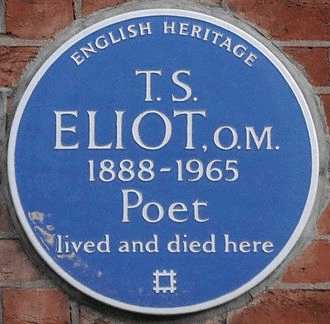
Born in St. Louis, Missouri, Thomas Stearns (T. S.) Eliot moved to England at the age of 25 and became an English citizen at 39 thus renouncing his American citizenship.
“During an interview in 1959, Eliot said of his nationality and its role in his work: ‘I’d say that my poetry has obviously more in common with my distinguished contemporaries in America than with anything written in my generation in England. That I’m sure of. … It wouldn’t be what it is, and I imagine it wouldn’t be so good; putting it as modestly as I can, it wouldn’t be what it is if I’d been born in England, and it wouldn’t be what it is if I’d stayed in America. It’s a combination of things. But in its sources, in its emotional springs, it comes from America.'” (See Hall, Donald (Spring–Summer 1959). “The Art of Poetry No. 1” (PDF). The Paris Review. Archived from the original (PDF) on 3 October 2009. Retrieved 7 November 2009.)
Awarded the Nobel Prize for Literature in 1948, (see https://en.wikipedia.org/wiki/1948_Nobel_Prize_in_Literature), Eliot was known as one of the most famous and influential poets of the last century. Among many others, he is credited for his influence on Virginia Woolf, Ezra Pound, F. Scott Fitzgerald, James Joyce, Bob Dylan and Andrew Lloyd Webber. Note the musical Cats is based on Eliot’s book of poetry Old Possum’s Book of Practical Cats (1939) and the movie Tom and Viv recounts his life with his first wife. (See https://en.wikipedia.org/wiki/T._S._Eliot)
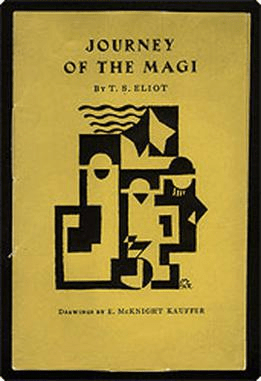
His most famous poems include The Waste Land, Hollow Men, Ash Wednesday and Four Quartets. However, my current favorite of his is Journey of the Magi which is a short 43-line poem. This poem recounts the original trip to the Bethlehem manger and it’s last 8 lines are:
Birth or Death? There was a Birth, certainly We had evidence and no doubt. I had seen birth and death, But had thought they were different; this Birth was Hard and bitter agony for us, like Death, our death. We returned to our places, these Kingdoms, But no longer at ease here, in the old dispensation, With an alien people clutching their gods. I should be glad of another death.
Family lore suggested my first great grandfather Cole had emigrated from Ireland to Canada. After a personal genealogy study, I surprisingly discovered three great grandfathers had been born in Canada, their five predecessors came from New York before my oldest known six great grandfathers were born in Holland. So far, the oldest records go back to 1450.
Yesterday was Ancestors’ Day in Cambodia which is a far distance from North America or Europe but why quibble. I’m choosing to recognize my ancestors today because my eighth great-grandfather, Jacob, was born on 9/25/1639 in New Amsterdam. Note: New Amsterdam was founded by the Dutch in 1624 and was renamed New York by the English in 1664. My grandfather would have been 25-years old when New York was established. He went on to live another 55 years and died at the age of 80 in 1719.
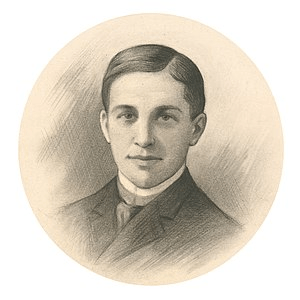
“Ernest Lawrence Thayer was an American writer and poet who wrote the poem “Casey” (or “Casey at the Bat”), which is “the single most famous baseball poem ever written” according to the Baseball Almanac, and “the nation’s best-known piece of comic verse—a ballad that began a native legend as colorful and permanent as that of Johnny Appleseed or Paul Bunyan.” https://www.poetry.com/poem/12844/casey-at-the-bat
Final stanza of Casey at the Bat:
Oh, somewhere in this favored land the sun is shining bright; The band is playing somewhere, and somewhere hearts are light, And somewhere men are laughing, and little children shout; But there is no joy in Mudville–great Casey has struck out.
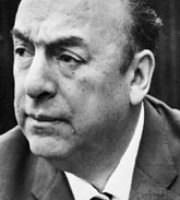
“Pablo Neruda was the pen name and, later, legal name of the Chilean Communist poet and politician Neftalí Ricardo Reyes Basoalto. He chose his pen name after Czech poet Jan Neruda. Neruda wrote in a variety of styles such as erotically charged love poems, surrealist poems, historical epics, and overtly political manifestos. In 1971 Neruda won the Nobel Prize for Literature.” https://www.best-poems.net/pablo_neruda/index.html
It took 355 words to say, “that’s all there is to it.” No, Pablo, we both know there’s more to it. Grief doesn’t end with a burial.
A Dog Has Died
by Pablo Neruda
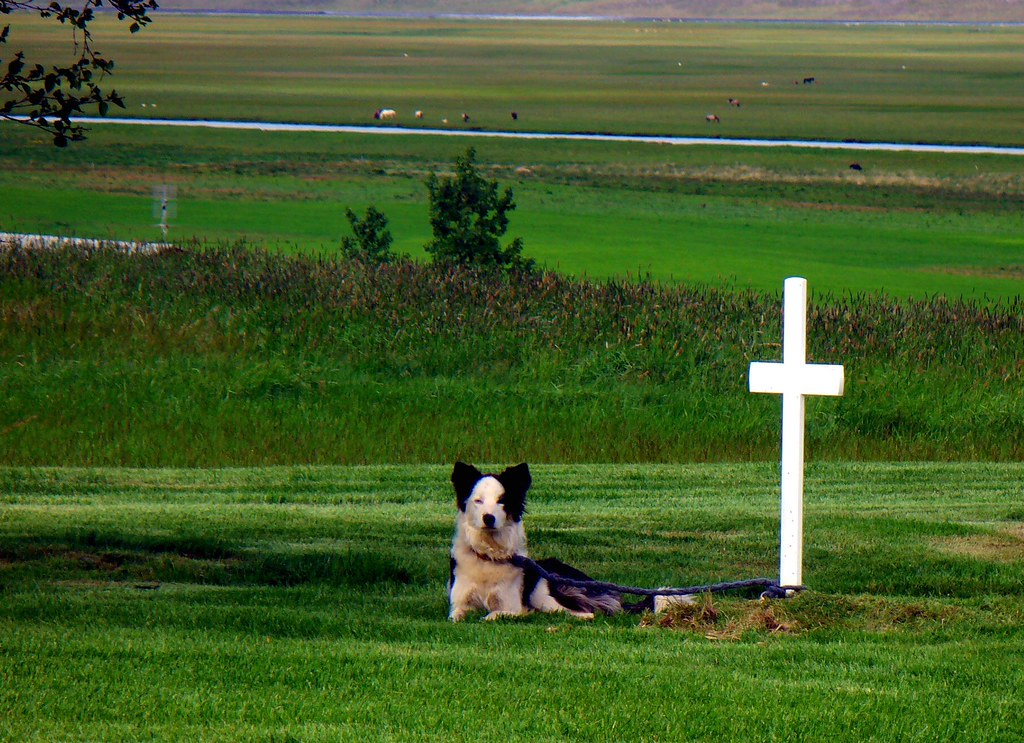
My dog has died. I buried him in the garden next to a rusted old machine. Someday I’ll join him right there, but now he’s gone with his shaggy coat, his bad manners and his cold nose, and I, the materialist, who never believed in any promised heaven in the sky for any human being, I believe in a heaven I’ll never enter. Yes, I believe in a heaven for all dogdom where my dog waits for my arrival waving his fan-like tail in friendship. Ai, I’ll not speak of sadness here on earth, of having lost a companion who was never servile. His friendship for me, like that of a porcupine withholding its authority, was the friendship of a star, aloof, with no more intimacy than was called for, with no exaggerations: he never climbed all over my clothes filling me full of his hair or his mange, he never rubbed up against my knee like other dogs obsessed with sex. No, my dog used to gaze at me, paying me the attention I need, the attention required to make a vain person like me understand that, being a dog, he was wasting time, but, with those eyes so much purer than mine, he’d keep on gazing at me with a look that reserved for me alone all his sweet and shaggy life, always near me, never troubling me, and asking nothing. Ai, how many times have I envied his tail as we walked together on the shores of the sea in the lonely winter of Isla Negra where the wintering birds filled the sky and my hairy dog was jumping about full of the voltage of the sea’s movement: my wandering dog, sniffing away with his golden tail held high, face to face with the ocean’s spray. Joyful, joyful, joyful, as only dogs know how to be happy with only the autonomy of their shameless spirit. There are no good-byes for my dog who has died, and we don’t now and never did lie to each other. So now he’s gone, and I buried him, and that’s all there is to it.
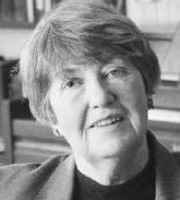
“Lisel Mueller is a German – American poet who won the Pulitzer Prize for her book Alive Together: New & Selected Poems in 1997. Her poems are extremely accessible, yet intricate and layered. While at times whimsical and possessing a sly humor, there is an underlying sadness in much of her work.” See https://www.best-poems.net/lisel_mueller/index.html
Today we honor Lisel Mueller and her provocative poem:
What The Dog Perhaps Hears
by Lisel Mueller
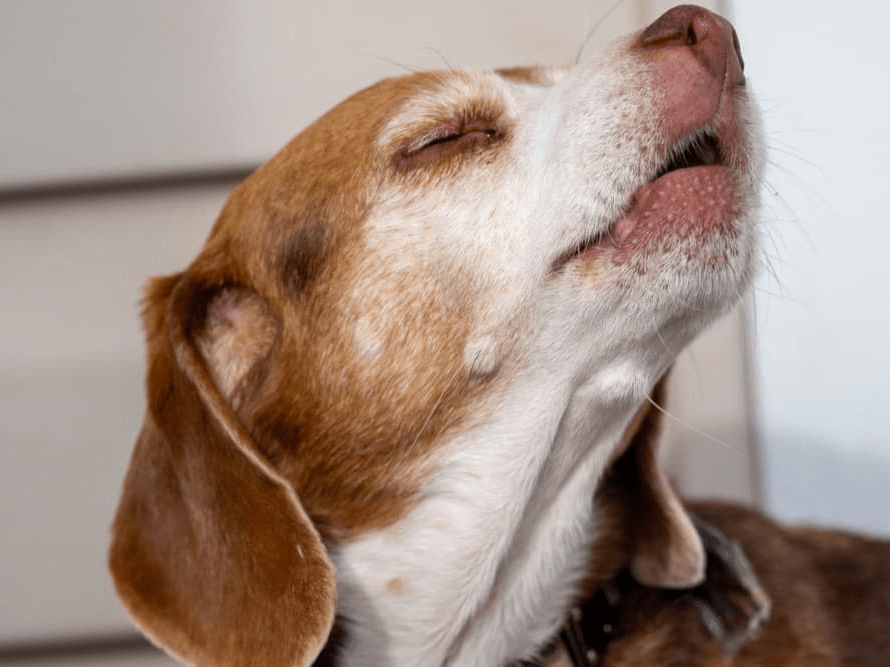
If an inaudible whistle blown between our lips can send him home to us, then silence is perhaps the sound of spiders breathing and roots mining the earth; it may be asparagus heaving, headfirst, into the light and the long brown sound of cracked cups, when it happens. We would like to ask the dog if there is a continuous whir because the child in the house keeps growing, if the snake really stretches full length without a click and the sun breaks through clouds without a decibel of effort, whether in autumn, when the trees dry up their wells, there isn’t a shudder too high for us to hear.
What is it like up there above the shut-off level of our simple ears? For us there was no birth cry, the newborn bird is suddenly here, the egg broken, the nest alive, and we heard nothing when the world changed.
Not all stories are happy. Today I recognize poet Spike Milligan and his poignant poem The Dog Lovers. Briefly, “Terence Alan “Spike” MilliganKBE (16 April 1918 – 27 February 2002) was a British-Irish actor, comedian, writer, musician, poet, and playwright.” He is also cited as having a major influence on The Monty Python Flying Circus. See https://mshistorytoday.com/spike-milligan/
While noted for his comedy, Spike Milligan could also describe tragedy. For example:
The Dog Lovers
by Spike Milligan
So, they bought you And kept you in a Very good home Cental heating TV A deep freeze A very good home- No one to take you For that lovely long run- But otherwise ‘A very good home’ They fed you Pal and Chum But not that lovely long run, Until, mad with energy and boredom You escaped- and ran and ran and ran Under a car. Today they will cry for you- Tomorrow they will buy another dog.
















 Life Matters